Loose Pass: The ‘nonsense’ Henry Pollock argument that spells ‘danger’ and private equity America is coming to England



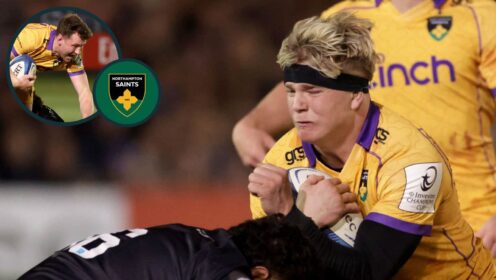
Northampton Saints back-row Henry Pollock tried to ruffle feathers against Leicester Tigers.

This week we will mostly be concerning ourselves with the American revolution in England, Henry’s big day out and the confusing role of the dog in rugby language…
They’re coming
Perhaps it is the similarity to Football – that’s Football, not soccer, man – but without the need to finance and construct a 90,000-seater arena to be properly accepted. Perhaps it is the spectacular failure of their national counterparts to ‘disrupt’ the soccer fabric at Chelsea. Perhaps it is the lure of the World Cup heading over there and the desire to be a part of something that, although small by FIFA standards, is still supposedly the third-largest sporting event in the world (the Olympics is second, since you asked). Perhaps it is a desire to be a part of something that, considering the core values are integrity, passion, solidarity, discipline and respect, Donald Trump will be going nowhere near. Perhaps it is a desire to have Devon and Cornwall be an alligator- and hurricane-free alternative to Florida. Perhaps it is the lack of relegation that makes the Prem and the Champ so tempting.
Whatever it is, the Americans are getting into English club rugby at boardroom level and it is looking like it could be a sea change. Whether you approve of private equity and all the long-term trappings or not, there’ll be more liquidity sloshing about Exeter and the Cornish Pirates over the next couple of years and both investments smack of being the early drops of a squall, if not even a full storm.
The Pirates, whose investors hail from Pittsburgh, where the baseball team is also the Pirates (but whose owners are no relation to the investors), is a particularly interesting project. In need of a new stadium after a storm tore the existing one to shreds earlier this year, with a local fanbase desperate for the region to regain its rugby relevance of yore, and with the Prem’s move to a franchise model over the next 3-4 years now a done deal, it looks like a project tailor-made for a private equity boost. A 19,000-capacity stadium would do the trick, never mind 90,000, while efficiency boffins of the Moneyball sort of ilk will surely have noted that the current side is punching well above its weight when it comes to measuring squad salary bills against its counterparts.
Low cost, high potential, and in a lovely part of the world to boot. And if Exeter is not so low-cost, there is the factor that it is a well-run club that is among the closest of England’s money-leaking club scene to turning a regular profit.
But it does make you wonder, in both negative and positive ways, what the future of English club rugby now holds under the looming franchised construct. What will bring the investors in, and what will not. Will Saracens, for example, historically nomadic and perhaps the most already-franchised of the current top flight, be taken over or simply overtaken? Is Harlequins the sort of project and sort of location private equity would find value in – considering that the first three clubs to become invested-in entities are Newcastle, Exeter and Cornish Pirates. Would traditionalists in the East Midlands want the Tigers and/or Saints to go down that route? Where does Sale fit into it all?
There is no suggestion here that these investments are bad for the game or the clubs involved. Used wisely, capital injections can only be a good thing. And it’s almost certainly a better idea than Wasps issuing their own bonds all those years ago. But the rapid acceleration of investment is going to mean that at some point a return is due. And whatever English club rugby has provided down the years, a financial return is not on the list. What will private equity America do with their assets in the south west then?
A load of Pollocks
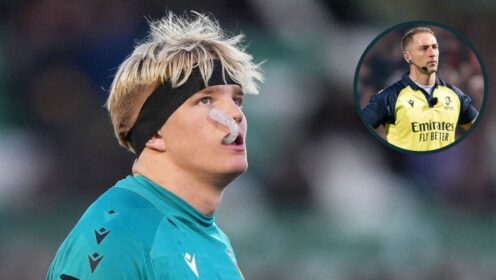
Loose Pass is not a fan of the bleached show-pony that is Henry Pollock on a rugby pitch. The stellar talent is in danger of being eclipsed by arrogance and gamesmanship antics, development stymied by the desire to do anything to be centre of attention, focus on the pitch diluted by distractions which have nothing to do with his job on matchdays.
Last Saturday’s chastening defeat to Leicester needs to be a turning point in this story. It should not get forgotten in the narrative that England’s maverick gave a fine try assist, while his was the pick and go surge that led to Northampton’s third score. Nor was it his fault that the Saints trailed 41-5 by the time of said assist. But on he came. Taking over everything, including line-out throws for no readily apparent reason other than he wanted to. The two mis-throws were thus his responsibility, if not conclusively his fault.
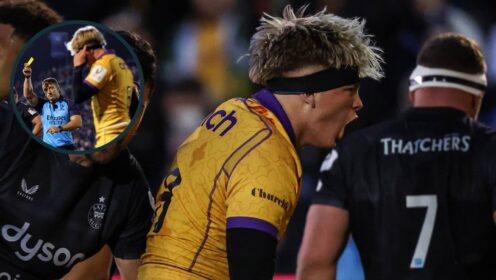
What was definitely his fault was starting a scrap within seconds of being brought on (with his side already down to 13 men and bizarrely, with the behemoth-like presence of Hanro Liebenberg). What was also his fault was backing that up with an expletive-laden rant and a ludicrous dancing, prancing, in-yer-face, poke-the-bear wind up of everyone in a green shirt within shoving distance. It was, in the circumstances, puzzling as to why Matthew Carley didn’t card him as well.
His talent deserves a better personal platform. And it is high time someone gets that into line. Currently he is lauded as a disruptor, as a maverick talent, as a flash of individual colour in a game populated by shades of grey.
That’s nonsense. His talent is colourful enough. The antics that go with it are mismatched splodges of colour, as though some child has flicked a fountain pen full of luminous orange ink over Sunflowers and tried to market it as the bold new thing. It’d be better if the bold new thing was the level of rugby he might be able to achieve.
Dogs
Not until Ethan Hooker was injured had Loose Pass heard the term ‘dogshot’. As the proud owner of a somewhat energetic Appenzeller mountain dog, and having watched said hound at play multiple times, the question has arisen: where does the term come from?
Dog imagery has been strong in rugby. A former coach with whom I worked with had a favourite expression to describe a player: “he’s got dog”, which meant that he was always determined to win the collision/scrap/ruck/etc. Indeed, it became a selection criterion: does he have dog or not?
Want more from Planet Rugby? Add us as a preferred source on Google to your favourites list for world-class coverage you can trust.
“Dogging it out” described similar – and is well-known and used – when claiming an ugly win in foul weather or against a forward-heavy team. Truffle-hounding has long since been synonymous with those who somehow manage to dig out a ball from the bottom of someone else’s ruck. And many team’s pack has a ‘big dog’ in the front-row.
But dogshot? Never heard of it. Dogs don’t tend to go at each other without facing up to each other first, which is absolutely not the accusation levelled at Luke Morgan. So can anybody shed light on the etymology of the dogshot?
READ MORE: ‘Tentative’ timeline set for Ethan Hooker’s return after Welsh wing’s dogshot on Springboks star