Italy v Scotland: Five takeaways as Gregor Townsend’s bold calls ‘backfire’ with Valentine’s fate date now set after Azzurri ‘rule Rome’
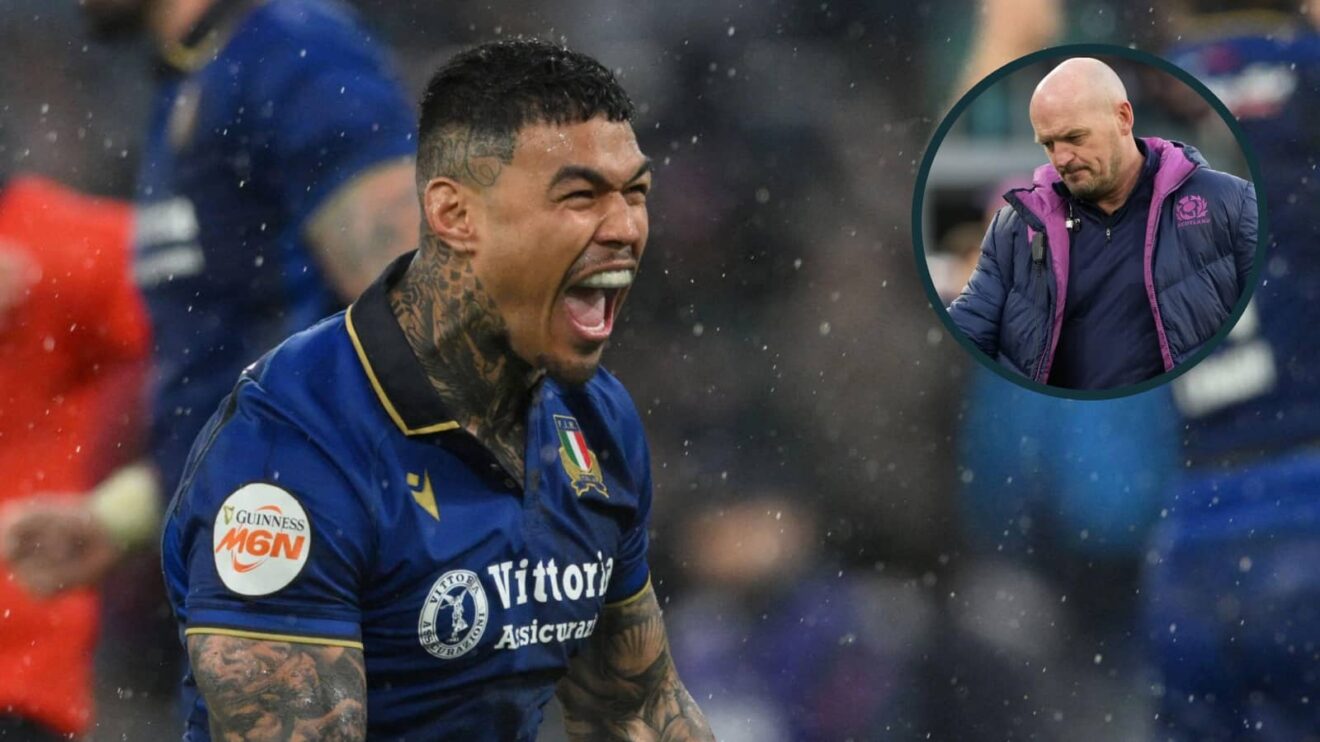
Italy's Monty Ioane celebrates with an inset of Scotland head coach Gregor Townsend.
Following Italy’s 18-15 victory over Scotland in Rome, here are our five takeaways from the Six Nations epic.
Top line
The Azzurri stamped their mark on the 2026 Championship with a statement three-point win at the Stadio Olimpico, producing a methodical, tactically brilliant performance in biblical conditions.
Scotland headed to Rome as the favourites, but the Italians did not let bookies do the talking for them as they went about repeating their 2024 heroics in front of a feverish 68,245 capacity crowd that braved the wet weather. The supporters were duly rewarded with two stunning tries in the first half.
The first was through Louis Lynagh, who latched onto a truly scrumptious through-ball grubber kick from the always-brilliant Juan Ignacio Brex.
Brex’s partner in crime, Tommaso Menoncello, doubled the Azzurri’s tally on the 13-minute mark after Lynagh rose brilliantly into the Rome skies to reclaim the ball that spun out to Menoncello, who dove over the line.
Paolo Garbisi added the extras to make it a 12-point game, leaving Scotland in need of a reply as the heavens opened at the Eternal City, and they finally got one after a plethora of Italian penalties set up a tap and go close to the line for the visitors. Jack Dempsey punished some lacklustre fringe defence with his swift footwork in the close quarters.
Garbisi established an eight-point advantage from the tee after missing a drop goal, which remained in place as the players sought the warmth and dryness of the interval dressing rooms.
The conditions remained torrid in the second half, meaning that chances were few and far between and the Azzurri squandered their first in the second half as Menoncello was dragged to ground after a stunning break, with Rory Darge winning a clutch penalty.
Finn Russell reduced the arrears to just five points after 46 minutes, with Garbisi responding just two minutes later. A yellow card to George Turner in the 54th minute thwarted Scotland’s efforts to close the gap after an ugly breakdown entry near the Italian try-line, but Gregor Townsend’s men were finally rewarded as George Horne snuck over in the corner with 14 minutes to play.
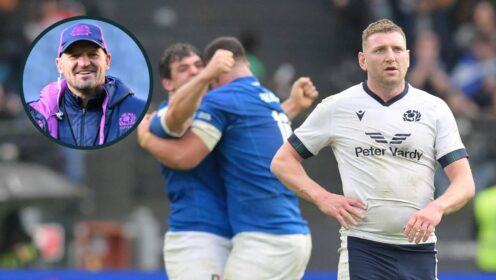
That set up a tense finish with the match progressing well beyond the 80 minutes, but the Azzurri defence held firm to rule Rome once again, clinching just their 10th win over the Scots in 39 meetings.
Pressure increases on Gregor Townsend as Italy stun Scotland in dramatic Six Nations clash
Italy go aerial
Much was made of Townsend’s bold decision to omit British and Irish Lions outside backs Blair Kinghorn and Duhan van der Merwe while he benched Darcy Graham for the opener and those calls frankly came back to haunt him with Tom Jordan and Jamie Dobie struggling to handle the pressure the Azzurri exerted upon them.
Italy, like France on Thursday evening, got a lot of purchase from their aerial game, with Lynagh sparking the attack that led to Menoncello’s try by sensationally grabbing the ball above his head fully stretched out and beating Dobie to possession. It was Dobie’s first international start on the wing, with scrum-half being his preferred position. His form for Glasgow certainly warranted the nod, but the risk of fielding him there did not bear fruit.
Similarly, Jordan struggled to control the backfield with Scotland often losing additional ground with fumbles on Italy kicks. While Ben White and Russell managed to force errors, from Garbisi in particular, this game was about capitalising on the scraps that were presented and the Italians were far better at doing just that than their counterparts.
It wasn’t just under the high ball where the Azzurri bossed matters but the lineout too.
Scotland player ratings: ‘Woeful’ set-piece proves costly as Finn Russell’s ‘poor form’ continues
Scotland set-piece mare
Despite World Rugby’s law changes, amendments and changes that have attempted to limit the influence of the set-piece on the game, it remains paramount at the highest level, a lesson the Scots were taught yet again at the Stadio Olimpico. In fact, it became even more pivotal as the conditions deteriorated from the monsoon that transpired mid-way through the first half.
Hooker Ewan Ashman endured a performance akin to the weather as he managed to hit his lineout jumper on five occasions from 10 attempts, a meagre 50 per cent success rate during his initial cameo. Any grass-level coach would be fuming about that ratio. Even on the five occasions that he did find the hands of Matt Fagerson, Scott Cummings or Grant Gilchrist, it was hardly a foundation to launch a half-decent attack from.
All the blame does not lie on Ashman’s shoulders, as those calling the lineout did not have any answers to what was transpiring, as the likes of Michele Lamaro and Andrea Zambonin wreaked havoc in Rome.
The lineout was a massive issue for the Scots, and it was not aided by Turner’s sin-binning for a nasty head shot at a breakdown shortly after coming onto the park, meaning that Ashman had to return after Matt Fagerson somehow got his skewed throw past the gaze of referee Ben O’Keeffe and co.
The conditions certainly made it difficult for the hookers and jumpers at the lineout, but it was stark just how badly the set-piece has regressed from the 2025 Six Nations where Scotland boasted a 90% success rate. They lost just nine lineouts last year in the Championship; they lost three-quarters of that in Rome (six).
To make matters worse, the Scotland scrum hardly faired any better as British and Irish Lions props Zander Fagerson and Pierre Schoeman were emphatically shunted off their own ball by the so often overlooked Danilo Fischetti and Simone Ferrari.
It was just another indication of an Azzurri outfit that came into the opening weekend of the Six Nations, having done their homework, formalised a plan and were not only accurate in their implementation but willing to adapt on the fly and punish the errors that forced.
Adapt and execute
Fundamentally, that is where Gonzalo Quesada’s charges dominated proceedings. When they weren’t getting rewards from the 50/50 breakdown pilfers, they became more selective in which ones they really attacked and reverted to counter rucking too.
When Scotland started to adapt to the more central high bombs, the Azzurri targeted the extremities and continued to get purchase, and when things were going their way, they leaned into it until it didn’t.
Their refusal to give Scotland a free ride at the front of the lineout meant that whenever the ball did make its way out to White or Russell was lethargic.
As much as we have praised the Italian backs for their aerial prowess, the pack certainly rose to the occasion too with gladiatorial performances throughout the eight, notably from the Cannone brothers, Zambonin and Manuel Zuliani.
With such a Glasgow-heavy selection, fans and pundits predicted that Scotland would get plenty of purchase from their maul as Franco Smith’s charges do, but Italy identified that threat and cut it off at the source. One has to wonder whether Gregor Hiddleston was the missing piece for the cohesion.
It wasn’t just the fact that Scotland were beaten by Italy that will increase the pressure on Townsend’s head, but the manner in which they were beaten. Russell’s poor Bath form followed him into the Scottish jumper and the side simply didn’t have answers to Italy’s efforts to nullify their threats.
Pressure mounts on Gregor
As much as the Scottish Rugby Union bigwigs have backed Townsend to the Highlands and beyond, the supporters’ tone is a lot more bleak on the evidence of the boos and jeers echoing through Murrayfield last November.
Warren Gatland was sacked mid-Six Nations some 12 months ago by Wales after a defeat to the Azzurri, and it’s certainly not inconceivable that Townsend’s fate may well be sealed with a final Murrayfield Valentine’s date with England next weekend.
Calcutta Cup victories have pretty much been all Townsend has been able to boast about during his almost nine-year tenure in charge of Scotland, and failure to deliver that against the Auld Enemy may well be the difference between a post-Rugby World Cup break-up or early parting of ways.
He swatted off reports this week of him signing to join Newcastle Red Bulls after Australia 2027, accusing the English press of fabricating the rumour to distract the Scots before their February 14 meeting, but ultimately it’s crystal clear his relationship with Scottish Rugby has an expiry date and as the love with the supporters deteriorates, so does the pressure on the board build.
In recent times, the performances of the team plateaued. While they were able to be in positions to beat both Argentina and New Zealand last November, they lacked the killer edge to get over the line and a similar storyline unfolded in Italy as they fought their way back into the game but couldn’t get the final result.
That begs the question: has Townsend taken this team as far as he possibly can? If so, his position is no longer tenable. All signs point to a pivotal Valentine’s Day date that will decide whether it’s worth working out the kinks in the relationship or if one of the parties be brave enough to call it quits.