Italy v England: Five takeaways as Steve Borthwick hanging by the ‘thinnest of threads’ as Azzurri create ‘seismic shift in European landscape’


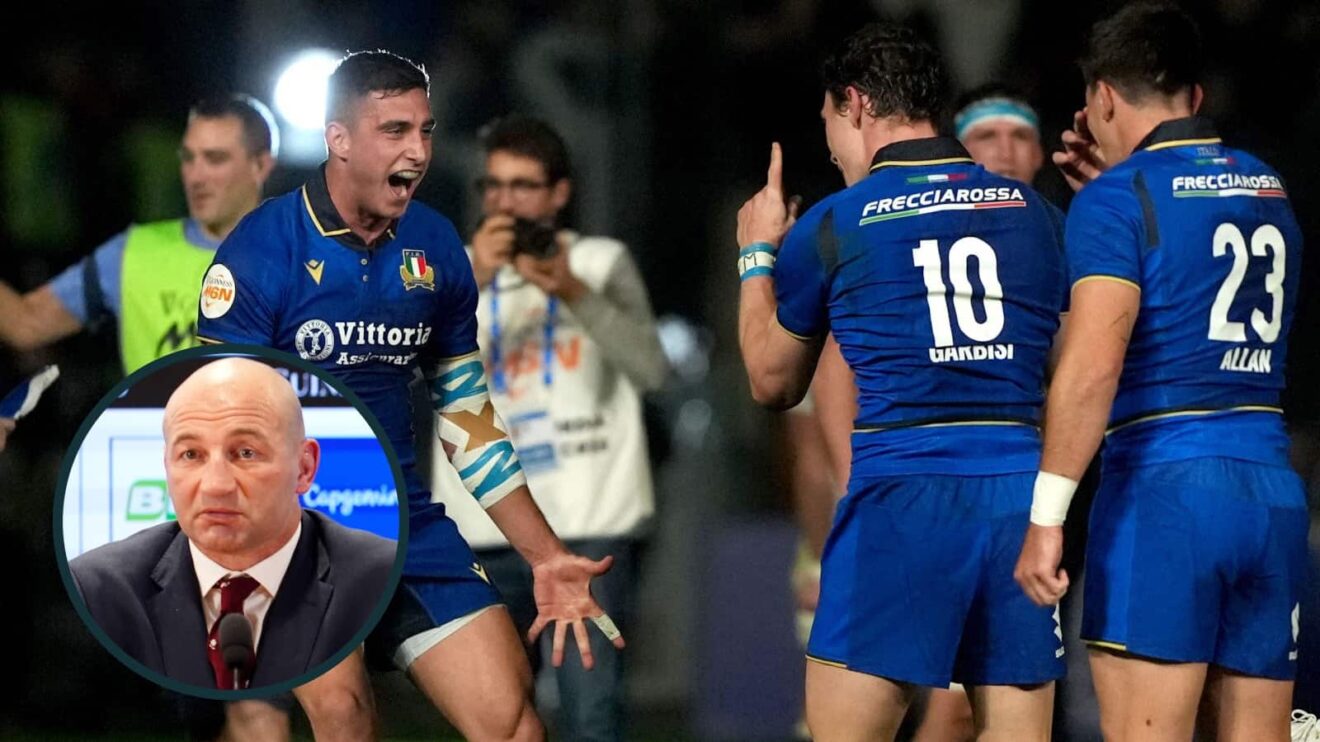
Italy celebrate Six Nations victory over England and Red Rose head coach Steve Borthwick.
Following a stunning 23-18 victory for Italy over England, here are our five takeaways from the Six Nations encounter at the Stadio Olimpico on Saturday.
The top line
This was the day Italy had dreamed of.
Not just a result, not just a statistic to file away in the record books, but a seismic shift in the landscape of European rugby that arrived on the most extraordinary afternoon this championship has produced in years. Rome erupted as 37 attempts, 33 years of accumulating Italian ambition, collapsed into a single moment of vindication that Gonzalo Quesada’s players had spent two meticulous seasons earning the right to experience.
England helped Italy, of course they did. They invariably assist their opponents when history is being made against them. Nine changes telegraphed Steve Borthwick’s priorities underlining something akin to brutal panic within the England ranks. Then two yellow cards dismantled whatever defensive coherence remained, and a discipline that has been visibly deteriorating across three rounds finally collapsed entirely in the Stadio Olimpico sunshine, handing Paolo Garbisi the penalty opportunities he needed and the space that Tommaso Menoncello and Leonardo Marin required to finish with the kind of eager awareness and opportunism that defines Italian rugby at its current best.
Tommy Freeman and Tom Roebuck crossed before the interval to give England a lead their performance barely merited, and then England being England, they proceeded to give it back through sheer collective indiscipline, as if 33 attempts at history simply wasn’t a compelling enough reason to hold their shape.
There is so much more to say about this afternoon, and there will be much written about it for many weeks to come. Make no mistake, this is a watershed moment, for both England and Italy, and for entirely different reasons.
The magnificent two
Menoncello has always known he is exceptional. You only have to follow his Instagram feed to understand here’s a young lad drunk on rugby elixir, in the best way possible.
That is not arrogance in any pejorative sense it is the quiet, absolute self-knowledge of a player who has understood since adolescence that his ceiling is somewhere most of his contemporaries will never reach, and in this match in Rome he played with the kind of liberated, joyful certainty that only arrives when a player’s belief in himself is matched entirely by the occasion demanding it. To say he’s a man made for the big occasion is an understatement, as other teams have already found to their cost.
He scored one and made one, made three line breaks that cut through an England defensive structure already fraying at the edges, and carried for 89 metres with a directness that was almost insulting in its simplicity; straight lines, enormous power, no mercy whatsoever for the defenders left grasping at air behind him.
Beside him, Italy’s heartbeat and vice-captain Nacho Brex was magnificent in a way that transcended rugby entirely. Planet Rugby readers will know that Nacho has carried a serious family health burden through these final weeks of the championship, the kind of private weight that reshapes perspective and tests character in ways that no training pitch can prepare a man for. What he produced today in defence, the reads, the tackles completed, the breakdown presence that suffocated England’s midfield ambitions repeatedly through the second half, represented something considerably more profound than a Six Nations performance and one that might help to salve the anguish this affable man has endured in the last fortnight.
These two are the embodiment of what Italian rugby is becoming. World class. Magnificent. Entirely ready, and best of all, thoroughly likeable.
The tide that turned
England won the first nine contestable balls and looked, rather predictably, in those opening exchanges, like a side that had identified the aerial battle as their primary route to field position and prepared for it with genuine intelligence, the kind of structured approach that suggested Borthwick’s coaching staff had at least diagnosed one Italian vulnerability correctly.
Then Louis Lynagh and Monty Ioane decided they had seen quite enough of that, and Italy proceeded to win seven of the next eight, the shift so complete and so sudden that it reframed the entire territorial picture of the match, England’s kicking game rendered redundant by two wide men whose appetite for the high ball grew in direct proportion to England’s apparent confidence and dull predictability in delivering it. Lynagh added two key carries in contact and two turnovers that demonstrated he is considerably more than an aerial specialist, his work rate across every facet of the game a dimension England had not sufficiently accounted for and will not quickly forget.
The breakdown told a parallel and equally damaging story. Sam Underhill was extraordinary whilst he lasted; not merely as a jackal but as a tackler of genuine ferocity, his hit rate and the physical impact of his defensive work repeatedly putting Italian ball carriers on the back foot before he could arrive to do further damage. Maro Itoje contributed three turnovers of the highest technical quality. When both departed to the sin-bin (Itoje’s transgression was mindless for a man of 100 plus caps), that competition collapsed almost immediately, Ben Earl left conducting a lone and ultimately insufficient battle against an Italian forward unit that sensed the opening and never stopped coming.
History-making Italy inflict a shattering loss on England to leave Steve Borthwick’s job on the line
Nine changes. No excuses.
Steve Borthwick selected nine changes for a fixture that represented, for the opposition, the most significant afternoon in their rugby history, and the charitable interpretation is that he miscalculated the occasion so catastrophically that no meaningful lesson about his judgment as a Test coach can be drawn from it.
However, the uncharitable interpretation is considerably more accurate.
Fin Smith had moments of genuine quality, creating two tries with the kind of instinctive decision-making that justifies his selection, but moments are not a game plan and quality is not territorial control, and England spent so much of this match operating from positions so deep and so desperate that Smith’s considerable individual gifts were perpetually undermined by the platform his forwards were incapable of providing. Cadan Murley worked with admirable commitment throughout and faded, as players invariably do when asked to carry an attacking burden that should have been distributed across a functioning collective.
The central problem, however, is one that nine changes cannot disguise and that Borthwick has never adequately addressed across his entire tenure. England lack pace. Genuine, threatening, decision-forcing pace. You can time their carries and lines with a calendar, their wide channels invite pressure rather than repel it, and Italy’s best players understood this within minutes of kick-off and exploited it without mercy for the remainder of the afternoon. England need more than the current plan of ‘give it to Tommy and hope.’ But that needs 14 others to step up to the plate at Test match intensity of both mind and body, and that simply has deserted this team in the 2026 campaign.
The feather duster
Borthwick flies to Paris next weekend hanging by the thinnest of threads. It may already be too late, as they go to face the full wrath of a French side humiliated at Murrayfield, a side that will arrive at the Stade de France with 17 points to prove, a Grand Slam to salvage and the particular fury of a nation that does not accept public embarrassment with anything approaching grace or equanimity.
If Borthwick is lying awake tonight constructing his tactical response to that challenge, the exercise should not detain him long, because the tactical innovations that he assured the fans and media that were supposed to redefine English rugby amount, upon honest examination, to a set-piece that functions adequately on its better days, a bit of aerial tennis and approximately nothing whatsoever beyond it.
No system in attack, no momentum management, no understanding of how modern Test rugby is won in the spaces between the structures, no pace and no power sums England up. A lineout that works and a game plan that doesn’t, which is a perfectly reasonable ceiling for a forwards coach promoted considerably beyond his natural altitude and never quite able to disguise the fact across four rounds of a championship that has exposed him with a thoroughness that no final weekend performance in Paris can meaningfully reverse.
He has played his hand. Every selection gamble, every structural reset has been attempted and found wanting, the squad grown old and battered together, lacking the pace, the physicality and the decision-making speed that Test rugby demands as its most basic entry requirement.
The wooden spoon is not merely possible but entirely plausible.
Yesterday’s rooster, today’s feather duster. The revolution cannot come quickly enough.