Ireland v Scotland: Five takeaways as Andy Farrell’s men clinch Triple Crown with typical ‘Irish bluster and cheek’


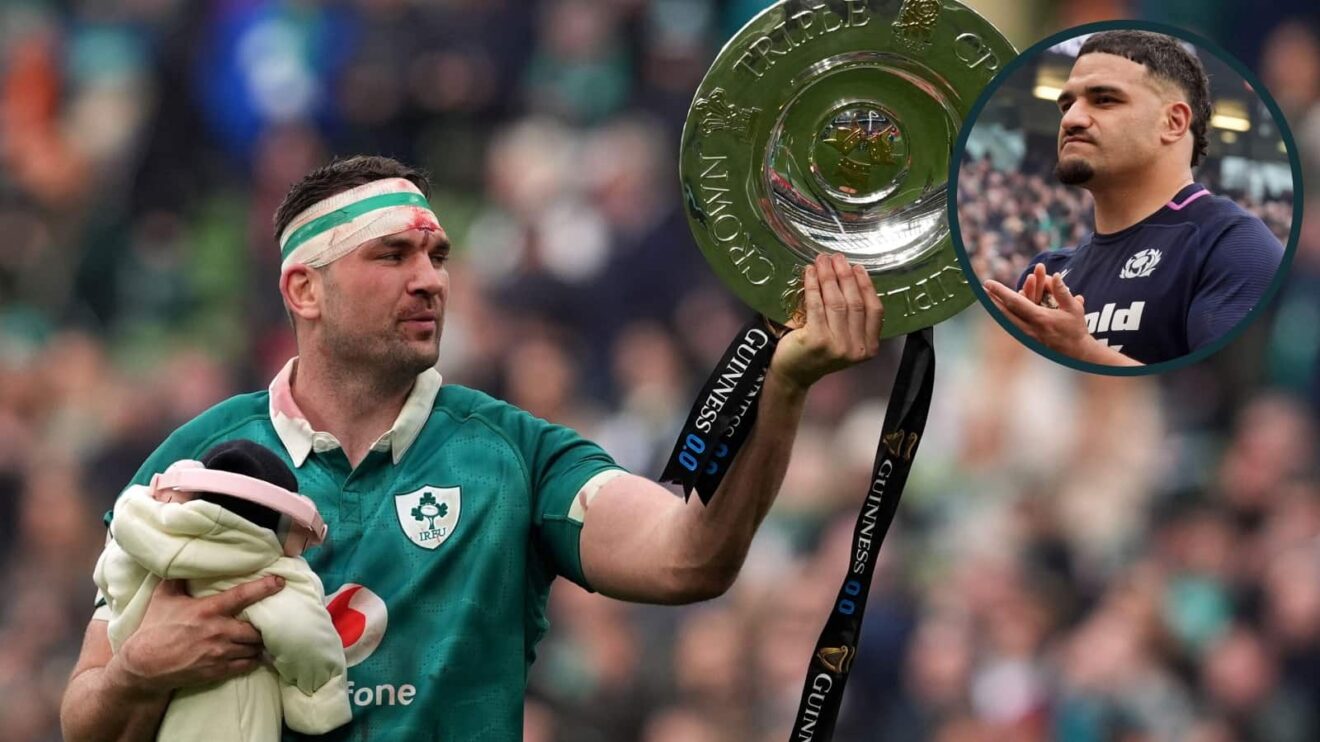
Ireland's Tadhg Beirne celebrates with the Triple Crown trophy and an inset of Scotland captain Sione Tuipulotu.
Following Ireland’s 43-21 victory over Scotland, here are our five takeaways from the Six Nations’ Triple Crown decider in Dublin.
Top line
Ireland did everything they could in a match that entertained all, as they ran in six tries to claim a bonus point win against a very good Scottish challenge. Their tries came from Jamie Osborne, Dan Sheehan, Robert Baloucoune, Darragh Murray and Tommy O’Brien (2) for Ireland. Darcy Graham, Finn Russell and Rory Darge replied for Scotland, but it wasn’t enough.
Ireland have claimed a Triple Crown for the fourth time in five years and done everything asked of them on Super Saturday to pressure France. Their bonus point is banked, 19 championship points accumulated, and if England do them a favour in Paris tonight, Andy Farrell’s side will be Six Nations champions.
What made this performance remarkable was not so much the twenty-point margin, but the standard of play and intellect shown throughout, not only by the hosts, but by the Scots too. Two of the most tactically sophisticated teams in world rugby spent 80 minutes dismantling and rebuilding their systems in real time, each finding answers to the other’s questions, each forcing the next adaptation.
Scotland were very good in parts, but Ireland were outstanding throughout. It was a truly fantastic match, one that entertained everyone who saw it.
Steely Ireland win Triple Crown as Scotland’s Six Nations dreams evaporate in Dublin
Key Battleground
The tactical narrative split cleanly at half-time, and the intellectual contest between Andy Farrell and Gregor Townsend was the story beneath the story as both teams made some in-game tweaks to their strategy, something unusual at the test level.
Ireland’s first-half defensive architecture was built on a deliberate decision not to compete at the ruck, maintaining twelve, thirteen and fourteen in the line, trusting width and line speed to suffocate Scotland’s phase game. It worked with clinical authority as Scotland won ruck after ruck and drifted laterally into green shirts, finding no vertical momentum, leaking six turnovers on the floor across the match through a combination of Irish defensive pressure and their own handling errors. The first three Irish visits to the Scottish 22 yielded 19 points at 6.3 per visit, whilst the Scots relied upon long phase plays to get on the board.
Townsend responded at half-time with a wholesale tactical shift, moving to a focus on kicking from 9 and contesting the aerial battle to disrupt Ireland’s defensive width and win territory. It worked immediately and Scotland used short pops to replace wider passes, counter-rucking slowed the Irish ball. Ben White tempo in partnership with Russell unpicked the very system that had been impenetrable for 40 minutes.
Scotland scored twice in nine second-half minutes and made it a match, and it looked all to play for until Ireland’s answer arrived through Bundee Aki off the bench, powering into contact and dragging two defenders before O’Brien finished. Farrell had the blunt instrument ready when the chess match needed one.
Shining stars
Stuart McCloskey again produced the performance of the match, and it arrived in two acts. The first was a tackle on Finn Russell under the Irish posts that was as much about reading the line as executing the contact, a championship moment in a position where Scotland might have scored.
The second was something of a different order; off an Irish scrum, McCloskey takes the loop through Crowley and Ringrose, draws Scotland’s defence narrow, then fires a 30-metre pass off his left hand directly across the nose of Blair Kinghorn to release Rob Baloucoune around Darcy Graham on the outside, a quite magnificent piece of skill execution under extreme pressure.
The weight, the timing, the disguise, were all delivered at championship pace from the big centre. 12 carries, 55 metres, five defenders beaten, and two try assists were the sum of a magnificent afternoon in his Dublin office. Up front, Josh van der Flier returned emphatically to his best with 23 tackles in 55 minutes, his ruck decisions the foundation of Ireland’s defensive system. Jamison Gibson-Park pushed tempo into Scottish faces before the defence could breathe, and finally, the great Tadhg Furlong looked back to his best as he provided the scrummaging authority from which Ireland’s platform was built.
Scots Pride
Scotland were not without their moments. The Finn Russell whip pass that released Turner for the line break that saw Graham’s early finish was outstanding. And for the setpiece nerds, Blair Kinghorn winning a lineout in his hybrid role was a real piece of fun from the visitors. But the structural problems were real.
Zander Fangerson’s standing up in the scrum conceded the penalty preceding Ireland’s opening try, six turnovers surrendered on the floor proved costly, and 20 missed tackles revealed a defence repeatedly caught out of position throughout the first half.
The second half told a more flattering story. Townsend’s tactical adjustments were intelligent and immediate, and the Russell-White partnership gave Scotland genuine control for a period that threatened something extraordinary. The Darge try, built across 14 phases of short pops and counter-rucking, was as good a forward carrying effort for accuracy as the tournament has seen this year. When White departed and George Horne entered the momentum Scotland had carefully constructed evaporated and the gulf between the two became significant; the instinctive partnership with Russell gone at precisely the wrong moment.
Scotland leave Dublin having contributed to a match of genuine quality and their championship dream ends here, but they’ve been great value.
Implications
Ireland have done all they can do; the bonus point is banked, the Triple Crown secured for the fourth time in five years, and the statement delivered with typical Irish bluster and cheek.
Fabien Galthié will know the exact arithmetic before his side’s first lineout tonight; win in any fashion and France retain the title. Ireland can still claim the championship if England produce the result of their troubled tournament under the Stade de France lights. Points difference could yet matter in the tightest of scenarios, but Ireland’s superior performance here has done everything short of winning it outright.
Andy Farrell’s side have played their hand with intelligence and walked off the Aviva having met every demand Super Saturday placed on them, turning around a terrible start against France, and a wobbly one against Italy. Finally, a word for referee Luke Pearce, who to his credit, had a solid afternoon, unfussy, clear and forgiving, selling his calls with the promotional enthusiasm of a White House press briefing. We need more of Pearce and less of some of the card-fests we’ve seen this tournament and the Exeter-based official had a big impact on the afternoon’s entertainment.