France v England: Five takeaways as ‘extraordinary’ finish to Six Nations leaves visitors with ‘complicated legacy’


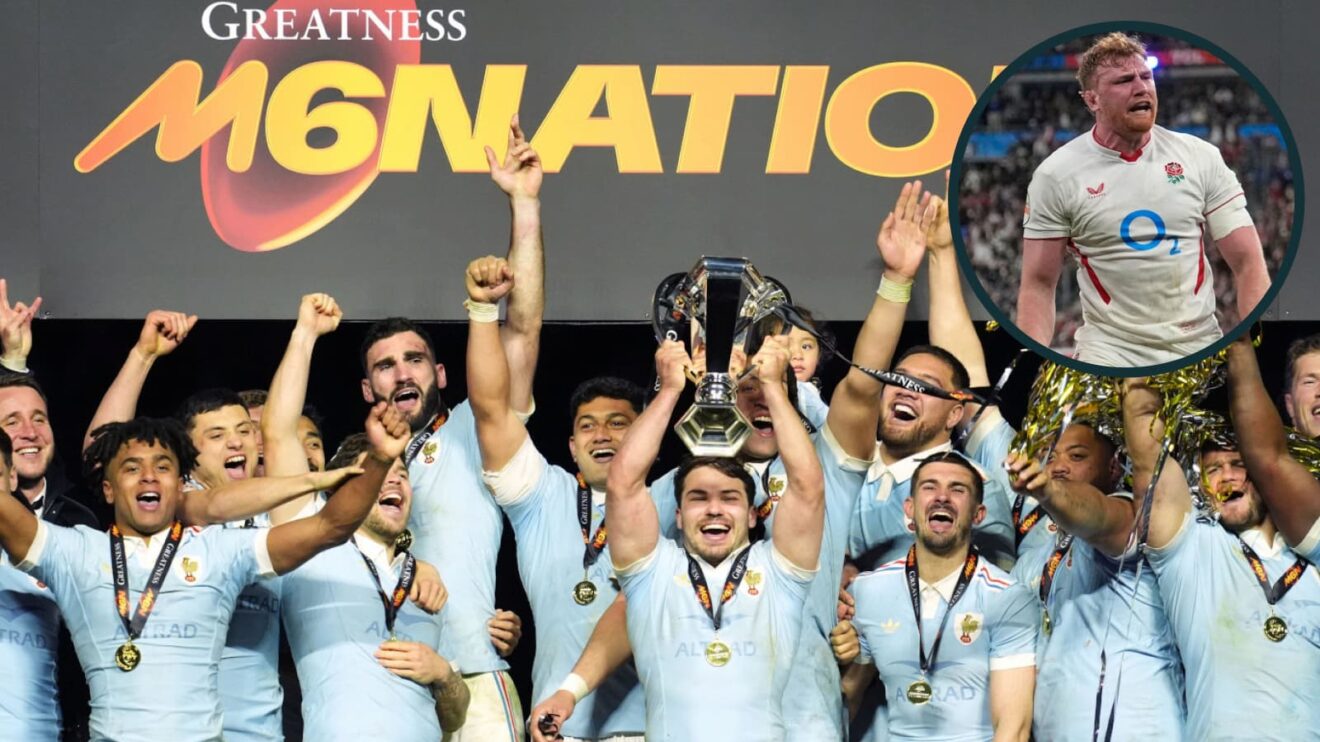
France retain their Six Nations crown.
Following a 48-46 win for France over England in the final Six Nations game of Super Saturday, here’s our five takeaways from a pulsating clash.
The top line
Nobody does this like the French. Before a ball had been kicked, before a lineout had been contested or a scrum had groaned into life, the Stade de France had already delivered something extraordinary. The opening ceremony for the 120th meeting between these nations was not pageantry for pageantry’s sake; it was theatre with chic, classy and precisely calibrated to the weight of the occasion. More than 200 people filled the pitch, two horses traced the ancient rivalry across the turf, and somewhere in the choreography was the entire sweep of a relationship that has defined European rugby for more than a century.
Then the cannons opened up. They thundered around the stadium with such sustained ferocity that, for one disorienting moment, a transatlantic invasion seemed entirely plausible. The 80,000 inside the Stade de France needed no such encouragement. The atmosphere was already deafening, the kind that does not build gradually but arrives fully formed, instantaneously, as though the crowd had been holding it in reserve for weeks.
England, meanwhile, had rather missed the moment. Having failed to complete their warm-up before the ceremonial traffic descended on the pitch, Steve Borthwick’s men were marooned in the corner, bewildered spectators at a party thrown emphatically in someone else’s honour. As omens go, it was not subtle. As it turned out, omens occasionally know what they are talking about.
What followed was one of the greatest matches in the 120-year history of this fixture, and it ended in the manner that only French rugby could manufacture; Thomas Ramos stepping up in front of the posts, the Championship on his boot, Francois Cros and Maro Itoje having just attempted to rearrange each other’s faces in scenes of barely contained madness, and 80,000 people holding a collective breath that could have been heard in Calais. The ball went over, France 48, England 46, the title retained, the Stade de France detonated.
Castillon, 1453, was the final battle of the Hundred Years’ War. Fought on French soil. It ended English territorial ambition on the continent permanently. In the 120th year of this fixture, England arrived having won once in five Championship matches, beaten for the first time ever by Italy, facing the worst Six Nations campaign in their history. They scored 46 points, led late through Tommy Freeman under the posts, and still lost. History, it turns out, has a very dark sense of humour.
Where the game was won
The story of where this match was won begins, as so many French stories do, at the set-piece and ends with a penalty kick and a nation’s nerve.
France scored twice from first-phase set-piece plays in the opening exchanges, and both scores had the quality of something deeply rehearsed and clinically delivered. Antoine Dupont generating genuine pace off the scrum base, Matthieu Jalibert providing the pace and vision, Louis Bielle-Biarrey arriving in space as though the defensive line simply did not exist.
Then, gradually, England found the scrum they needed. Dorian Aldegheri was taken apart as the match matured, and behind him there’s a French tighthead conveyor belt that had already run dry. Uini Atonio’s retirement has left a structural gap that was exposed with some brutality: Regis Montagne injured, Rabah Slimani summoned to the squad at 36 years old, a man who has been playing Test rugby since some of tonight’s England squad were in school, and Demba Bamba offering no greater reassurance off the bench. France’s first-phase platform, the source of everything threatening in their attacking game, was crumbling at its foundations.
The tackle count told its own story. England operating at 86% success against France’s 72% – a differential reflecting not just effort but a French defensive system repeatedly switching off at restarts, losing the intensity required to hold a line that England, with Elliot Daly enabling width and Ben Earl carrying with violent intent, were stretching on every phase. Freeman found the space the numbers always said was there – England, led by Ollie Chessum and Earl were at times quite brilliant. And still it was not enough.
Shining stars
14 tries in 10 Six Nations appearances. Bielle-Biarrey completed a four-try masterclass on Super Saturday and in doing so placed a number on the scoreboard that has no precedent in the history of this tournament. The first came with brutal simplicity; Tom Roebuck stood up like a man losing his lunch money, job done, and the Stade de France singing Seven Nation Army into the Paris sky. The second arrived from first phase off the scrum, Dupont’s pace the trigger, Jalibert the architect, Bielle-Biarrey the inevitable conclusion. The third, Mickael Guillard off the bench, Charles Ollivon screaming through the scramble defence, the passing finding the winger in space, because it always finds him in space. The fourth, sheer pace again chasing down Dupont’s kick. Four tries. One evening. A record the history books will struggle to contain. On a night of 94 combined points, one player defined it and it was the flying UBB wing.
Chessum walked out to this match having been unable to complete his warm-up, marooned in a corner by ceremonial traffic, and spent 80 minutes dismantling every case against him for supposedly playing out of position. At blindside flanker, he carrying powerfully, changing direction at contact, and then producing the moment of the first half; a rolling maul for the ages, every English body against what felt like every Frenchman in the building, the French defence extraordinary in its resistance before cracking, Chessum forcing himself over. The bewildered man in the corner at the start of the match became the man who silenced 80,000 voices. On another night he is the match-winner. On this night he was magnificent and it was not enough.
Earl has made nonsense of every critic who questioned whether he was a genuine number eight. His carrying, his direction changes at contact, his sustained presence at the breakdown across 80 extraordinary minutes; this was the performance of a complete forward and England’s most compelling individual display of the championship. He deserved to be on the winning side and the cruelty of 48-46 is that several England players did.
Daly operated in the position he knows best and at 33, he silenced so many of his critics as the experienced enabler may have been invisible on the scoresheet but he was essential to much of the scores on it. His 25-metre pass created Roebuck’s try; his running lines created the space that others exploited all evening. Roebuck himself deserves his line, humiliated by Bielle-Biarrey inside three minutes, he responded immediately with a finish of genuine quality, Fin Smith’s vision and Daly’s release doing the work. Above all England showed character here in Paris, and it was Chessum and Earl that personified that.
England heads high
England produced 46 points at the Stade de France and lost. That sentence requires a paragraph of its own before the autopsy begins.
They were brilliant in passages. The Chessum maul, Alex Coles finishing off Fin Smith’s vision when England had taken the lead. Marcus Smith, introduced from the bench, scoring in a second half of sustained English pressure. The scrum dominance that cracked Aldegheri and exposed France’s most significant structural weakness. And then Freeman, under the posts, England ahead with the clock dying, a moment of such improbable drama that the Stade de France fell briefly, bewilderingly silent.
Then Ramos. In front of the posts, the Championship on his boot and he killed their bravery, cruelly. In a match like this it’s a shame any side have to lose.
Ellis Genge will not sleep easily. England were ahead and dominant before half-time, and his hands on the maul on the French line converted what should have been seven points into a penalty try and a yellow card; the hinge on which the first half swung entirely. The held-up call before the break, Jalibert and Roebuck arriving simultaneously, a decision worth four points in real terms. Ollivon hauling Henry Pollock down on the line when England were inches from a score that might have ended it. Three moments. Any one falls differently and Borthwick lifts something extraordinary tonight.
He does not and England, as the accountants will tell you, go one win from five. The worst Six Nations campaign in English rugby history, confirmed. Yet tonight contained the best of what this side can produce, and that is a complicated legacy to carry into the summer. The question is not whether England are improving. They plainly are. The question is whether improvement of this quality, arriving at this rate, is sufficient given the pace at which the game is moving around them.
Implications
France retain the Six Nations title and with it the claim to European supremacy, the Championship decided in the most extraordinary circumstances the tournament has witnessed in living memory. The, the last kick of the match, 94 points scored across 80 minutes of rugby that defied every convention of what Test matches are supposed to look like. Fabien Galthie’s side retain their title having been beaten to the line by Freeman and then rescued by Ramos. They will not care how. The trophy is theirs.
But the structural issue does not disappear with it. France have a tighthead problem that Bielle-Biarrey’s obscene scoring rate and Ramos’s nerve cannot permanently conceal. Aldegheri was taken apart tonight. and Bamba is clearly not the answer. A World Cup arrives in 18 months and England, of all teams, demonstrated precisely where the French ceiling sits. Galthie retains the title but he know about the problem – and France, through their scrum and indiscipline, almost threw away the fruits of their attacking brilliance.
Want more from Planet Rugby? Add us as a preferred source on Google to your favourites list for world-class coverage you can trust.
For England, the paradox is acute. Their worst Championship campaign by results produced their most complete performance of the cycle in its final match, against the champions, in Paris, in the 120th year of the fixture. That is the Borthwick condition in miniature: progress visible, results insufficient, the margins brutal and occasionally unbearable.
The 120th meeting between these nations. Two horses, 200 ceremonial figures, cannons that rattled the ribs of the Stade de France, Cros and Itoje attempting to remove each other from the premises permanently whilst a nation’s Championship hung on a penalty kick.
England had spent the opening ceremony stuck in a corner, bewildered by the traffic of history. They left having scored 46 points, led late, and lost by two. In 1453, at Castillon, English ambition on French soil ended permanently. Tonight it ended on the boot of a kicker who didn’t miss when it mattered.
Some defeats are indistinguishable from glory. This was one of them.
READ MORE: ‘Worst kit clash in history’ as fans blast ‘shameful’ France-England decision