Five reasons the South African universities are the real ecosystem of world rugby and why the rest of you keep missing it


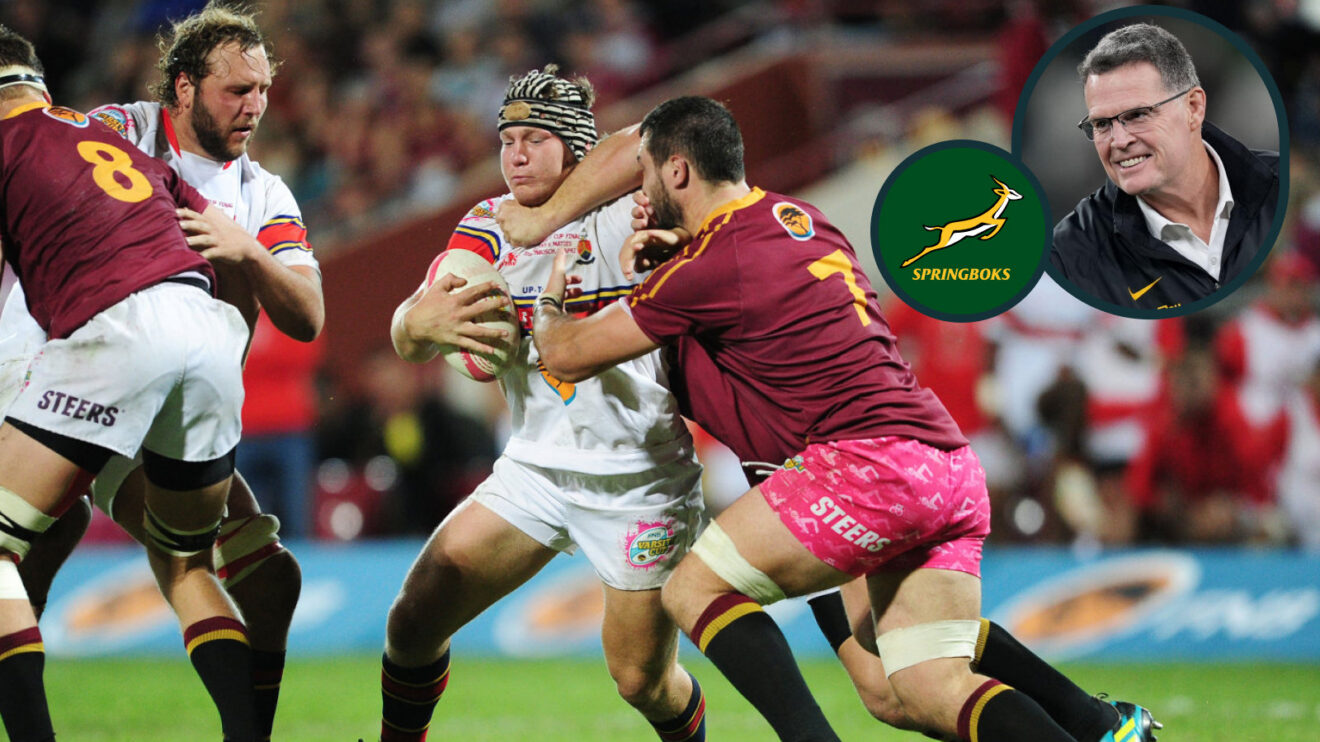
Bulls and Springboks hooker Johan Grobbelaar in action a Varsity Cup match for Tukkies against Maties and Boks head coach Rassie Erasmus (inset).
Planet Rugby features writer James While delves into the impact of South Africa’s universities on the Springboks’ success and what makes the varsities the real ecosystem of world rugby.
Every few weeks a graphic appears on social media listing the 10 biggest rugby clubs in the world, and every few weeks the same institutions get omitted in favour of whoever the compiler watched as a child.
The most recent example put Cardiff Rugby at number 10, ignored every South African franchise, and made no acknowledgement that the actual production engine of world rugby exists at all.
The omission is not a quirk. It is a structural failure of how Northern Hemisphere rugby thinks about its own sport. Here are five reasons the South African university system, anchored by Maties (Stellenbosch University), Tukkies (University of Pretoria), Shimlas (University of the Free State), Ikeys (University of Cape Town) and a handful of others, is the real ecosystem, and why the rest of the world’s lists are essentially fan fiction.
One: The player numbers are not close
Maties Rugby Club fields somewhere in the region of 1,500 active players across all teams in any given season. Tukkies are not far behind.
Toulouse, the most successful professional rugby club in history, runs a senior, academy and youth structure totalling a few hundred. Leicester Tigers fewer than that. Cardiff Rugby, lurking inexplicably at number 10 on a recent graphic, run a professional setup that could fit comfortably inside the Maties second-team pre-season.
Stellenbosch alone has more registered rugby players than the entire Welsh regional system combined. This is not a debating point. It is the operating reality of how rugby gets played in the country that has won three of the last five World Cups, and the people compiling global rugby lists either do not know this or have decided it does not count, neither of which reflects well on the lists.
Two: The Springbok production line runs through these institutions, not around them
Have a look at the squad photos from 2019 and 2023. Then trace the route every player took to get there. The pattern is monotonous in its consistency. Schoolboy rugby into provincial union into university programme into Currie Cup into franchise into Springboks.
The university stage is not a side door. It is the main corridor. Eben Etzebeth, Malcolm Marx, Handre Pollard, Damian de Allende, Manie Libbok, Bongi Mbonambi, RG Snyman, Kurt-Lee Arendse, Ox Nche, and several other players who has ever worn a Springbok shirt at a World Cup final has at some point passed through a university programme that is invisible to global rugby lists.
Compare this to the English system, in which the Prem academies have produced an England team currently being out-thought by everyone they play. Compare it to Wales, where the regional academies have produced a national side ranked outside the world’s top 10 and getting beaten by Georgia.
The South African universities are doing the work that other countries’ professional structures are failing to do, and the world keeps pretending those structures are more important.
Three: The institutions have weight that European clubs cannot match
Maties was founded in 1880. They have won the Western Province Grand Challenge over 80 times, a number which makes Toulouse’s 23 French titles look quaint and Leicester’s 11 Premierships look like a club starter pack. The institutional alumni networks of Stellenbosch and Pretoria run through every level of South African rugby coaching, administration and selection, in a way no European club achieves.
Rassie Erasmus is a Shimlas man. Heyneke Meyer is a Tukkies man. Half the SA Rugby boardroom went through one or other of the major universities. The institutional reach of these clubs is the rugby equivalent of Oxbridge in British public life, and the rugby equivalent in Europe of, well, nothing.
The closest European parallel is the relationship between Toulouse and the south-west of France, which is genuine and powerful, but operates at a fraction of the institutional scale of Stellenbosch within the Western Cape, never mind Stellenbosch within South African rugby as a whole.
Four: The competitive intensity is real, just not where you are looking
The Varsity Cup gets dismissed by Northern Hemisphere observers as a glorified student competition, which is roughly the same level of analytical rigour as dismissing the Calcutta Cup as a small regional fixture. The standard at the top of the Varsity Cup is genuinely high. Players regularly transition straight from Varsity Cup into Currie Cup squads and from there into the United Rugby Championship franchises.
The pace, physicality and tactical sophistication is closer to second-tier professional rugby than anything else in the world. Compare it to BUCS Super Rugby in England, which produces almost nobody of professional standard, or to the French university system, which produces nobody at all.
The South African universities are not playing recreational rugby with the talented few going on to better things. They are playing semi-professional rugby in which the talented many are simultaneously studying and being conditioned for the professional game. Until the Varsity Cup gets credited as a genuine development competition, rather than a curio, global rugby will continue to misread where the talent actually comes from.
Want more from Planet Rugby? Add us as a preferred source on Google to your favourites list for world-class coverage you can trust.
Five: The cultural depth is what produces the players that win finals
There is a thing the Springboks have that no other side has, which is an absolute conviction that they will not lose the moment that matters most. Watch the 2019 and 2023 finals. Watch the way they defend their own line in the 75th minute when everyone is exhausted. That mentality is not invented in a Bok camp. It is forged in places where rugby is taken so seriously, and so early, that by the time a player reaches a national squad the idea of giving in is genuinely foreign to him.
The South African university system is one of the primary forging grounds. The intervarsity matches at Maties and Tukkies are played in front of crowds and in atmospheres that many European rugby clubs cannot replicate in their domestic leagues.
Players who emerge from those institutions have already played in front of partisan, hostile, demanding crowds before they ever wear a franchise jersey. By the time they get to a Test match they have been pressure-tested for years.
This is the part that European rugby does not understand and probably cannot reproduce. The cultural depth is what produces the player. The professional structure merely refines what the cultural system has already created.
So when the next graphic appears, with Cardiff at 10 and Toulouse at one and not a single South African university anywhere on the page, the correct response is not to argue about the rankings.
The correct response is to point out that the lists are missing the entire production engine of the sport. Toulouse are the best professional club in the world. Crusaders are the best professional franchise in the world. Maties produces more rugby players than both combined and supplies an institutional pipeline that has won the last two World Cups. All three things are true, and only one of them gets onto an Insta graphic.
The lists are wrong. The system they fail to recognise is the one that wins the trophies that matter.
Until that gets understood properly, every global rugby ranking will continue to be a parochial Northern Hemisphere exercise dressed up as a global one, and people who actually understand the sport will keep rolling their eyes.