EXCLUSIVE: David Campese backs Rassie Erasmus’s frustration as Wallaby great urges rugby to ‘simplify the game’
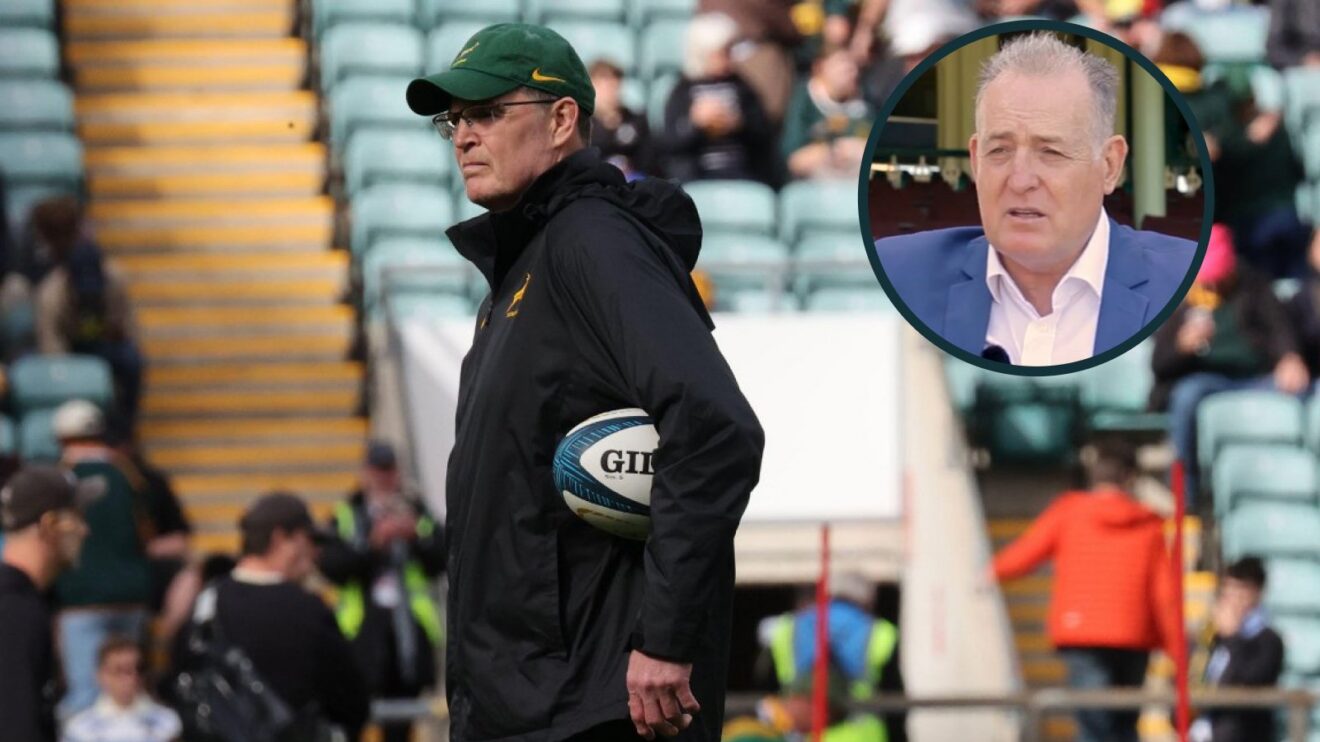
Springboks head coach Rassie Erasmus and Wallabies legend David Campese (inset).
David Campese doesn’t condone Rassie Erasmus’ “match-fixing” comments, but the Wallaby great shares the Springbok coach’s frustration with the officiating in Paris and believes World Rugby should have dealt with it behind closed doors.
“Look, I love the game more than anybody else,” David Campese told Planet Rugby on Wednesday morning, and with Campo that’s never been in doubt; an all-time great of the game, his 101 Tests, a then world-record 64 Test tries and player of the tournament when Australia won the 1991 World Cup give him a fair claim to it.
Campo had watched France beat South Africa 21-19 at the Stade de France, and he’d watched the fallout too: the Erasmus press conference in Dublin, the 17 alleged knee-drop tackles Rassie said went unpunished, the allusion to match-fixing, and the subsequent six-match ban which, subject to SA Rugby’s request for a full misconduct hearing, rules him out of Saturday’s Test against Ireland, the finals weekend and South Africa’s first four Tests of 2027.
The panel World Rugby convened found that Erasmus’s comments clearly amounted to disrespecting the authority of the match officials and, for the record, it’s the third time he’s been sanctioned for the same offence, after the hour-long video on Nic Berry in 2021 and the two matchdays he lost in 2022.
Campese has never been shy of an opinion, which is half the reason we love him, and his take is well worth hearing, not least because it cuts across a lot of the noise in the media with the critical eye of somebody who’s been there and done it.
A titanic battle
“I won’t hold back on the match itself,” said Campese. “It was a titanic battle, an incredible spectacle of rugby, but the aftermath has been a real eye-opener. I don’t condone the match-fixing comments, but I understand totally where Rassie’s frustration comes from, and having watched the game myself, I feel there were a number of French offsides that went uncalled as well.”
It was some match. Antoine Dupont, starting a Test at fly-half for the first time, though he spent plenty of it at scrum-half, ran it from the front, Louis Bielle-Biarrey’s try put France 21-7 up after 32 minutes, and South Africa spent the second half hammering away without ever finding the route they needed to the try line. For Campo, though, the knee-drop row is now part of a much bigger conversation about how the game is being refereed and how it’s being played.
Educating the tackler
“Look, from my perspective,” Campese noted, “the knee-drop and hip-drop laws themselves, I’m very much in favour of them, and I don’t think that issue has gone away. I think Sam Prendergast was the first player to be cited under the new hip-drop regulations, after his tackle on Peceli Yato, and I’m surprised that’s been downgraded. But I see this as much an education issue as a refereeing one.”
“Players,” Campese continued, “simply are not tackling well enough, and the number of tacklers, as a simple example, getting their heads on the wrong side of the ball carrier is really concerning. The laws are right, for sure, but the players have to educate and upskill themselves too, in my opinion.”
It’s the other side of Erasmus’s coin; a law only protects players if they’re coached to tackle within it, and for Campo, that’s the big change that has to come.
Behind closed doors
Nick Mallett: Rassie should never have said that – ‘I don’t know how he can defend himself’
Where Campese parts company with World Rugby is on the process. He believes Rassie should have been called in privately and had the riot act read to him, told plainly that the match-fixing comments were not acceptable, and then asked to sit down calmly and talk through what was bothering him.
Instead the sanction came in public, within a day, under the Match Official Abuse Sanction Process introduced in July, and the upshot is that SA Rugby now want a full hearing so Erasmus can assure the panel it wasn’t his intention to allege that any match official had acted with ulterior motives. “That’s the problem as I see it,” said Campese. “Quite why this wasn’t done in the first instance is completely beyond me.”
World Rugby would argue that the public route exists for a reason. Its own research has found that much of the online abuse aimed at officials starts with inaccurate comments from people in positions of authority, and the new process was built to act quickly and visibly.
Five resets and five beers
“My biggest frustration,” Campese remarked, “is the one most fans share, and it’s consistency. Let’s be honest, you see a penalty at the first and second scrum, and then five resets if it’s in the last couple of minutes, because the referee is paralysed from making a call in case he gets it wrong or gets criticised for it.”
Paris had its own scrum saga, with France conceding nine penalties at the set-piece, so he isn’t short of evidence.
“People don’t want to watch forwards just pounding away at the try-line,” he told us. “My mates were watching a forward sequence five metres out the other night, and whilst it was going on they went out and got five beers. They came back and the forwards were still pounding away at the try-line.”
That, of course, is a typical Campese line, tongue firmly in cheek, but there’s a serious point inside it. “People want to see switch plays,” he continued. “They want to see running plays. They don’t want to see scrums, and they don’t want to see people kicking the ball away,” which is exactly what you’d expect from the man who gave the rugby world the famous Campese goose-step.
Want more from Planet Rugby? Add us as a preferred source on Google to your favourites list for world-class coverage you can trust.
A home World Cup
Behind all of this sits next year’s World Cup on home soil, the biggest yet with 24 teams, 52 matches and the first-ever round of 16, which opens in Perth on October 1 and ends at Stadium Australia on November 13, 2027.
“We need to sort this well before then,” Campese said. “Whilst Australia aren’t flash on the field at the moment, we want to put on a great spectacle; sport means everything to our country, and we don’t want referees taking over.”
It’s essential, he pointed out, that everybody gets this right. “We’ve got to be fair, we’ve got to simplify the game again, we’ve got to give people equity, and we’ve got to move forward from where we are right now, today.”
READ MORE: Jim Hamilton: Rassie Erasmus is the ‘only guy with the bollocks’ to call World Rugby out