Ex-refs boss blasts World Rugby trial as ‘abject failure’ and calls out ‘chumminess’ that ‘serves no purpose at all’


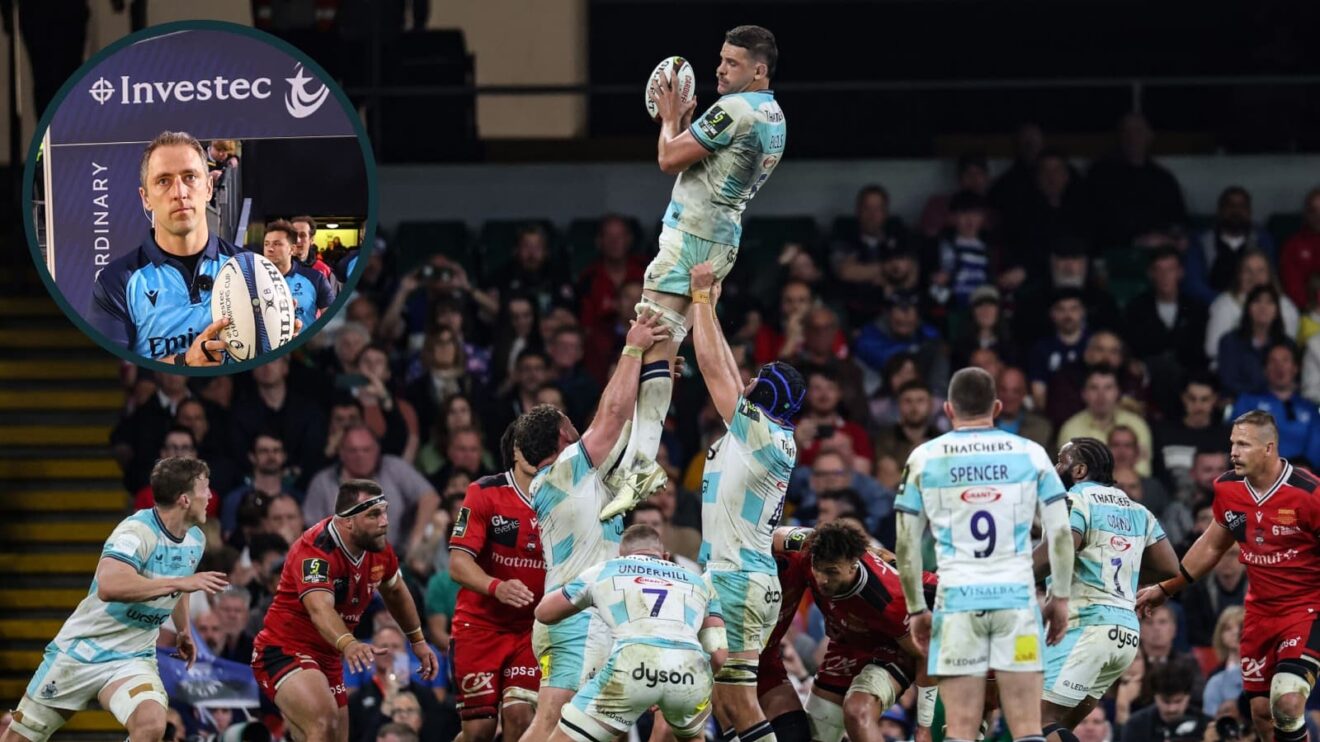
Ex-referee Owen Doyle has plenty to say about the current state of the lineout and the chumminess Andrew Brace, inset, has with players (INPHO/Billy Stickland and Ben Brady)
Former IRFU referees boss Owen Doyle has called on World Rugby to rescind its global trial of not calling crooked lineout throws, otherwise he believes the set-piece out of touch is in “grave danger” of going the same way as the scrum and no longer being a contest for possession.
The ex-Test level referee has also hit out at the level of “chumminess” that exists in the communication between referees and players, claiming that this “faux friendliness” serves no purpose at all as it prevents the officials from being tough on players who over-appeal or give backchat.
World Rugby are next set to meet in June to discuss the progress of the game’s law trials and the retired Irish official wants the discussion surrounding the lineout to put an end to a change that came into effect in January 2025.
Rather than calling a halt to play for a crooked lineout, it was decided to allow play on if the lineout was uncontested, but Doyle has suggested this tweak has resulted in players illegally leaving the lineout before it ends to set up a maul.
“No idea why it has been allowed to infiltrate the game…”
Outlining what he feels is now happening too frequently at the lineout, Doyle wrote in his latest Irish Times column: “The referee sets things up, carefully insisting there is only one receiver, and the hooker prepares to throw. As he releases the ball, several – usually three or four – leave the lineout. At this point, there’s a heck of a lot more than just one receiver.
“So next, binding together, they drive into their catcher as he lands, thus propelling the maul forward. It is a huge advantage, very difficult to defend and has encouraged yet more mauling.
“It probably counts towards ball-in-play time, even though the ball is pretty much invisible while all this is going on. It is also forbidden in the law book, so the officials are usurping the written word and favouring teams with massive forwards and bomb squads.
“The law is absolutely clear: No player can leave the lineout until it is over. The throw is just the start, not the end of proceedings. This is not a trial, rather a novel law interpretation which is clearly wrong and negates the lineout as a contest for possession.
“I have no idea why it has been allowed to infiltrate the game. One suggestion is that it’s very hard to referee it consistently. If that is true, it is preposterous. It is extremely easy to see. It cannot be too much to ask that the law is refereed.
“The global trial of not calling crooked lineout throws, unless the opposition put up a jumper of their own, was introduced to encourage teams to compete,” he added, returning to a hot topic he addressed as recently as February.
“It has been an abject failure with the defending team all too often choosing not to contest possession, preferring to stay grounded to better contest the inevitable maul. It’s not too late to rescind the trial. Nobody can claim, with any credibility, that it’s doing what it says on the tin.”
Reflecting on the matches he watched last weekend, his interest was piqued by the level of rapport referee Andrew Brace had with the Ulster and Leinster players in their United Rugby Championship fixture.
He suggested that the fake friendliness on show allowed players to get away with continuous warnings rather than be sanctioned for taking umbrage over the decisions made by the referee.
Insisting that Brace had refereed the match in Belfast well, he added this caveat: “He failed to be tough on players who over-appealed and gave backchat.
“He warned players on several occasions without ever achieving the desired result. Strong refereeing means sanctioning players when necessary. Continuous warnings are meaningless – a waste of breath.
“Brace was on first-name terms with many of the players, but their behaviour hardly returned the faux friendliness. He is not alone in using this modus operandi and it serves no purpose at all.
“All referees should sit down and have a serious rethink about how they address players and manage dissent. It is quite clear what they are doing is not working. It is broken and in need of urgent repair.”
Doyle went on to blame referees in England for this style of interaction with players. “Where did all this chumminess start? The English Premiership referees were certainly in at the start,” he claimed.
“For some illogical reason, nearly everyone considered this new idea to be a good one. When Irish referees ruled the roost they did not see any reason to use first names – in fact, the plan was not to do so. It was an important point of difference as they went from strength to strength.”
READ MORE: Courtney Lawes: ‘I don’t want to go to the World Cup if I’ve got nothing to offer to the team’