Ex-ref boss insists World Rugby review into TMO ‘cannot come soon enough’ in wake of ‘leading contender’ for ‘poorest decision’


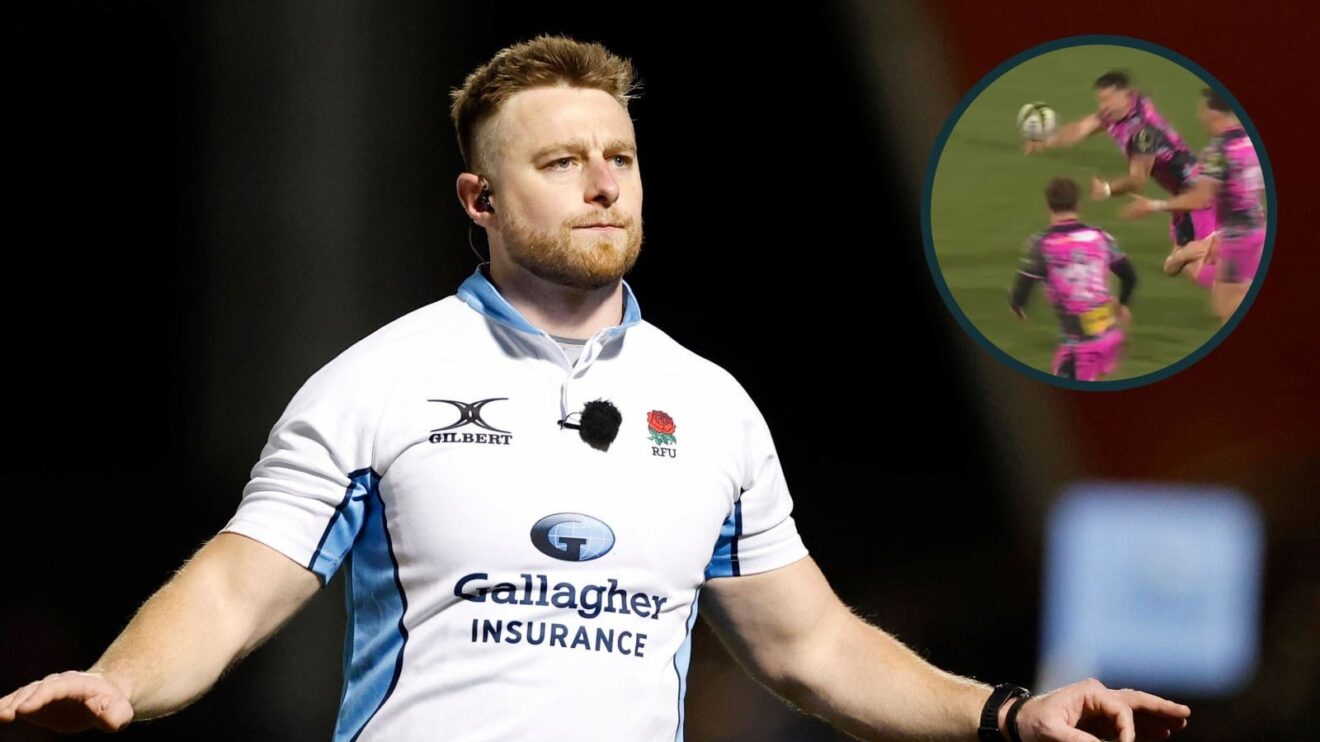
Referee Anthony Woodthorpe going to the TMO and the Ospreys pass which was controversially deemed forward.
Former IRFU referee boss Owen Doyle believes that the Ospreys were robbed of a famous victory after a late try was controversially ruled out.
With the Welsh region 28-24 down against Ulster with just under three minutes remaining, the scrum-half thought that he had secured them a place in the Challenge Cup quarter-finals.
The score was initially awarded by the referee but the TMO alerted him to a potential forward pass by Owen Watkin in the build-up.
Despite Watkin’s hands appearing to go backwards, it was ruled out and it was the hosts who progressed into the next round.
‘Flummoxed’
“This writer’s firm view sees it is a leading contender for the ‘poorest decision of the season award’,” Doyle, who is also a former Test referee, wrote in his Irish Times column.
“Between them, referee Anthony Woodthorpe and his TMO for the day, David Rose, pulled the rug from under the Ospreys, denying them a famous win over Ulster.
“It is essential that TMOs stick to the protocols which state very clearly that they should only advise the referee on issues which are clear and obvious. This certainly did not meet that requirement. Rose had no rhyme nor reason to get involved.
“So, the next step for Woodthorpe was to overrule his colleague, right? Not this time. I was not alone in being flummoxed when the referee agreed with his off-pitch official, and that was that.
“A complete misread of the situation and a blot on the competition. If this decision was ever to become the yardstick to measure forward passes, we’re going to see an awful lot of tries ruled out.
“It’s also important to say that there can be no suggestions of bias, that it was effectively a hometown decision. Nobody should entertain any such sentiment. But, my goodness, there are questions of competence which surely arise.”
World Rugby’s review
Doyle has often been frustrated by the role of the TMO and hopes World Rugby will alter the protocols in order to improve the process.
“There is also a significant danger of referees becoming dependent on the input from the TMO. I’d suggest some have done so already. World Rugby’s review of the TMO protocols cannot come soon enough,” he added.
“What we are seeing, on an all too frequent basis, is far too much TMO involvement. If referees are afraid to make mistakes, then they should not be there.
“And the officials certainly should not be allowed to stretch the protocols beyond recognition, to a point where the TMO becomes the near-equivalent of a second referee.”