Debating Tadhg Beirne’s ‘style of game gone’ claim: The 35.8% statistic that backs up Ireland star’s argument
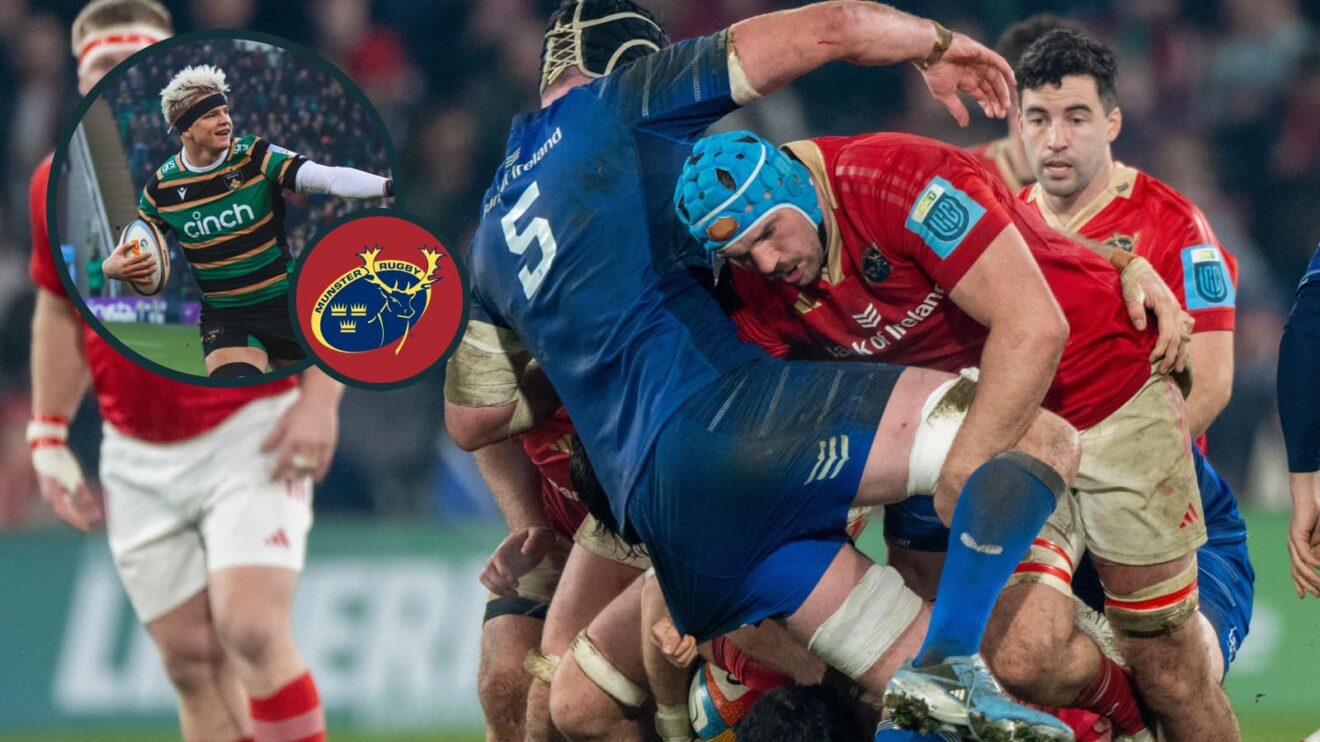
Munster's Tadhg Beirne has expressed his frustration with rugby's current style but Northampton and Henry Pollock, inset, are still managing to play a lovely brand
Tadhg Beirne cut a figure of frustration on Saturday night with the dust settling on a United Rugby Championship derby in Limerick that won’t live long in the memory.
The Munster versus Leinster match-up traditionally gets hyped as potential classic material, but the reality is that the spectacle more often than not leaves so much to be desired.
So it was again at the weekend, a drab affair with limited creativity to entertain the sold-out 26,006 attendance and those tuning in from around the world on TV. You definitely didn’t need a full hand to count up the game’s best moments.
Leinster fans delighted with the bragging rights will, of course, tell you that winning ugly is still great fun (they have been doing it all season long), but rugby can’t continue messing with the paying public, claiming that it is in the entertainment business but producing matches that frequently pass by without anything memorable happening.
Valid point
The cynics will argue that it is surely up to the respective head coaches to come up with game plans to excite the fans who buy the tickets and pay for the multiple TV subscriptions required to follow the sport. It is a valid point.
Dull, pragmatic coaches, though, don’t want to entertain; they just want the W by whatever means possible. But the way the laws keep changing in a sport where there is too much boardroom meddling has now resulted in a star player such as Beirne making public his frustrations with the direction the game is evolving.
“The style of the game is gone,” reckoned the recent British and Irish Lions Test series winner, trying to make sense of the colourless 13-8 weekend loss. “Let’s be honest, the style of the game has gone backwards if we are being serious.
“Teams are just kicking the ball. Why? Because it’s a 50/50 chance of getting the ball back. Certain teams are going to set-piece more because you put up the 50/50 in the air and you get a knock-on, you get a scrum. And if you have a good scrum, you can get a penalty, into the corner.
“It’s just becoming a set-piece and kicking game with the way they have kind of changed the rules. You see teams kick more and more, and it’s just going to continue going that way unless they decide to do something about it.”
Relying on these behind the scenes bureaucrats who pull the law strings to get it right is a tall order, given the current dog’s dinner of a spectacle from one week to the next.
What about the numbers, though, behind Beirne’s claim that kicking and scrummaging have negatively taken over? Drilling into the statistics of the half-dozen Round Eight URC matches, there were 283 kicks in play across the 480 minutes – basically a kick on average every 101.7 seconds. Just 40 of those kicks were retained.
Switching to the scrum, there were 67 across the weekend, a set-piece every 429.8 seconds. Most interesting was how 24 of those 67 scrums – 35.8 per cent – resulted in an offence getting whistled by a referee.
URC is ahead of the game in terms of the immediate statistical information it volunteers from its matches compared to the rival leagues in England and France.
In PREM Rugby, there were 248 kicks from the hand in its 400 Round Eight minutes last weekend– a kick every 96.7 seconds across the five matches.
There was no information on its website on the number of kicks retained, and it’s similar as regards the number of scrum offences that happened in its 68 put-ins, on average a scrum every 352.9 seconds.
Moving to the Top 14, it saw 368 balls played with the feet in its 560 Round 13 minutes – a kick every 91.3 seconds. There were also a total of 97 scrums – a scrum every 346.3 seconds.
Of the 36 teams in action across the three tournaments, PREM leaders Northampton were the side that kicked the least – just 14 times – and their visit to defending champions Bath had the least number of kicks in any of the 18 matches – 33. Compare that to Racing-Montauban, which had 63 kicks, and Sale-Harlequins, which had 62.
Want more from Planet Rugby? Add us as a preferred source on Google to your favourites list for world-class coverage you can trust.
Not kicking, though, doesn’t automatically mean a team has a limited attack intent; Toulouse kicked 33 times on Sunday night, but the calibre of their rugby was such that they still fashioned nine tries – some of them absolutely brilliant efforts – in their 60-14 hammering of La Rochelle.
What do all these numbers below mean? It’s impossible to say without the context of statistics from across an entire season. But what seems definite, going by the percentage of scrum offences in the URC, is that Beirne has a potentially sound point – that kicking in the hope of forcing an opposition knock-on and then a scrum can pay a rich dividend for those sides who do it well.
England A star with ‘pace to burn’ to return to Newcastle as exit from PREM rivals confirmed
URC: 283 kicks in play in 480 minutes (40 retained) – a kick every 101.7 seconds; 67 scrums (24 scrum offences) – a scrum every 429.8 seconds
58 kicks in play: Cardiff 28 (3 retained) Dragons 30 (4 retained) – 14 scrums (1 offence against Cardiff, 2 against Dragons)
54 kicks in play: Edinburgh 23 (1 retained) Glasgow 31 (6 retained) – 12 scrums (4 offences against Edinburgh, 1 against Glasgow)
48 kicks in play: Scarlets 25 (8 retained) Ospreys 23 (3 retained) – 10 scrums (3 offences against Ospreys)
43 kicks in play: Munster 19 kicks (2 retained) Leinster 24 (4 retained) – 13 scrums (4 offences against Munster, 2 against Leinster)
40 kicks in play: Connacht 21 kicks (4 retained) Ulster 19 (2 retained) – 12 scrums (3 offences against Connacht, 3 against Ulster)
40 kicks in play: Benetton 21 (1 retained) Zebre 19 (2 retained) – 6 scrums (1 offence against Benetton, 1 against Zebre)
PREM Rugby: 248 kicks from the hand in 400 minutes – a kick every 96.7 seconds; 68 scrums – a scrum every 352.9 seconds
62 kicks from the hand: Sale 33 Harlequins 29 – 12 scrums
59 kicks from the hand: Exeter 30 Leicester 29 – 14 scrums
49 kicks from the hand: Gloucester 19 Saracens 32 – 19 scrums
45 kicks from the hand: Bristol 17 Newcastle 28 – 10 scrums
33 kicks from the hand: Bath 19 Northampton 14 – 13 scrums
Top 14: 368 balls played with the feet in 560 minutes – a kick every 91.3 seconds; 97 scrums – a scrum every 346.3 seconds
63 balls played with the feet: Racing 33 Montauban 30 – 16 scrums
57 balls played with the feet: Bayonne 29 Stade Francais 28 – 13 scrums
56 balls played with the feet: Clermont 32 Bordeaux 24 – 19 scrums
56 balls played with the feet: Toulouse 33 La Rochelle 23 – 10 scrums
53 balls played with the feet: Toulon 26 Perpignan 27 – 22 scrums
45 balls played with the feet: Castres 22 Lyon 23 – 10 scrums
38 balls played with the feet: Pau 23 Montpellier 15 – 7 scrums
- Kicks in play, kicks from the hand and balls played with feet are the respective descriptions used by the URC, PREM Rugby and TOP 14 on their websites