Dave Rennie tight-lipped on World Rugby’s Greatest Rivalry officiating verdict as All Blacks boss hits out scrum law again


Dave Rennie has taken aim at the brake foot scrum law yet again.
All Blacks head coach Dave Rennie has taken aim at the brake foot scrum law yet again but has refused to divulge World Rugby’s verdict on the officiating during Rugby’s Greatest Rivalry series.
He and assistant coach Neil Barnes aired their dismay with how the scrums were officiated during the Test series with the Springboks.
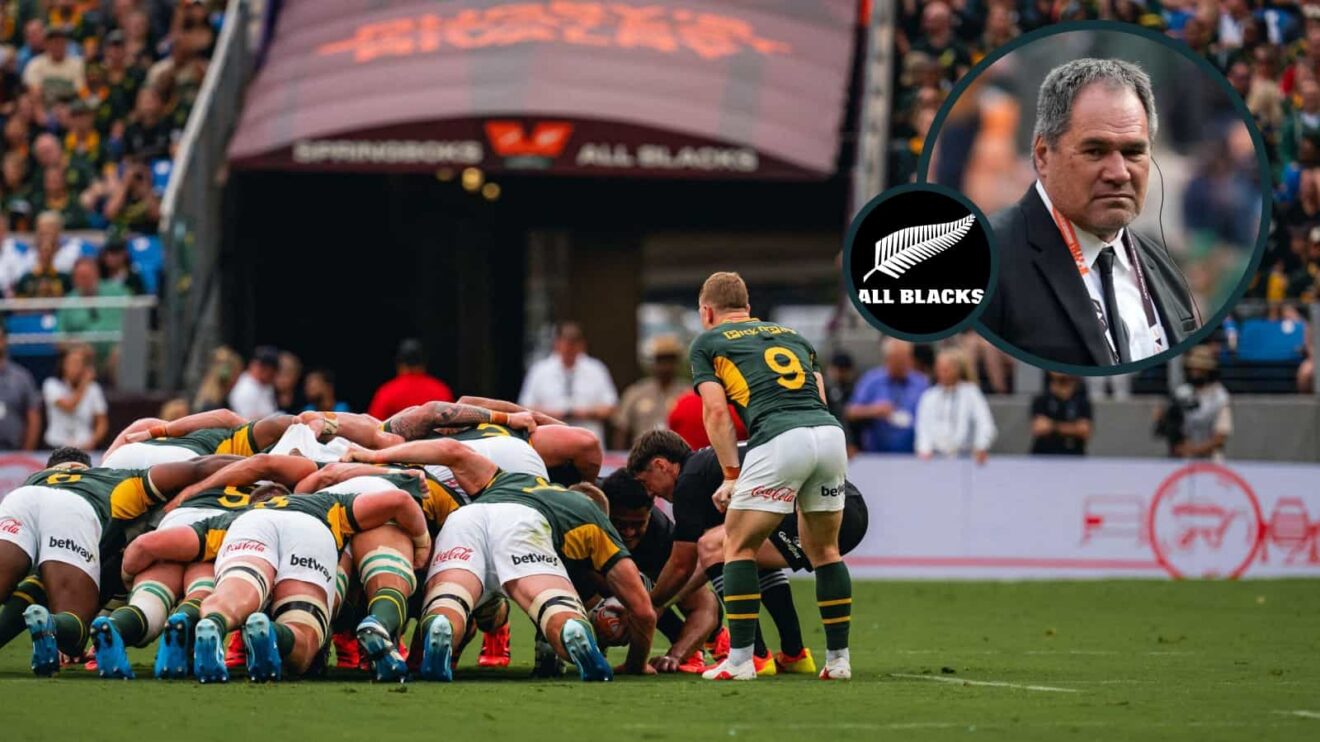
Rassie Erasmus’ charges were accused of ‘walking around’ in the set-piece by the duo, while they have also argued that the brake foot does not serve any purpose.
World Rugby introduced the law that requires the hooker to have one foot positioned forward in the middle of the tunnel in a bid to help stabilise the scrum and avoid axial loading (pressure on heads and necks).
Dave Rennie repeats scrum complaint
This position is supposed to be adopted throughout the ‘crouch’ and ‘bind’ elements of the engagement sequence, with the foot only withdrawn after the ‘set’ call and before the strike for the ball.
The All Blacks and Springboks were both penalised for failing to use the brake foot during the series, and Rennie has repeatedly questioned its use, stating that all it does is give referees something else to look at.
In an interview on Newstalk ZB’s Weekend Sport with Jason Pine, he challenged the game’s governing body to simplify the scrum by deleting some of the laws.
Speaking ahead of the Bledisloe Cup Test match against the Wallabies, he echoed his previous sentiments.
“I’m mentioned during the week, but it’s a challenging game for the referee,” he said.
“The whole brake foot focus, I can’t find any evidence of the benefit of it other than one more thing for a referee to look at, and then you miss the obvious pictures around angles and so on.”
Australia and New Zealand don’t have as big of a focus on scrum dominance as the Springboks, instead using the set-piece more as a restart of play.
Given that, Rennie predicts that the brake foot will be less of an issue and added that the scrums in the last few international matches were ‘squarer’ compared to those from earlier in the RGR series.
“So, I don’t envision that being a major issue this week. Certainly in Baltimore, the scrum was squarer and looked pretty square against the Wallabies last week.”
Furthermore, much has been made about the officiating during the Test series between the All Blacks and Springboks. Assistant coach Barnes was one of the loudest voices, stating that South Africa were awarded penalties ‘for bugger all’.
That prompted the question as to whether World Rugby admitted that there were a few things that were wrong, but Rennie wasn’t giving anything away.
“I won’t divulge that,” he remarked.
Wallabies’ aerial threat
South Africa also managed to put pressure on the All Blacks through their kicking game and aerial prowess, but the Boks were outplayed in that department in Perth against Australia.
While Rennie hailed the Wallabies’ ability in the air, he predicts that they will hold onto the ball more than the South Africans did against them.
“They got good men in the air. We had a strategy around it; I think if you include the scraps and the amount of ball we got clean in the air, we’re around 50%,” he said.
Want more from Planet Rugby? Add us as a preferred source on Google to your favourites list for world-class coverage you can trust.
“South Africa are excellent in that department, but what we know is we want teams to kick to us because we’ve got a mindset that we want to play off that.
“I’m sure the Wallabies will play a lot more footy than South Africa, but they’ll also kick smart. Ryan’s got a good kicking game, and I’m sure they’ll use that to take pressure off others.”