Comment: Les Kiss has plenty to think about as Wallabies ‘morphing into something unfamiliar for Australians’


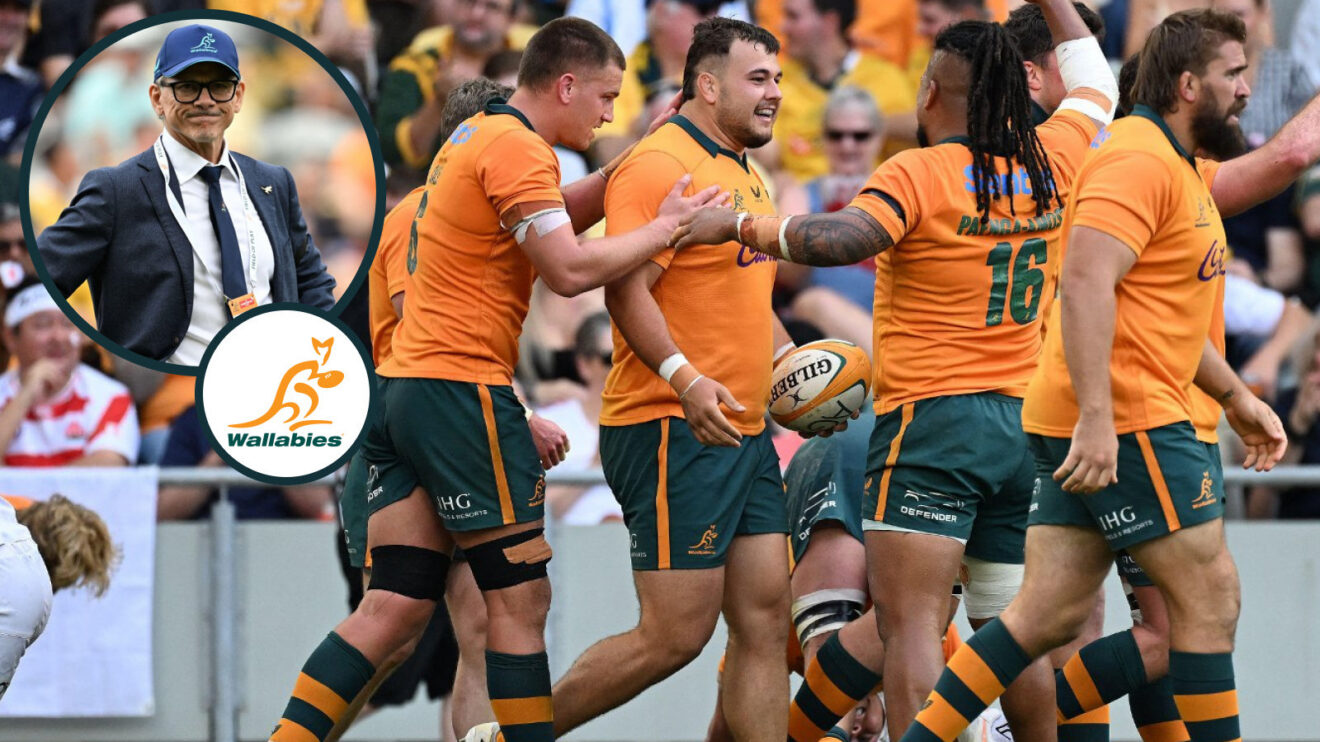
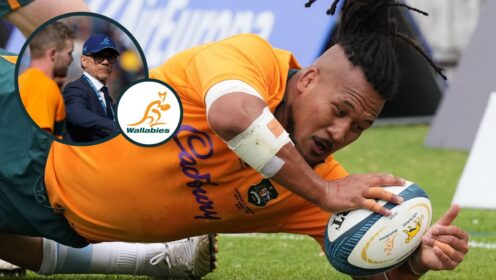
Under the guidance of their head coach Les Kiss (inset), the Wallabies are relying heavily on their forwards to win games.
The Wallabies are on the up. There’s no doubt about that after four straight wins for the first time since 2021. But midway through the international season, the question for Australian fans is what is the end game for the Wallabies 13 months out from next year’s World Cup on home soil?
After seven Tests in 2026, the Wallabies are morphing into something unfamiliar for Australians, more reminiscent of the Springboks with their crash-and-bash, forward-oriented style.
But will it be so effective against the world’s best?
Thus far, of the Wallabies’ 34 tries in 2026, 25 (73 per cent) of the nation’s five pointers have come via the forwards, including three of their four tries against Argentina during their 27-21 win in Jujuy over the weekend.
The Wallabies’ forwards are also the side’s main ball carriers. Rob Valetini (17) and Tom Hooper (14) easily led the way for the Wallabies during their tense six-point win in Jujuy. The next three were also forwards, before Hunter Paisami (nine) was the first back to carry more than six times.
Compare that to the All Blacks’ top four ball-carriers, all of whom were backs, with Quinn Tupaea (14), Will Jordan (13), Jordie Barrett (13) and Leroy Carter (12) leading the way. Three of the All Blacks’ four tries were also scored by backs during their 33-26 defeat in Cape Town to South Africa.
It’s hard to imagine the Wallabies’ set-piece, which has been brilliant thus far in 2026 under scrum coach John Ulugia and lineout mentor Tom Donnelly, and general phase attack will enjoy the same success against the Springboks and All Blacks.
It’s why Les Kiss will be thinking long and hard about his attack over the next few days and indeed weeks, because the former rugby league flyer would have been slightly concerned had he been playing on the wing under the current system. After all, outside centre Isaac Henry hardly touched the ball in the opening Test on Argentina soil. Nor was he alone, with the Wallabies wingers, including supreme talent Max Jorgensen, barely seeing it.
To be fair to Kiss, the new Wallabies winger said last month that defence would be the early focus on the training paddock since taking over from Joe Schmidt.
And three matches in, it looks that way too. Kiss, too, knows it. The former Reds coach described the Wallabies’ win as “clunky” – and that it was.
Competition emerging but Kiss has way to go
Les Kiss recently said he wants to build enough depth to have two teams. Or, in other words, to be two deep in every position.
In truth, he needs to be three deep in some positions, especially at tighthead prop, tighthead lock, halfback and fly-half – and he’s got some way to go there.
When Ryan Lonergan left the field early in the second half, the Wallabies fell away massively. Tate McDermott is yet to find his best form since his major hamstring injury last year, which saw him sidelined for the best part of nine months, and Kiss will likely be considering giving Kalani Thomas a second cap after being left out of the 23 in all eight Tests to date this season.
Carter Gordon has also shown that he’s clearly the Wallabies’ best playmaker. Ben Donaldson and Declan Meredith have some work to do to show they’re capable replacements.
But Kiss will be thrilled with some of the talent that is hardening and rising to the surface.
Josh Canham is thriving after being handed more responsibility in 2026, his second-row partner Jeremy Williams is a goer, there’s some depth in the back-row, and there are plenty of options out wide, even if none of them would likely make a world XV.
Midfield selection coach’s biggest headache
Next week’s second Test in Argentina could be one of the most pivotal ahead of next year’s World Cup for the Wallabies because it could crystalise Kiss’s thinking in the midfield.
After Len Ikitau missed the Japan Tests, the reigning John Eales Medallist returned to the squad for the Argentina tour but was given another week to get up to speed under Kiss.
But in the interim, Kiss’s regular No.12 at the Queensland Reds, Hunter Paisami, was one of the Wallabies’ best backs.
He made a decisive break ahead of Tom Hooper’s try – the Wallabies’ only five-pointer in the second half – by getting through contact.
While he didn’t quite unlock his side’s attack like he did for the Reds, the feisty and combative midfielder has also been strong defensively.
His strong effort led Kiss to describe Paisami’s game as “smashing”.
So there’s no doubt Ikitau will be under some pressure to immediately pick up where Paisami left off when he likely returns for the second Test on tour in Mendoza.
Joseph-Aukuso Suaalii’s encouraging cameo off the bench won’t have been lost on Kiss either, with the Wallabies’ most expensive player getting his hands on the ball regularly and finding space and metres, including in the 80th minute, against the Pumas.
Want more from Planet Rugby? Add us as a preferred source on Google to your favourites list for world-class coverage you can trust.
Rugby Australia can’t abandon Victoria
Somewhat extraordinarily, a third of the Wallabies’ starting line-up against Los Pumas came from Melbourne.
Prop Isaac Kailea, lock Canham, back-rower Rob Valetini, centre Paisami and winger Harry Potter all hail from Victoria.
That’s a record representation for Victorians in the Wallabies’ starting side, and the high number showed the value of the now-defunct Rebels, where four of the five began their careers.
It was also the clearest sign yet that Rugby Australia must continue to invest in rugby in the state, especially given Melbourne is quickly becoming the nation’s biggest city.
Some 70 per cent of registered players in Melbourne also have Polynesian background – and their characteristics are well-suited to the high-intensity, explosive nature that rugby has become.