All Blacks: Tana Umaga reveals how ‘disrespectful’ moment led to birth of Kapa o Pango Haka


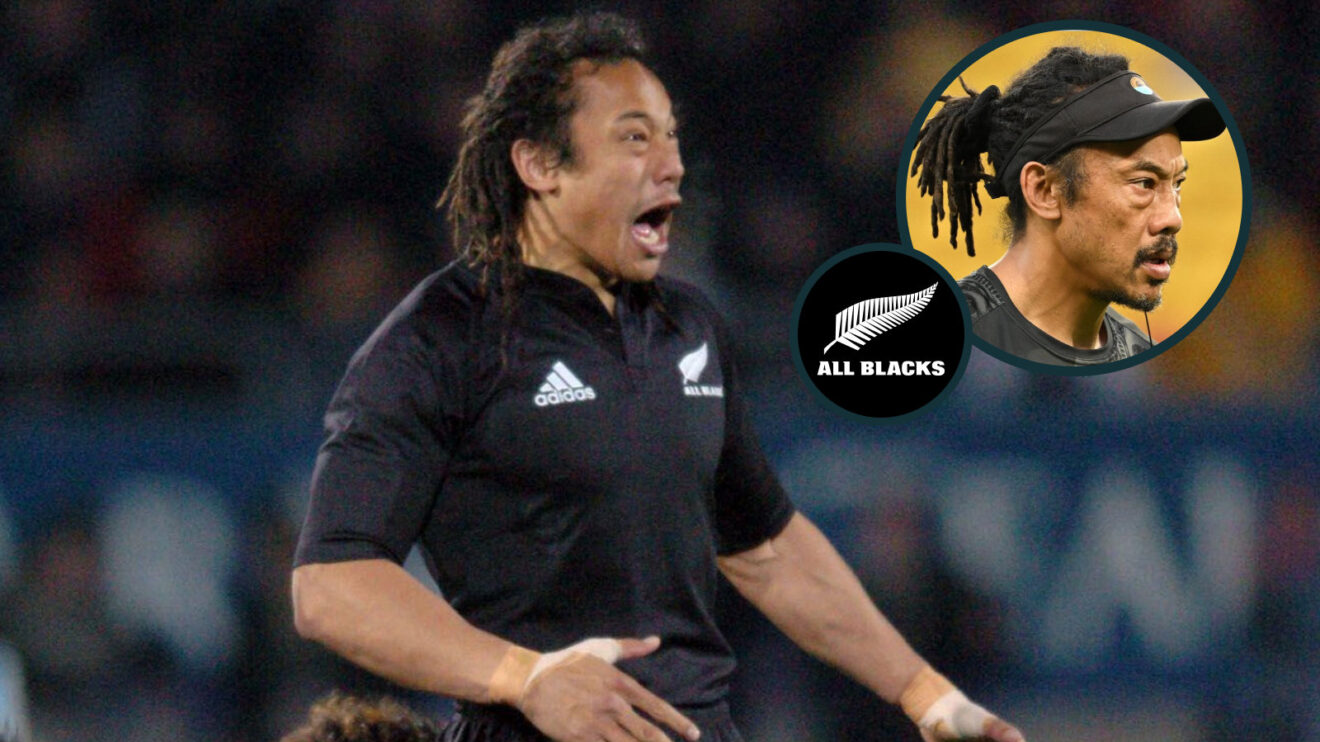
Tana Umaga leads the All Blacks as they perform the Kapa o Pango haka for the first time and in action during a Moana Pasifika training session (inset).
Tana Umaga has opened up on how a “disrespectful” moment from him led to the creation of the famous Kapa o Pango haka during his stint as the All Blacks captain.
He represented New Zealand with distinction on the wing and at centre in 74 Tests from 1997 to 2005 and was appointed as the All Blacks captain in 2004.
Umaga was the first player with Pacific Island heritage to skipper the men in black and he captained them in 21 internationals until his retirement from Test rugby, finishing with an 86% win record in the leadership role.
The haka is a war dance which hails from New Zealand and was initially performed by Maori warriors in preparation for battles.
It has subsequently been adopted by the All Blacks, who perform it ahead of their Test matches, and by doing so they lay down a challenge to their opponents.
The Ka Mate haka, which was composed by Ngāti Toa chief Te Rauparaha around 1820, was only originally performed by the All Blacks in Test outside of New Zealand before this changed in 1987.
It has become popular with spectators as it is entertaining and adds to the build-up ahead of Tests and since 2005 the All Blacks have also introduced the Kapa o Pango haka. It has grown in popularity and the latter war dance is now being used for bigger clashes.
Helped to create the Kapa o Pango haka
Umaga played a pivotal role in the birth of the Kapa o Pango haka and he recently revealed how by going through the motions with the Ka Mate haka led to the All Blacks creating a new one.
“Well, with Kapa o Pango, it started in probably 2004. There was a bit of talk around are we just going through the haka for the sake of it? Because we’ve done it everywhere,” he told the Behind the Ruck podcast.
“And we don’t have a real understanding around it or a real connection to it other than where we play for the All Blacks and we’re from New Zealand.
“And we got a Maori elder in, Derek Lardelli, who really explained it to me. And for me, it was really simple. And that’s what resonated with me.
“Because I remember vividly in 2004, we went to South Africa and we just wanted to play. And there was a bit of a (hassle), and we had to do the haka.
“And I thought: ‘We should just get into it. We’re ready to go’. And that was disrespectful to where we come from and the people who have been before (us).
“But it was just because of that lack of understanding. So, when Derek Lardelli came in and did a workshop with us, he asked very simply: ‘Do you have any loved ones buried in this land?’
“And this land being Aotearoa, New Zealand. And I said: ‘Yeah, I’ve got family.’
“And he said: ‘That’s our connection with those around you. Because our bloodlines that are buried in this land are intertwined and this is where we draw strength when we’re stomping our feet on the ground, trying to awaken that strength and our unity to come through us to give us the strength to represent the best of our abilities’.
“And I just said: ‘Man, you got me.’ “I said: ‘I like that.’
“And that drew a connection for me because I’m not Maori, obviously (Umaga is of Samoan descent). People think I am. And my wife’s Maori and I’ve got children that are obviously half Maori. And so I have a lot of respect for the culture.
“But that was what really connected me to it. And from there on in he talked about that as part of the legacy, a lot of Iwis, which is tribes and villages, they have multiple haka, that mean multiple things.”
Umaga, who currently coaches Moana Pasifika in Super Rugby Pacific, said things progressed quickly after that and the idea of a new haka soon became a reality.
“And so that, you know, we thought about, well, we would like to add a haka to the All Blacks. And this is where Kapa o Pango came from. So, we worked with Derek Lardelli around some of the values that we hold, what the black jersey means to us,” he explained.
‘We had to get sign-off from the whole team’
“And then he choreographed and came up with Kapa o Pango. But then when we did that in 2005, we wanted it to be ready for the British and Irish Lions. But we had to get sign-off from the whole team because we said: ‘We’re a collective here. We’re not just going to be leaders that are (for ourselves), we’re going to put it on you guys, whether you like it or not.’
“Because that’s kind of like what was done to us.
“It was just something that you did and you just had to bond even though you didn’t understand it. So, we decided as a leadership group that we’re going to talk to the whole group and we all have to agree to buy into implementing Kapa o Pango and taking this on board and making it a part of the legacy.”
Want more from Planet Rugby? Add us as a preferred source on Google to your favourites list for world-class coverage you can trust.
Umaga revealed that selling the idea of a new haka to the rest of the All Blacks squad was not so easy, however.
“But we had a couple of young guys who (were) first year All Blacks who said: ‘Well, who am I to change something that’s been going for over a hundred years?’, which was a valid question,” he said.
“And so it took us a lot longer to convince them to be a hundred percent of the squad all in to perform it and make it part of us. And I remember before the South African Test (in Dunedin in 2005) that we had one more meeting as a team to try and sell it to these guys.
“And we knew if we didn’t do it now, we probably wouldn’t do it.
“It had been going for so long. But they finally agreed, they understood. They finally understood. And then we brought it out against the South Africans in 2005. The only thing I said once we all agreed is that if we do it, we’d better win.”