Springboks v All Blacks: An England tighthead hands New Zealand an unconventional way out of the scrum in Baltimore


Springboks v All Blacks: An England tighthead hands New Zealand an unconventional way out of the scrum in Baltimore
Kyle Sinckler props for a living, and on Dan Biggar’s podcast, he made the concession that neither camp would go anywhere near.
The top line
“You’re speaking to a tighthead, so I’m always going to be biased.”
Kyle Sinckler says that to Dan Biggar about a third of the way through their Biggar Thinking: Rugby Analysis podcast hour together, and it’s more candour than this argument has had out of anybody in a coaching shirt since 22 August.
Because after three Tests, three referees, a complaint lodged with World Rugby, an expletive from Rassie Erasmus that spoke volumes at volume and Nick Mallett droning on and on, appropriately with drone footage, what nobody had actually produced was a mechanism, and the reason for that is that hardly any of us has ever had our head in the dark of the scrum.
Sinckler has, for a decade and more, been a Test tighthead, from the Lions in 2017 through to whatever the Top 14 does to a man’s neck on a wet Sunday in the provinces, and his verdict comes from experience at the coalface.
There was walking around in this series. It happened once, at Ellis Park, on 55 minutes, and Matthew Carley got it exactly right. Everything else that’s been freeze-framed, arrowed and posted was legal, and the explanation is duller than cheating, despite the rattle on social media coming from a variety of armchair scrummagers.
The scrum is won before the ball goes in
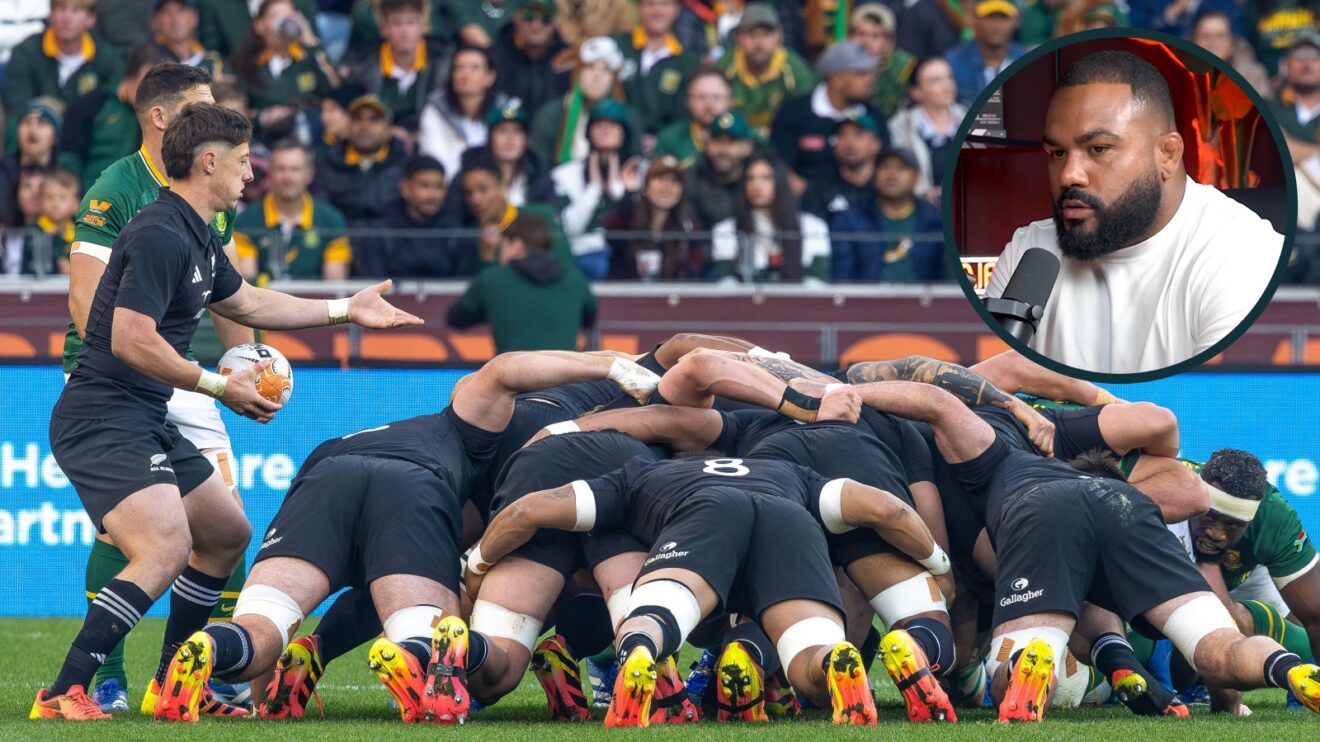
The loosehead tucks his right shoulder in under his own hooker’s left shoulder as he sets; Ox Nché does it, George Bower does it, and Sinckler would suggest that 95 per cent of looseheads everywhere are the same. It puts the opposition tighthead in a vice, with the hooker’s head on his left pectoral and the loosehead’s head on his right, the two of them lifting him and turning him in. Props call it the pincer.
The tighthead’s counter is the seam, so he gets his head onto the hooker’s left shoulder, splits the join between hooker and loosehead, and from underneath the hooker he can drive.
At the FNB stadium, Wilco Louw’s head was on Asafo Aumua’s left shoulder, because Bower had set fractionally deeper than his hooker; Louw read it and went through the join; Lomax, meanwhile, was square to Nché, and behind the pair of them Siya Kolisi and Pieter-Steph du Toit were loaded and driving whilst one of the New Zealand back five was still arriving. Four inches of head placement decided the moment, all on the setup, before the ball reached the tunnel.
Ruben Love was in the bin, South Africa were five metres out, and Amashukeli gave the penalty try.
Who decides how long it lasts
The side putting the ball in chooses the length of the contest. New Zealand under pressure go quick channel one, with the strike agreed between nine and hooker before they engage and the ball at the number eight’s feet inside a second, and the referee waves play on with a tighthead’s knee on the floor because the ball’s there to be played. South Africa hold it, so it sits in the tunnel for fifteen, twenty, thirty seconds whilst they work, and every one of those seconds is another go at three points.
Biggar’s count across the series is three penalties conceded by New Zealand from 29 scrums on their own ball, against twelve or thirteen penalties and advantages won by South Africa from theirs, and most of that gap is the speed of the strike.
The law has moved to clarify this, because front rows used to hit and chase, and a hooker striking the ball left his tighthead scrummaging half a second on his own, which was the moment you went for him; now the engagement carries a stability phase, so you hit, you stabilise, and you hold, and that window has gone.
You can see what all this does to a side by watching who wants a scrum. In the opening exchanges at FNB, New Zealand had an advantage running for a knock-on and played five or six phases with it thirty metres behind the gainline, whilst later in the same match a Springbok replacement was waving Amashukeli to let it go deep inside his own half.
A front row under the pump narrows everything behind it, so the handling tightens, the kicking game shortens, and every knock-on becomes a scrum nobody wanted in front of 85,976 people. Sinckler has had it both ways and he’s blunt about the good one, which is that when your scrum’s on top your backs can drop as many as they like.
The loosehead’s get-out-of-jail card
A tighthead engages with a lock of 125 kilos, a number eight of maybe 115 and a flanker of 110 stacked up behind him, so when the loosehead opposite pulls back an inch and drops, he goes face first into the turf with a quarter of a tonne arriving on top of him, and he’s penalised for taking the scrum down.
That’s the law as it stands, and it’s the part of all this that annoys Sinckler, because the man who wins the collision is the man who gets pinged, and a loosehead who fancies a breather has a legal way to arrange one.
Height does the rest, since Lomax is 6ft 3in whilst Nché is a good deal shorter and scrummaging underneath him, so Lomax sinks on engagement, Nché goes lower still, and a knee brushes the grass. Sinckler’s test is where the ball is: at the eight’s feet and available, play on; at the second row’s feet, referee it.
Go pedantic on the first and you have to be pedantic at every ruck, maul and lineout for eighty minutes, which is roughly what the gantry asks for whenever a voice up there wants a clock put on the scrum, having spent the previous eighty minutes telling us the set piece is the soul of the game.
What walking around actually is
The loosehead moves his head to his left and pulls it round the outside of the opposition tighthead’s shoulder, taking himself out of the contest and dragging his own tighthead through the join between the opposition hooker and loosehead, and it opens a gap for the man next to him.
It’s a move for a neutral engagement, because win the hit and you’ve no use for it: a dominant tighthead attacks the hooker on the angle, a dominant loosehead steps round and gets aggressive, and both of those come free with the collision.
Ellis Park, 55 minutes. Six scrum penalties in the bank, 19-16 down, a shot in front of the posts waved away to scrummage again, and Bower, Aumua and Fletcher Newell freshly on and steadying the New Zealand set piece. The engagement was neutral, the loosehead went looking, and Carley pinged him. “Probably one of the only examples in the series,” is Sinckler’s verdict.
He gives a reason for it, and it’s a fair one, because a front row handed four or five penalties in the same square metre expects the next one, the team has just given it the decision by turning down three points, and a prop stood there with a series on it feels he has to produce something. Blame the situation.
A harsh one at FNB
Fifty-one minutes into the third Test, on Thomas du Toit’s first scrum after coming on, Amashukeli penalised South Africa for the same offence. Sinckler’s reading is specific: du Toit won the engagement, the New Zealand loosehead had set his head wide, so du Toit went after the hooker on the angle, chased his feet, felt purchase, and the scrum went down before anything that looked like a walk around had happened. He’d have reset it, and he makes the point that a prop who has been on the field for seconds hasn’t had time to find his feet.
Rennie has since arrived at much the same place by a different road. Asked about the scrums on the media call from Washington, he said that “clearly our view and the view of World Rugby and the officials is different”, that they don’t see it as New Zealand do and that they’re the ones who matter on a Saturday; World Rugby, he said, had agreed with parts of what the All Blacks put to them and not with the rest.
He’d rather it stopped being a topic altogether.
The way out
Sinckler’s fix happens before contact, and it starts with a short memory, because there’s nothing technical in a Monday morning spent watching Saturday again; then head alignment, then the engage, and once that’s yours, there’s very little the other side can do to you.
And if you don’t like your set-up, you don’t have to engage at all.
Stand up.
Refusing to engage is an infringement in its own right under Law 19.12, and it costs a free kick, which Sinckler would take all day before packing down five metres from his own line already compromised, and he can afford to because World Rugby removed the scrum option from a free kick in July 2024, so South Africa can’t answer it with another scrum.
It’s an escape hatch priced at a free kick, and it’s sitting there for Newell, or whoever gets the three shirt in Baltimore.
It’s also the best argument yet for handing that option back, which this column has made before. The recommended counter to the finest scrum on earth is now to infringe deliberately before it can begin.
The rest of it takes all eight, because a pack that all wants to scrummage beats a technically better pack that’s half interested, and the cohesion Sinckler keeps coming back to is Nché, Marx and Louw packing down against Gerhard Steenekamp, Deon Fourie and du Toit every Tuesday, which is very nearly the two best front rows in the world going at each other before either has met an opponent.
New Zealand are mid-rebuild with a new coaching group and still shuffling combinations, and they’re further along that road than a fortnight of this has let anybody say.
“There’s no grey area when it comes to dominance,” is the line to take into Baltimore. Everything argued over in this series has been a 50-50, a moment where a referee had to decide something, and the dominance at FNB needed no interpretation, because eight men went backwards at speed.
Karl Dickson has the whistle at M&T Bank Stadium on Saturday, with Carley and Christophe Ridley on the touchlines and Andrew Jackson upstairs, and all four of them will be looking at the same half-second before contact.