Springboks scrum: How two words from Rassie Erasmus birthed the most feared set-piece in world rugby


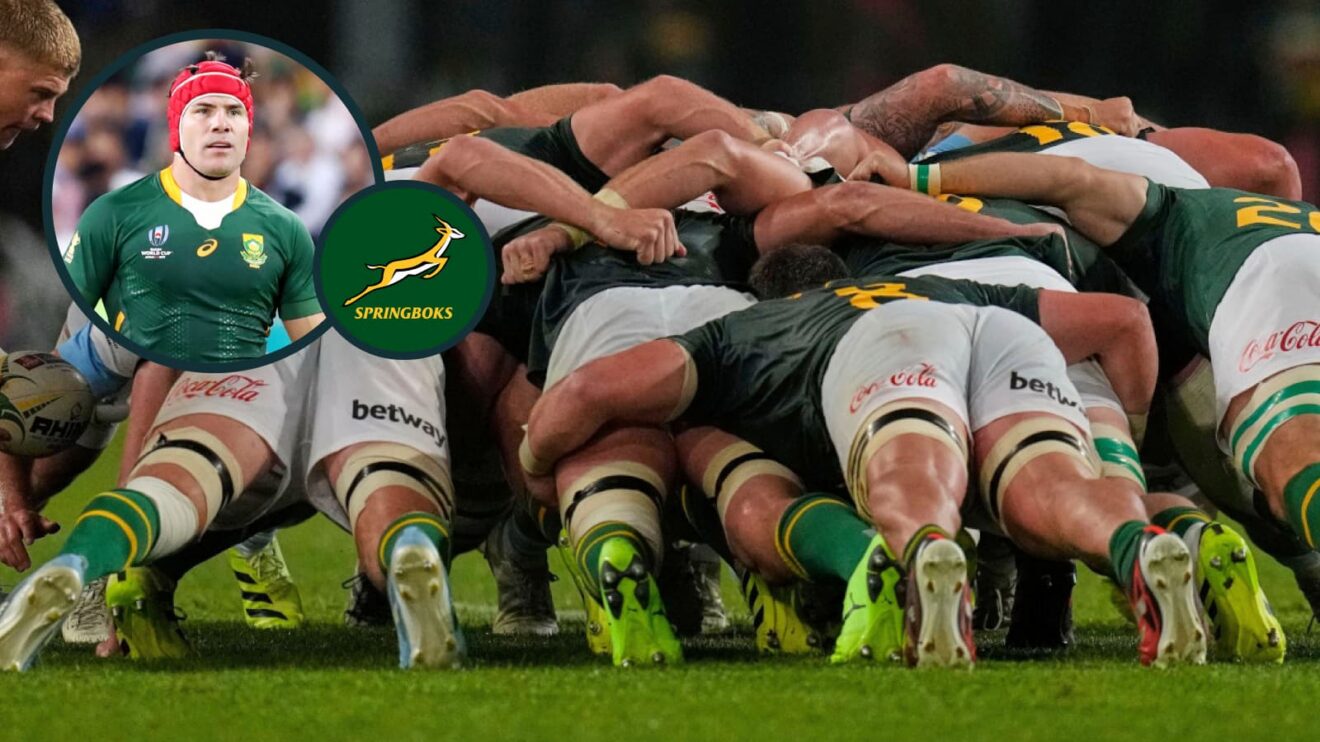
The Springboks scrum is one of the best in the world.
Ask most of the rugby world why South Africa scrummage as they do and you get an answer about genetics, farms, and red meat. Ask the men who did it and you get something far less romantic and far more useful.
I put this to Schalk Brits during the 2023 World Cup, in the days after Ox Nche had taken England apart in Paris. I’d expected the usual stuff about farm boys and heavy bones, but what I got instead was a conversation from the beginning of the Rassie Erasmus era that explains everything which has happened since.
The coaches had asked the front-rowers why South Africa were no longer as dominant at scrum time as the sides they grew up watching. The players pushed back with what they thought was obvious, which was that you can’t scrum for a penalty at every scrum.
“Rassie smiled and replied, ‘Why not?'”
That’s the whole thing: a coach declined to accept a limit that everybody else in the game had quietly agreed to, and nothing whatsoever about physiology came into it. If you’re fit enough and mentally prepared, Erasmus told them, it doesn’t matter whether there are two scrums in the match or 20. Fight for a penalty in every one.
Brits had a name for the doctrine that grew out of it. Previewing the France quarter-final earlier in that same tournament, he reduced South Africa’s method to three words: scrum, steal and smash. The order matters. The set-piece comes first because everything else in the Springbok game is built on the territory and the momentum it generates.
The myth of the bigger men
The convenient explanation is size, but that simply doesn’t hold up since I’ve never really seen a set of pack weights that supports it. Across the fixtures that produced the folklore, the two eights have been broadly comparable in mass, and South Africa have still won the exchange with ease.
Steven Kitshoff, who played in both of the scrums that have defined the England fixture this century, has spent his retirement trying to kill the same myth. The idea that props are pulled off farms, fed steak and pointed at the opposition amuses him, because it skips the part that actually matters. What South Africa have, on his account, is repetition, technique, belief and buy-in.
Brits made the same point from the other end. His front-rows were the wheels, he said, and the locks and flankers were the engine. Get it wrong at the front and you’ve wasted the work of five men behind you. That’s a description of a system, not a gene pool.
The numbers behind the folklore
Folklore is a poor basis for an argument, so here’s the evidence. Since Erasmus took charge in 2018, South Africa have won 60 of their 68 scrums against England, a success rate of 88.2 per cent. England over the same period have managed 33 from 44, at 75 per cent. The penalty count runs 23 to 12 in South Africa’s favour.
Widen it out and the picture holds. Across that period, the Springboks rank first among the leading nations for scrum success on their own feed, first for scrums won against the head, first for scrum penalties won per game and first for fewest conceded. That’s not a rivalry quirk or a run of favourable referees. It’s the most reliable set-piece weapon in the sport, and it has been for the better part of a decade.
The moments everyone remembers sit on top of that base. Four penalties from six completed scrums in the half hour Nche was on the field against England in the 2023 semi-final. Handré Pollard’s winning kick, which existed only because a scrum near halfway went one way rather than the other.
A scrum university
The mechanism, though, is cultural, and this is the part that other nations have found hardest to copy.
Brits described a training environment built to remove ego from the equation. In most set-ups, live scrummaging becomes a series of private duels, one man proving a point against his own team-mate. South Africa banned the instinct. Go as hard as you like within the laws, but if Nche got the better of Frans Malherbe on a Tuesday, Malherbe congratulated him, and then the group talked openly about why it had happened, how to repeat it on Saturday and how to stop it happening to them.
“Learning without blame in an open culture, a scrum university if you like,” was how Brits put it.
The same logic produced the 6-2 bench and everything that followed from it. Erasmus asked the front-rowers to stop thinking of themselves as 1, 2 and 3 and 16, 17 and 18, and to think instead of two units of equal standing. The pairings are chosen by who works best together, with height a significant factor, and the finishing front-row is lower and, as Brits put it, possibly less heavy than the one that starts. The purpose is to present a different technical challenge rather than a fresher version of the same one, so the opposition prop who has solved the first problem is handed another an hour in, when his legs have gone.
Then the detail that tells you how seriously they took it: Erasmus changed the win bonuses so they were shared equally regardless of minutes played. If two units are genuinely equal, the money says so. Very few unions have been willing to follow them that far.
Brits was blunt about the intent. They wanted opponents to dread the next scrum. They wanted their own smiles at the referee’s whistle met with groans. That’s why South Africa take the scrum from a mark or a free-kick rather than the safety of touch, because a side that believes it will win a penalty would rather have the engagement than the lineout.
The man in the middle
Daan Human replaced Matt Proudfoot after 2019 and refined the language again. Kitshoff’s shorthand for it is 16 feet on the ground and everybody scrummaging through the hooker’s shoulders, the man in the middle. Eight players driving through one point rather than eight players driving.
The value of that’s not aesthetic; rather, it makes the parts interchangeable. If everyone is drilled into the same shape, the identity of the loosehead matters less than it does elsewhere, which is precisely how South Africa run two front-rows without a drop-off and why the production line keeps delivering.
Human’s methods have become their own folklore. Asenathi Ntlabakanye and Jan-Hendrik Wessels were both sent to his farm outside Bloemfontein for private conditioning and scrum work, Erasmus posting the footage under the name Kamp Daandraad. Ntlabakanye shed somewhere between 15 and 18kg. He has described Human as a coach with little interest in talking and a strong preference for the work being done first.
Why the law keeps coming for it
Which brings us to the uncomfortable part, and the reason this deserves defending rather than simply admiring.
The scrum has been steadily depowered. The 30-second set-up clock, the protection of the scrum-half at the base, the drift towards free-kicks rather than penalties for technical offences: each change is defensible on its own and the cumulative direction is unmistakable. World Rugby is now weighing a further amendment that would give referees more latitude to withhold the yellow card when a pack is being repeatedly overpowered, on the argument that a side shouldn’t be punished for physical inferiority.
Want more from Planet Rugby? Add us as a preferred source on Google to your favourites list for world-class coverage you can trust.
Nigel Owens has made the case sympathetically, pointing out that a prop being shoved backwards isn’t necessarily committing an offence, but he has also made the counter-case, which is that weaker packs will collapse deliberately if the sanction is soft enough, and that separating the two demands a very experienced referee.
I’ll put it more plainly than a former referee reasonably can. Reducing the reward for scrummaging well isn’t a neutral technical adjustment. It transfers value from the teams who have invested in a skill to the teams who haven’t, and it does so in the one area of rugby where a smaller, better-drilled unit can still beat a bigger one. The Springboks didn’t inherit this advantage. They built it in a shed in the Free State and in Tuesday sessions where a beaten prop was expected to applaud.
Any amendment discussed at World Rugby’s Shape of the Game conference won’t be implemented before the 2027 World Cup in Australia.
Which leaves the sport time to work out what it’s actually deciding. If the Springbok scrum is a biological accident, an inheritance of size and soil, then containing it through law is housekeeping, a sensible correction to an unfairness nobody chose. If it was built, through a question asked in a team room in 2018, a training culture that removed ego from the contest, a bonus scheme rewritten so that finishing counted as much as starting and a coach running private sessions on a farm outside Bloemfontein, then reducing its reward is a different act entirely. It would mean legislating against the thing rugby claims to prize, which is a group of players doing the hard and unglamorous work better than anybody else has bothered to.