Sergio Parisse exclusive: I’m not being optimistic, unit for unit Italy are better than England… it’s time for them to show exactly that


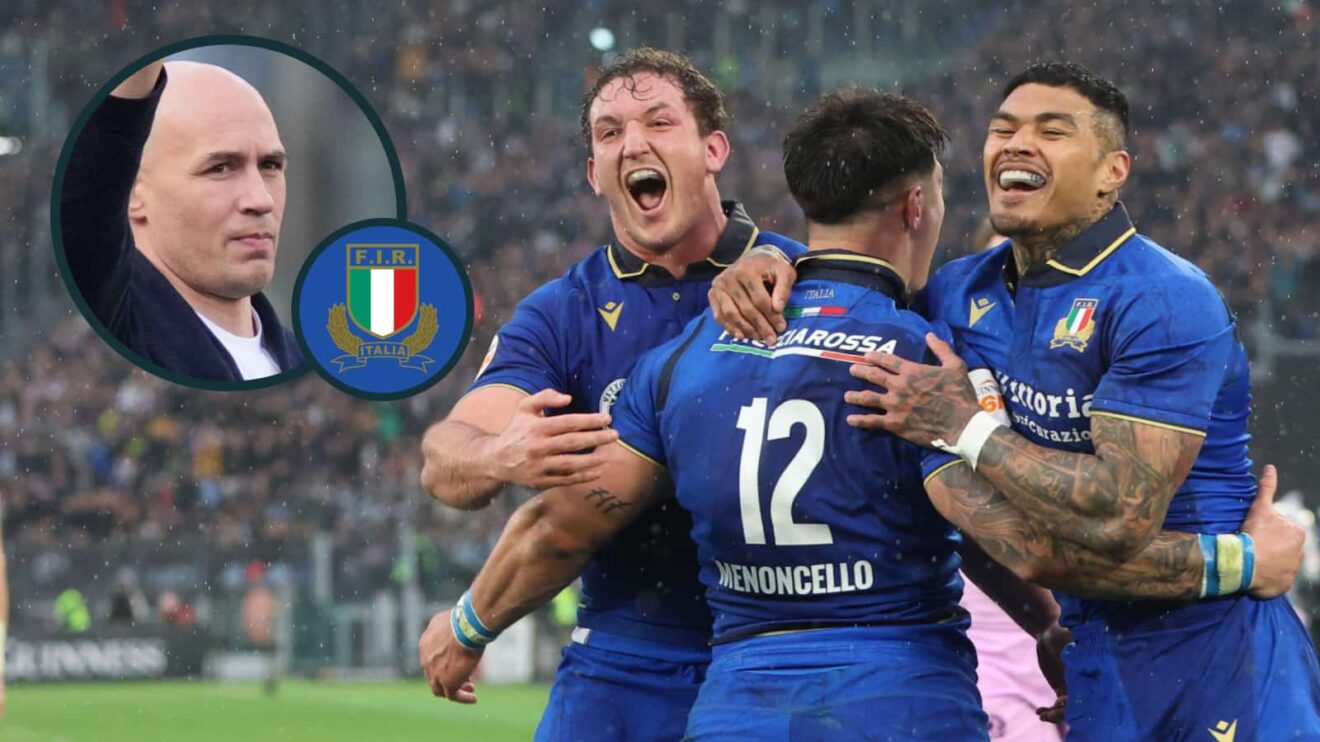
Tommaso Menoncello celebrates with his Italy teammates and an inset of Azzurri legend Sergio Parisse.
The man who played 142 Tests wearing the Azzurri blue on his back, who spent nearly 20 years as the most respected forward in the world whilst leading a team he once admitted were simply fighting to avoid the wooden spoon, now watches this Italian generation with something approaching wonder.
Sergio Parisse is not short of analysis; anyone who knows him knows he’s never short of it. But when he turns his focus to the Olimpico on Saturday, something sharpens in him. This is the match he always believed was possible; he just never quite got there himself.
There is a moment in the early days of this Six Nations when Italy’s identity shifted in public perception, quietly but permanently. It happened not in Rome but in Paris, where a French side of genuine world-class quality emerged from the Stade de France having just played what Antoine Dupont described as the most physical Test of the season, despite having won. Thomas Ramos said the same thing independently, that this was the most physical Test of their season, against Italy. When France’s superstars start volunteering that information, the argument about whether this Italian side deserves respect is settled.
New generation’s experiences
Parisse has watched it all with the particular lens of a man who knows exactly what the view looks like from the other side.
“What strikes me most about this Italian team,” he says, “Is that they are a completely new generation with completely different experiences to the one I was part of. I listened to Tommaso Menoncello and Michele Lamaro talking in the build-up this week about how this group came of age together, about how they watched us struggle, watched us fight every Six Nations simply to avoid the wooden spoon, and what was remarkable was that they didn’t say it with any sense of shame.
“They said it as their origin story. They understand where they came from. But they also know, absolutely and without question, that they are something else entirely now. They believe they can win; they have the reference points, the results, the performances to prove that they can win. They are no longer the whipping boys of this tournament and yes, they are fighting for a top-three finish.”
That sentence deserves dwelling on. Top three, in a Six Nations that contains France, Ireland and England. It is not bravado, because Parisse has been around long enough to deal only in facts. It is a statement of revised possibility, supported by the evidence of a team now ranked above both Scotland and Wales, having beaten both of them in recent Test rugby.
What makes Saturday so compelling is not simply what Italy bring, it is what this fixture has historically done to England, and what it no longer does.
“For the first time that I can remember,” Parisse says, “England are under genuine pressure coming into this game. And that is not a small thing. The dynamic has always been the same. England don’t really talk about the Italy fixture. It exists in their schedule, and they address it, but the conversation has never been about whether they win. It has always been about the margin. How many? That has been the question England ask themselves before coming to Rome. And for the first time, that question has changed. This is the first time England genuinely do not want to talk about the Italian threat, because the Italian threat is real and they know it.”
Rassie Erasmus doubles down on Italy praise and his ‘wouldn’t be surprised’ warning to England
Test rugby is decided by three things
That is a remarkable thing to hear from the man who endured that particular condescension more times than any other player in the history of the game.
The popular conversation heading into Rome has been dominated by the centre matchup, and the fascination is understandable. Nacho Brex and Menoncello are as good a pairing as exists in world rugby right now, full stop. Against them, Steve Borthwick has turned to a rookie combination in Seb Atkinson and Tommy Freeman, two players whose age group familiarity gives them more mutual understanding than you might initially assume, but who are at the start of a journey those two Italy centres have largely completed.
Parisse, though, is not interested in letting the narrative settle there. “I think the whole conversation about the centre matchup, as fascinating as it is, misses the real contest,” he says.
“Test rugby at this level is decided by three things, and it has always been decided by those three things. The set-piece. The breakdown. And who can defend. When you look at Italy through that lens, the picture looks very different to the one the media are painting.”
On the scrum, Italy’s advantage will worry Steve Borthwick. They won four penalties against the South African pack in November. The Springbok scrum is a renowned force, and extracting that kind of return from it requires genuine technical dominance. Parisse knows this territory intimately.
“Italy’s scrum is a weapon,” he says flatly. “Four penalties against South Africa in November tells you everything. That is not luck and it is not one good day. That is a front row with the technical quality and the physicality to dismantle one of the best scrums in the world – Simone Ferrari and Danilo Fischetti are both world-class operators and England will feel that on Saturday.”
The lineout presents a more complicated picture. Italy were exposed by France but competed credibly against both Scotland and Ireland, and there is a telling subplot in England’s team selection. Borthwick has opted for Jamie George over Luke Cowan Dickie, widely considered the superior scrummager, with the selection call rooted primarily in lineout architecture.
England are travelling to Rome with two primary jumpers against Italy’s four, and the arithmetic of that contest, should Italy’s driving maul become a platform in the closing quarter, is uncomfortable.
“I find it very interesting that England have gone with Jamie George ahead of their better scrummager,” Parisse says. “It tells you what England are worried about. They’re trying to shore up their lineout and they know they’re facing a significant threat there. But four jumpers against two is a substantial difference in an 80-minute contest, and Italy will really look to push an advantage there.”
The breakdown and England’s leadership
It is the breakdown and the collision work that Parisse returns to with the most conviction, and this is where his analysis cuts deepest. “What people don’t always appreciate about this Italy side is how extraordinary their standards are in the parts of the game that don’t look spectacular but win Test matches,” he says.
“We call it no skill excellence,” he grinned.
“I’m talking about their ability to get off the floor immediately, to reset, to get back into the defensive line and repeat that at the same intensity from the first minute to the last. The willingness to compete physically for eighty minutes without any drop in that standard. As noted earlier, Dupont said after Paris that it was the most physical Test of France’s season and Ramos said the same thing. France won that game. But the two best players on the pitch were still talking about the Italian physicality in the press conference afterwards. That tells you precisely what level this team operates at.”
England’s breakdown record under Borthwick has been a contested area throughout this championship cycle. Italy’s capacity to generate turnovers, slow ball and reverse momentum at the ruck will test a team whose attacking identity depends on continuity and tempo.
“England want to play high-possession rugby,” Parisse notes. “But they are playing that game against a side with arguably a greater jackling threat, a greater steaming threat at the breakdown than they themselves have. Italy can take that ball away. And when you take the ball away from a high-possession team, you don’t just stop one phase. You change everything about how they function.”
The leadership question surrounding England is one Parisse raises with what sounds like genuine curiosity rather than point-scoring.
“Nine new players coming into this squad is significant,” he says. “And I think the question that hasn’t been fully answered is, when England are under pressure in Rome, when Italy start hot and the crowd is behind them and things are not going to plan, who in that back line stands up and changes it? Who looks at what’s not working and has the authority and the clarity to do something different? England have, throughout this tournament, shown a tendency to stay within their own system even when the system is struggling and to fail to feel the emotional rhythm of a Test match.
“Italy’s leadership group does not have that problem. Menoncello and Brex are both exceptional leaders. The pack is full of experienced Test players who have been in difficult moments and come through them. Lamaro, Fischetti, Cannone, these are players who know how to play their own game regardless of what the scoreboard says.”
Azzurri’s attack and shot at history
Italy’s attacking architecture is more nuanced than their critics still allow. The opening phases will see Menoncello used hard in the 12 channel, crashing into contact to occupy England’s centres and establish the physical toll that compounds over eighty minutes. Then the picture changes.
“After those first phases, Brex and Garbisi split wide,” Parisse explains.
“So Brex defaults to the 12 position and suddenly Italy are attacking both sides of the pitch simultaneously. That is a very different problem to solve. England predominantly constructs play around the left channel. Italy will go left and right. They will use the whole field. And against centres who are still finding their feet at this level, that width and variation is extremely difficult to manage.
“Tommy Freeman’s defensive positioning is a specific vulnerability. Freeman has a tendency to get narrow, which we saw against Ireland. He drifts infield. Italy know that. In the first and second phase, they will use Menoncello in the channel closest to him to fix his eye-line, and then they will go around him. He is facing two of the best centres in the world, and he is doing it in a game where the margin for individual error is as small as any he will experience in his career.”
Parisse ends where he must end, because he is both analyst and participant in this history, and the history is inescapable. Italy have never beaten England. Not once. Every year that has passed in which Italy competed and came close but did not find the result has added a layer to the weight of that fact.
“I know this road,” Parisse says quietly.
“Italy have gone into England fixtures with a great deal of confidence before. I was in some of those teams. We believed we could win. And we didn’t. I know how that feels.
“Which is exactly why I want to be precise about what I am saying now, because I am not simply being optimistic, I am looking at this Italy side and I am telling you, unit for unit, they are a better team than England.
“The scrum is theirs, the breakdown is theirs. The centre combination is without question one of the finest in world rugby. And the leadership in this group is real. It has been tested and it does not flinch.” He pauses.
“This would be one of the biggest scalps Italy have ever taken, because England are a side we have never beaten. The history of that is enormous, but this team has the quality and the belief and the strength in every department to end that history on Saturday. It is time for them to show exactly what they are.”
He has waited a long time to say that and mean it. At the Olimpico on Saturday, a generation of Italian players who grew up watching Parisse fight simply to stay off the bottom of the table will have their chance to prove him right.