Schalk Burger: The ‘either-or’ solution for where the Springboks are ‘still weak’



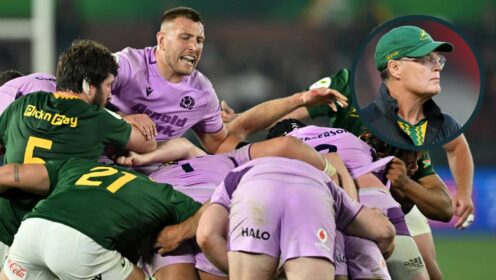
Springboks centre Jesse Kriel and an inset of Schalk Burger
Schalk Burger says that the Springboks’ attack is still faltering and that needs to be addressed before the third Rugby’s Greatest Rivalry Test match in Soweto.
South Africa levelled the series in Cape Town last weekend, securing a 33-26 victory over New Zealand after they were defeated 33-16 at Ellis Park the week prior.
While Rassie Erasmus’ men did emerge victorious in the Mother City, Dave Rennie’s team still scored more tries than the hosts, which was obviously the case in the first Test as well.
Ultimately, it was Cheslin Kolbe’s accurate boot that got the Springboks over the line in the second Test, with the winger keeping the scoreboard ticking over with three second-half penalties. South Africa led by 10 points at the break, and while they conceded two tries in the second 40 minutes, Kolbe’s accuracy meant that the Boks didn’t have to go in search of tries.
Still, the statistics heavily favoured the All Blacks at the final whistle, with Rennie’s side making more running metres, having more possession and territory, and making more line breaks.
Fast start but there is still a weakness in South Africa’s game
That raised the question from ex-centre Jean de Villiers as to how the Springboks won the match despite the All Blacks dominating the stats on the Verdict show.
The answer was simple from Burger: “Scoreboard pressure.”
Fellow ex-Springbok Hanyani Shimange agreed and added: “They had to chase the game at the end. So they’re naturally going to dominate the stats; you’ve got to look at it in context.”
Burger added that Rennie’s side started to panic, particularly after half-time, but also said that they failed defensively in the opening minutes of the match as they knew exactly what was coming their way from the Springboks.
“I think for New Zealand, at the start of the second half there was a bit of panic. So they started playing from deep,” he explained.
“Like Malcolm Marx was obviously exceptional when he came on in the 35th minute. His turnovers and that scoreboard pressure made them chase the game, and they started playing from a little bit too deep. In saying that, our first set was incredible. But like, if you’re a New Zealander, what do you expect from the Boks on the 22? It’s going to be a maul. They dominated them with a 25-metre maul: first carry Jasper Wiese, second carry Siya Kolisi, third carry Jesse Kriel; too easy.
“Not a single proper shot was put on the Springboks, and you know it’s coming. They knew they were going to be direct, and it’s almost like the Boks went a little bit old-school, like we were so physical.”
That was mighty effective, and the second Boks’ try came in a similar manner to the first, as Damian de Allende forced his way over the line, while the only real difference for the third was that it was sourced from a scrum, not a lineout.
‘Well done to World Rugby’ – Rassie Erasmus praises law change that is ‘working all teams’
Where the Springboks need to improve
While Burger was impressed with Erasmus’ men overall, he warned that they have to improve if they are to go 2-1 up in the series in Soweto. He pointed to the inaccuracies in attack both in possession and with turnover ball.
“Areas, on attack especially, where I think we are still weak is that we don’t have that fluency. You could see every time we try to pull it out the back, the error came, but also what that leads on to is whenever we create that unstructured play by the contestable and winning that contestable – You think of Eben Etzebeth and Cheslin Kolbe – even there,” he continued.
“If you think in the past how quickly we were to set that shape off the unstructured play and find the right ball carrier that has an option of dominating contact, have the skill set to play it out the back, play the tip, or the inside ball. In that case, they found Thomas du Toit wandering out of nowhere, and he actually turned around to give it like a basketball pass, but we don’t set fast enough on those transition plays.
Want more from Planet Rugby? Add us as a preferred source on Google to your favourites list for world-class coverage you can trust.
“It’s almost like for a few weeks now, the focus is somewhere else instead of an all-out attack going. The All Blacks scored nine tries in two games; you’ve got to assume they’re scoring 30 points this weekend again, and the Springboks would have to discover their attacking flair or sort out their defence – either or.”
Rassie Erasmus hints that Springboks could repeat controversial selection ploy
Difference in tactics
De Villiers added that South Africa are still making ‘a lot of handling errors’ with the men in Green and Gold conceding 15 turnovers in Cape Town.
Shimange argued that the tactics of the two teams mean that there is bound to be a difference in the stats, with the All Blacks willing to keep ball in hand in areas of the pitch where the Springboks would kick contestables.
“We are never going to make more passes than New Zealand,” the former hooker said.
“In that middle third area, they want to play for a penalty, so they’ll keep the shape and keep going, keep going, keep going until you make a mistake, a line break, or then they look to kick if the defence is really good.
“We generally get into their one-two rucks, fade a contestable, or we kick a box kick up and try to get the ball back from then on. So it’s two different strategies; hence, possession is more, and territory is the surprising one for me, but that also comes down to penalty count and the long kicking game.
“So you’ve got to give it context and look at the game itself. It’s just two different strategies. We will never burn rucks or burn phases in that middle third area of the field.”