Law discussion: The referee’s explanation that clears up Ruben Love’s yellow card in the All Blacks’ defeat


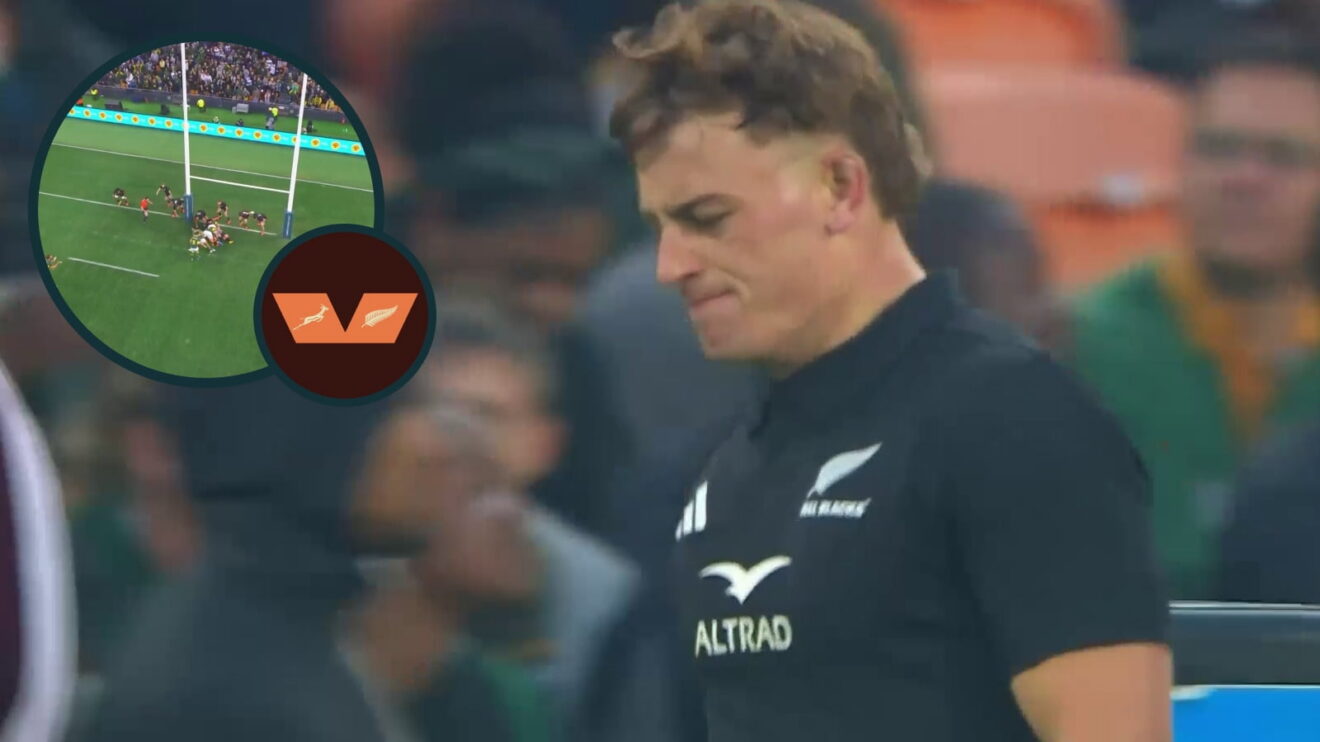
All Blacks fly-half Ruben Love.
Ruben Love’s yellow card in the All Blacks’ 29-24 defeat to the Springboks has left many fans and pundits baffled.
The New Zealand fly-half was sent to the sin bin in the 35th minute of the third Rugby’s Greatest Rivalry Series match in Soweto after being deemed offside at the breakdown.
The incident occurred after Cobus Reinach had ripped the ball off Asafo Aumua, which sparked a Springboks attack from turnover ball inside their own half.
A phase later, Reinach whipped the ball out to Jasper Wiese, who powered through the attempted tackles of Tupou Vaa’i and George Bower before offloading to Ox Nche, who stunningly held onto the ball and passed to Manie Libbok.
Libbok sped away into the All Blacks‘ 22, evaded the tackles of Damian McKenzie and Peter Lakai before stumbling towards the tryline and was tackled by Will Jordan. After the ensuing ruck, referee Nika Amashukeli indicated that the Springboks had a penalty advantage as the ball was spun out to Jesse Kriel, who scooped it up from the deck and sidestepped Ruben Love.
Jordie Barrett chopped down the centre just short of the line, and Love was involved again, standing right next to the ruck. He launched himself at Nche, who was next to carry, and the prop was denied a try courtesy of the efforts of Sam Darry and McKenzie.
The front rower was clearly held up as Amashukeli went back for the Boks’ penalty while calling Love over and issuing the fly-half with a yellow card as he was deemed to be offside.
Confusion around Ruben Love’s yellow card
This is where the confusion online is, as many believed that it was Love who was penalised for offside when Libbok went to ground.
“How is Ruben Love off sides here? And a yellow? Ooof that’s tough,” one comment on social media platform X read. “Such a well timed run from the goal line on D. Referee with his back towards Love.”
Writer Ben Smith weighed in: ” Ruben Love became the first-ever player to be sent off for being onside! Congrats Ruben! Sacha, two professional fouls; he’s got to go! Cobus also!”
While another comment slammed the referee’s decision: “Ball has been picked up to clear here. That’s an absolutely disgraceful decision. A yellow card!!! He wasn’t even offside.”
However, referee Amashukeli explained his reasoning perfectly amid the continued commentary of former Springboks Jean de Villiers and Hanyani Shimange on SuperSport, with the broadcasters cutting the replay of when Love was actually offside.
“The first offside was by 13 (Quinn Tupaea) there,” the Georgian said in reference to the breakdown pictured below.
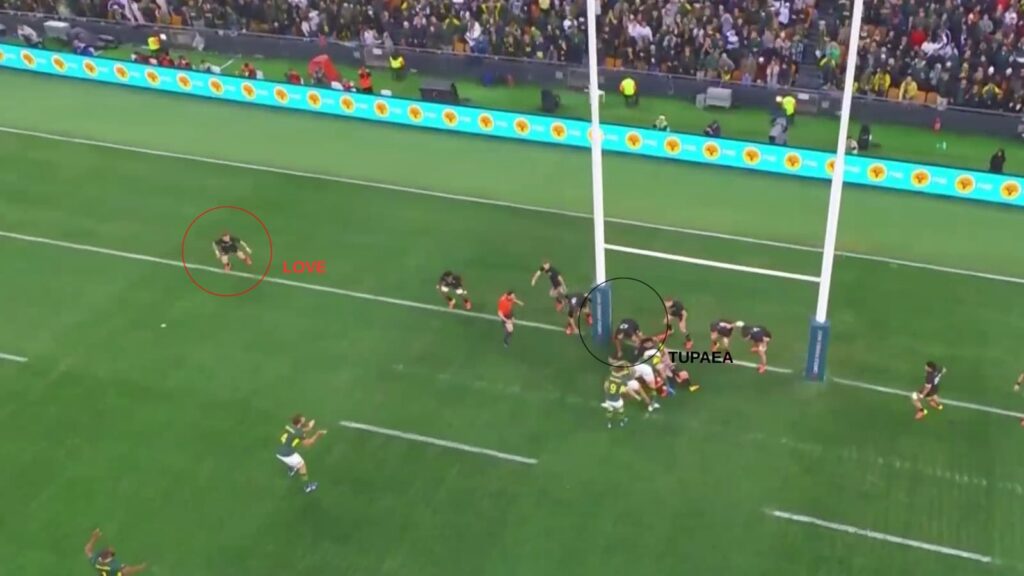
Quinn Tupaea offside – first penalty (image credit: Sky Sports)
He added, “Then you are offside here; that’s a yellow card.”
As seen below, Love’s right foot is in front of the tryline when Nche first puts his hands on the ball and therefore the All Black was offside. This is where the fly-half was sanctioned and at the aforementioned breakdown.
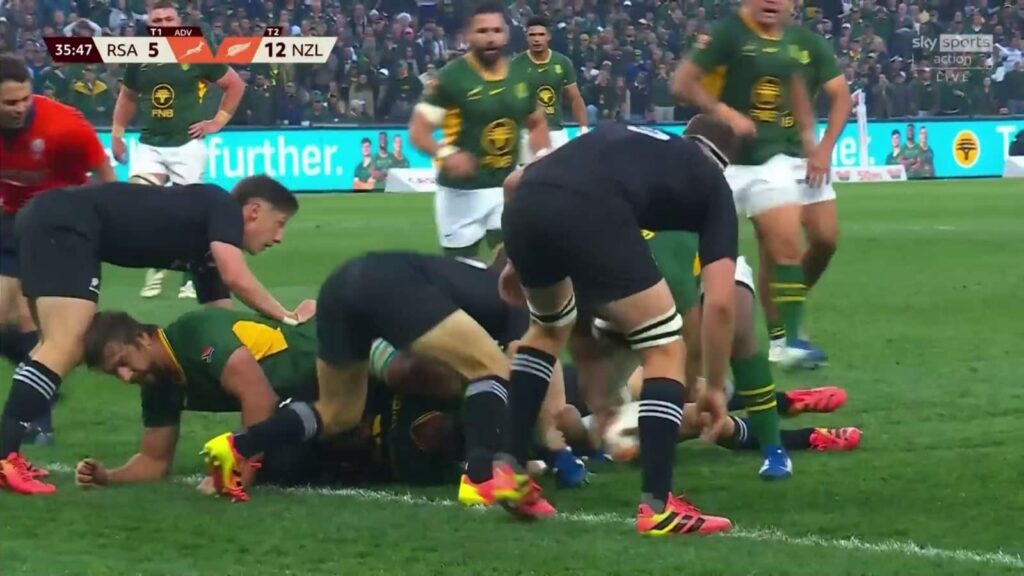
Ruben Love offside – second penalty (image credit: Sky Sports)
Ultimately, the confusion stemmed from screenshots of the incorrect breakdown being shared on social media, with the commentary team speaking over Amashukeli as he explained the sanction.
The referee was also well within his rights to issue the yellow card because the All Blacks had cynically infringed in an attempt to stop the Springboks’ attack.
Also, in accordance with World Rugby laws 9.8 to 9.10 concerning repeated infringements, which read:
“9.8 A team must not repeatedly commit the same offence. Sanction: Penalty.
“9.9 A player must not repeatedly infringe the laws.
Sanction: Penalty.
“9.10 When different players of the same team repeatedly commit the same offence, the referee gives a general caution to the team, and if they then repeat the offence, the referee shows a yellow card to the guilty player(s).”
Want more from Planet Rugby? Add us as a preferred source on Google to your favourites list for world-class coverage you can trust.
While the actions of Tupaea and Love initially stopped the Springboks from scoring, the hosts did get seven points soon after as they dominated New Zealand at the ensuing scrum.
Why the All Blacks weren’t yellow carded again
Amashukeli rewarded the set-piece dominance by awarding the Boks a penalty try after the All Blacks’ scrum denied the hosts a try-scoring opportunity.
Law 8.3 reads: “A penalty try is awarded between the goal posts if foul play by the opposing team prevents a probable try from being scored, or scored in a more advantageous position. A player guilty of this must be cautioned and shown a yellow card or sent off. No conversion is attempted.”
However, many were perplexed as to why the official did not issue another yellow card to an All Blacks player after he awarded the penalty try. He also explained this point to Siya Kolisi.
“It’s not going to be a yellow card because it’s a group infringement,” Amashukeli explained.
As per the above, the referee would need to single out a player who infringed, but on this occasion, he deemed it a collective penalty.
Furthermore, the All Blacks were awarded a penalty on halfway as per the lawbook as Reinach had tipped Cam Roigard over after Amashukeli had awarded the penalty try to the Springboks. Had the incident occurred before he had signalled for the penalty try, the referee would have been in his rights to overturn the decision and award New Zealand a penalty instead.