Brian O’Driscoll provides insight into TMO set-up after Bordeaux-Bath dispute as Champions Cup doesn’t use ‘gold standard’ operation


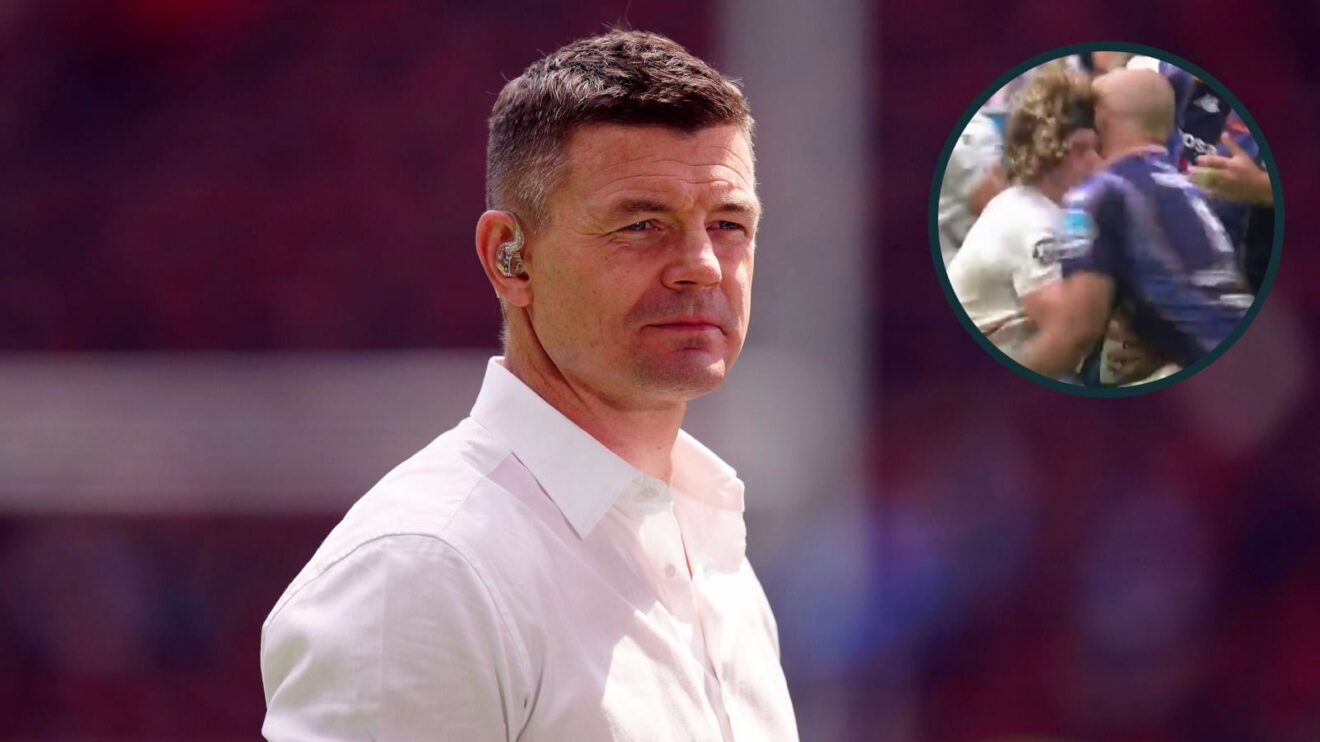
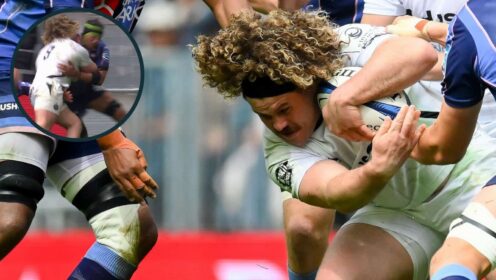
Ireland legend Brian O'Driscoll and Maxime Lucu collision with Alfie Barbeary.
Ireland legend Brian O’Driscoll has stated the TMO for the Investec Champions Cup semi-finals will not have had the best set-up when it comes to getting the most accurate decisions.
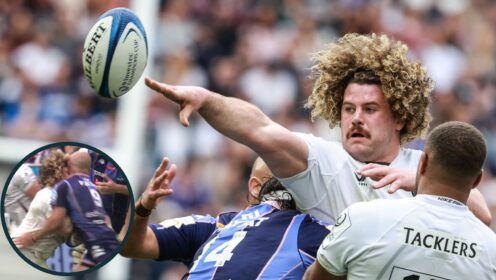
Controversy reigned during the Investec Champions Cup clash between Bordeaux-Begles and Bath where at least two hits on Alfie Barbeary were not reviewed.
Blame has been placed both on the French director and the officials with question marks over how the system works and whether it is effective.
O’Driscoll, who regularly works in these games as a pundit and co-commentator, duly gave some insight into how they work.
TMO ‘listens to the commentary’
“I spoke to a director friend today to understand. There are different processes depending on different competitions and different broadcasters but my understanding is, certainly with TNT and Premier Sports, the TMO sits in the truck,” he told Off The Ball.
“They will be listening to the commentary.”
Host Eoin Sheahan then interjected, raising the issue of the TMO listening to the commentary when watching the game, suggesting that it could result in them being influenced.
“That’s mad in itself, that they have to, not be subjected to it, but there is a theme coming through that they’re exposed to. Should they not be watching it completely devoid of any commentary? Any audio in fact?” Sheahan asked.
O’Driscoll responded, “Yeah, probably”, but did provide a caveat, adding: “Are we not trying to get to the right decision? Does it matter how you’re getting to the right decision? Whether you’ve got intel from someone going, ‘oh, I’m not sure about that’, and then you have a chance to check.
“As soon as a contentious issue comes to pass and a decision has to be made, all comms is cut and it goes on the big screen and then there’s communication between referee and the TMO.
“The TMO is speaking to the director over the course of the game, behind the scenes as well because he will key in, going ‘I want to have a look at that, can I have a look at that?’ Because they don’t want stoppages the whole time.
“There’s that communication piece going on the whole time and will be calling in different angles because they don’t have operatives with them.
“They are reliant on the director to give them the necessary angles that they are looking for. They have a real-time screen and they’ve got a delayed screen as well.”
Differences for Six Nations and Rugby World Cup
That appears to be the set-up for the recent Champions Cup semi-finals, but it is different for the Six Nations where the TMO gets more help and independence, albeit they’re still at the behest of the local director.
“It changes for Six Nations, they have their own truck or porta cabin on site, they have their own operatives, but yet, when it comes to decision-making, there’s still a reliance on the host broadcast director to be able to run those pictures in when they’re looking for different angles, rather than the operatives,” O’Driscoll said.
It is only at the Rugby World Cup where the local broadcaster does not come into play with O’Driscoll stating: “There are operatives and almost a director is secondary to the operatives, so when foul play or a contentious is to be decided with the referee, the operatives, the TMO, the referee and a separate director collaborate, so the match director is kind of irrelevant.
“That’s perceived to be the gold standard.”
READ MORE: Andy Goode’s ploy to ‘eliminate inconsistencies’ amid French TV debacle: ‘Rugby is so muddled’