State of the Nation: Scotland


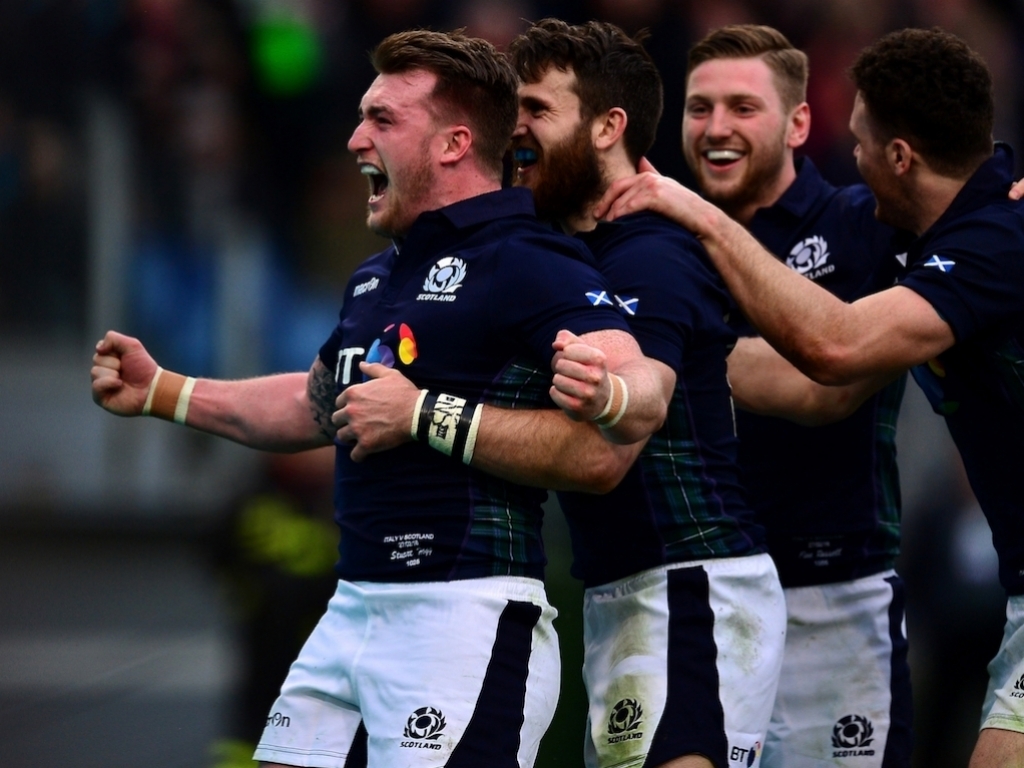
Scottish rugby press conferences have long read like the movie Groundhog Day – a dull exercise in perpetuity.
Were he a man to engage in such frivolous pursuits, Vern Cotter could probably pen a highly accurate script for these gatherings – matching questions he’d be posed, and from whom, with a withering retort.
The problem is, until very recently, those questions have remained as valid as they were when Cotter took over from Scott Johnson. Or when Johnson – whom, one suspects, had Cotter inputting from afar – hauled Scotland through a mortifying “transitional” 2014 championship. Or when he in turn took the wheel after Andy Robinson’s reign detonated with defeat to Tonga in Aberdeen.
Talk of “character” features heavily these days. The odd “courage” will crop up, so too “accuracy” is a staple. But the latest, and most poignant, press box de rigueur is the mantra of “progress”.
Ah, progress. We hear so much about the strides this Scotland squad are making behind closed doors. Stick with us, they say. Trust us; we’re getting there.
That agonising refrain persisted all the way through last year’s Six Nations whitewash, where Scotland fell short in several very tight fixtures, until Ireland’s utter dynamiting of Cotter’s troops on the final day.
Scotland were doing plenty right, but the things they did wrong were maddeningly recurrent and deeply punitive. Then came the World Cup. A botched lineout and a sickening penalty call – let’s not go there – denied them a semi-final.
At the climax of this year’s Six Nations, the evidence of progress is abundant. Two victories, rather than a cursory grind past Italy, or worse, is a small but significant step.
It also afforded the press corps the opportunity to put some novel questions to a winning Six Nations coach and captain.
Scotland are playing Cotter’s way, and it suits them. They’re finishing more chances and scoring more tries. A final tally of eleven sits two higher than in any previous championship, and is at least four greater than any since 2005. The scrummage, spearheaded by Al Dickinson, Ross Ford and Willem Nel, has evolved into a potent machine.
The midfield, once the threadbare scourge of Scottish rugby, is now laden with international-standard options, each with different strengths and profiles.
In John Barclay and John Hardie, Cotter has two of the best fetchers in Europe, and in Stuart Hogg, the tournament’s form full-back.
So, where do the failings persist?
In the Six Nations, probably more so than any other tournament, lapses and errors, however small, are catastrophically expensive.
The teams, on the whole, are matched so equally, that there aren’t many hammerings. Only six of the 15 tournament matches this year were decided by more than 10 points – and four of those involved Italy.
So, if you bungle a lineout on your own line, as Scotland did in the lead-up to Jamie Roberts’ try in Cardiff, you are likely to pay a dear penalty. Likewise if you miss tackles, as four Scots did when George North slalomed his way to the whitewash.
Or if your fielding of a kick veers into slapstick territory, as it did for Keith Earls’ try last weekend. Or you concede – justly or not – two yellow cards, or fail to capitalise on attacking impetus, as occurred in Dublin.
Barclay and Hardie, meanwhile, are terrific weapons to wield at the breakdown. They are also fine rugby players in open play. But they become so entrenched in the fetching and spoiling and general nuisance around the contact area, that a bruising, hard-yards carrier like Dave Denton, Josh Strauss or Adam Ashe is an essential foil.
That lack of ballast – especially with Jonny Gray injured – was particularly damaging against Ireland, where Jamie Heaslip and CJ Stander made hay in midfield. The Irish too, masters of streetwise rugby, exploited a lingering streak of naivety in Scotland’s game, not always legally, but effectively. That, you hope, will be eradicated with time and Test minutes.
A June voyage to Japan beckons now, an opportunity for Cotter to shuffle his deck and see what latent aces might lie within.
He should unquestionably leave Dickinson, Ford and Nel at home. They’ve had enough rugby for one season. He should leave behind Hardie, Gray and skipper Greig Laidlaw too.
It’s time to turn loose the likes of Ashe, Rory Sutherland, Sam Hidalgo-Clyne, Ben Toolis and Stuart McInally, all fine players lurking on the fringes of the Test squad.
A return for Mark Bennett, jettisoned from the international squad, would not come as a surprise. And Damien Hoyland has been a dangerous rapier on the Edinburgh wing.
Teen prodigies like Jamie Ritchie, Scott Cummings, Blair Kinghorn, or even Adam Hastings may also enter the fold – each has made tremendous strides, absorbed the rigors of senior rugby in their first real tilt at a professional season.
Piecing together Lions XVs a year out from the tour is generally a horrible waste of time and brain cells, but on their tournament form, you could make a compelling case for half a dozen Scots to make it.