Opinion: Boks must address fly-half issue in 2022



Handré Pollard’s move to Leicester as well as the development of several fly-half alternatives may address one of the Springboks’ most pressing problems.
Earlier this month, Leicester confirmed that Pollard will join the Tigers ahead of the 2022/23 season. After a couple of years with perennial stragglers Montpellier, Pollard has decided to further his career at a club with the potential to win the Champions Cup as well as the Premiership.
There’s more to be gained by the move, however, than another winners’ medal. The Bok fly-half, who has already won the Rugby Championship, the World Cup and, more recently, a series against the British & Irish Lions, could take his game to the next level after spending some time with Steve Borthwick’s ambitious Tigers.
Pollard’s place in the South African squad is not in jeopardy. The senior players within the setup, as well as the coaches, often pay testament to his leadership. If he stays fit, he will wear the number 10 jersey when the Boks travel to France in 2023 to defend their to World Cup title.
Work to do
And yet, it’s fair to say that Pollard and the Bok backline have work to do in the Tests leading up to the next global tournament. While South Africa won some big games in 2021, their attacking execution and overall game management let them down in other fixtures against Australia, New Zealand and England.
Perhaps a stint with an English club will provide one of the Boks’ key players with a golden opportunity to improve. Faf de Klerk boosted his game management skills after completing a move to Sale Sharks in 2017, and ultimately developed into one of Test rugby’s most well-balanced players. Pollard could take similar strides in 2022 and beyond.
It would be harsh to blame the player himself for a lack of progress over the past 12 months. Pollard sustained a serious knee injury in September 2020. When he returned to action for Montpellier in May 2021, insiders feared that he would struggle to regain his previous form.
To an extent, those fears were realised when Pollard – and the team itself – blew hot and cold over the course of the Test season. As many of the coaches and players admitted afterwards, the long period spent living and training in bio-secure environments had a negative impact on performances.
New head coach Jacques Nienaber still managed to grow his squad over the course of a challenging year. At fly-half, however, Nienaber relied primarily on Pollard. Elton Jantjies travelled with the team as the official back-up, while Morné Steyn served as third-choice for the Lions series and Rugby Championship.
It’s a policy that requires revision ahead of the 2022 season. Injuries are a part of Test rugby, and it’s only a matter of time before South Africa’s depth is tested.
As things stand, they are not equipped to cope if both of their existing Test options succumb to injuries. While Rassie Erasmus and, more recently, Nienaber have done an exceptional job of creating depth in every other position, they have struggled for long-term solutions in this department.
Only three fly-halves have been backed in a starting capacity since Erasmus and Nienaber returned to South Africa to coach the Boks in 2018.
Springbok fly-halves: (Test starts 2018-2021)

Pollard played most of the matches over the 2018 and 2019 seasons, and was entrusted with the responsibility to start against big opponents such as the All Blacks and England.
By contrast, Jantjies started seven of the 26 games in that two-year period. He did not feature at all in the 2019 World Cup play-offs – as Frans Steyn was listed as the official cover on the bench for multiple backline positions.
In 2021, Pollard started in 11 out of 13 Tests. Jantjies featured in five Tests – but only in two as the starting 10.
Morné Steyn came off the bench in the third Test against the Lions to kick the winning points and clinch the series for South Africa. The decision to back the 37-year-old veteran in the short-term was inspired, but it hasn’t addressed the team’s lack of depth at 10. Steyn has since retired from international rugby.
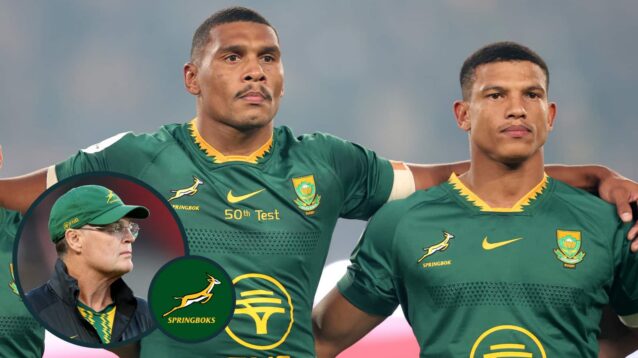
Damian Willemse and Frans Steyn have been listed as the alternatives to Pollard and Jantjies in recent years, but are unlikely to start in that channel in the lead-up to the World Cup. Willemse has only ever started at number 15 for the Boks, while Steyn has started at 12 and 15 since returning to the South African set up in 2019.
Johan Goosen recently returned to South African rugby after a lengthy stint in France. Goosen certainly has the experience, having first featured at 10 for the Boks in 2012. If the versatile Bulls player travels with the 31-man squad to the World Cup in 2023, he could also cover centre and full-back.
A couple of 20 year olds – Kade Wolhuter of the Stormers and Jordan Hendrikse of the Lions – have been marked for higher honours. Perhaps Nienaber should bring one or even both of these playmakers into the group sooner rather than later. After all, Pollard himself made his Test debut at the age of 20.
Will Nienaber have sufficient time to develop several fly-half options, though? The Bok coach has made the point that fewer than 20 Tests remain until the team leaves for France in 2023.
Will Pollard and the first-choice backline combination have enough time to implement the necessary attacking changes? Nienaber faces another dilemma with Jantjies, who desperately needs more game time. Does he back Jantjies more often over the next season or so, at the expense of younger alternatives that deserve a look?
2022 should provide some answers. Ideally, a fit and firing Pollard will start the big games for the Boks at the 2023 World Cup. Nienaber and company have to start planning for the worst-case scenario, though, to ensure that they are well equipped to handle a crisis.
Creating more competition for the number 10 jersey could bring out the best in Pollard, too.