Opinion: New South Africa-New Zealand ‘mini-series’ poses questions about Springboks’ future


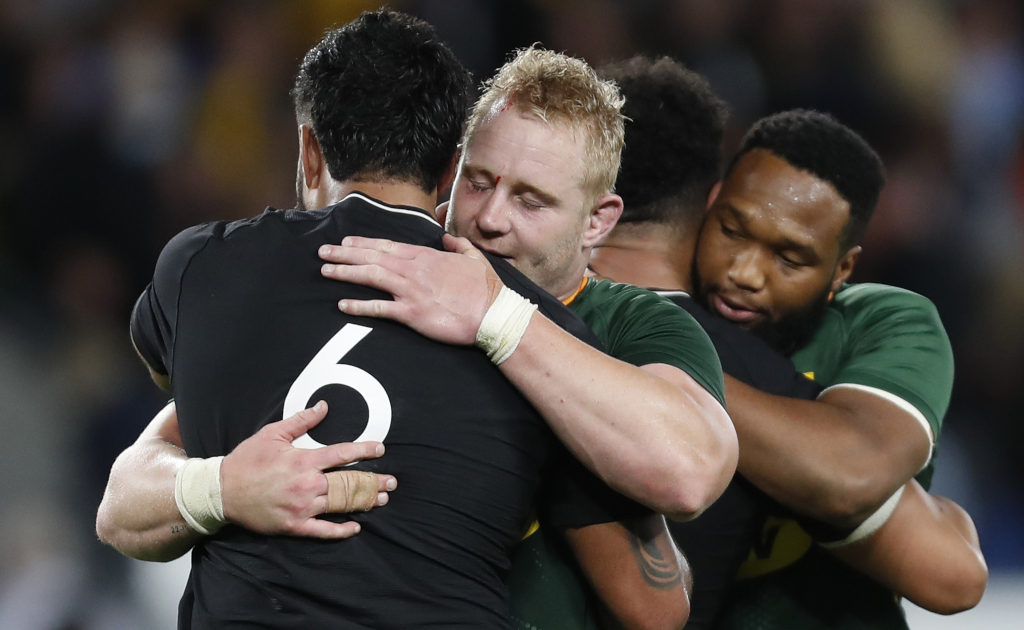
The Springboks could have their cake and eat it if they feature in an expanded Six Nations and in a revamped Rugby Championship after the 2023 World Cup, writes Jon Cardinelli.
The four biggest South African franchises have already joined the United Rugby Championship tournament, and will feature across the European Champions Cup and Challenge Cup competitions from next season onwards. Thereafter, the Boks could join the Six Nations in 2024, either by replacing Italy or by entering the tournament as the seventh team.
The latter is more likely to come to pass. While Italy have struggled to compete in the Six Nations – the Azzurri recorded their 34th consecutive Six Nations defeat when they lost to England on Sunday – they remain entrenched in the European structures.
Come 2024, England, France, Ireland, Italy, Scotland, Wales and South Africa could all be part of the same regional Test tournament. The competition will need to be restructured to accommodate a series of Bok matches in Europe, as well a one-match tour to South Africa for each of the European teams.
There will be challenges, with the tournament staged on two continents and during a time when European temperatures plummet and when the South African summer peaks.
Major plus to broadcasters
Commercially speaking, there is plenty to be gained from the new venture. The negligible time difference between Europe and South Africa is viewed as a major plus to broadcasters.
Rumours of an expanded Six Nations have been circulating since early-2020. The noise will continue to build in the lead-up to the next four-year cycle, when significant structural changes will be implemented.
What’s interesting to note is that SA Rugby has no desire to burn their bridges with Sanzaar – at least not yet.
Sources within SA Rugby have confirmed that the long-term goal is to have all of their teams competing in the major European tournaments – and that includes the Six Nations.
SA Rugby does not, however, want to lose its place at the Rugby Championship table. More specifically, the Boks don’t want to lose the opportunity to face their biggest rivals, the All Blacks, on an annual basis.
Last week, SA Rugby confirmed the Boks’ home fixtures for the 2022 Test season. While the northern-hemisphere rugby community pored over England’s loss to Scotland, the looming battle between heavyweights France and Ireland, and – to a lesser extent – the possibility of the Boks joining the Six Nations, the southern hemisphere focused on a revamped Rugby Championship structure and New Zealand’s two-match tour to South Africa.
After hosting Wales for three Tests in July, the Boks will play the All Blacks in back-to-back matches. The first clash will be staged at Mbombela Stadium in Nelspruit on August 6, and the second will take place at Ellis Park in Johannesburg a week later.
The All Blacks haven’t played a Test in South Africa since 2018 due to Covid-19 restrictions. They beat the Boks in Townsville last season, before losing to the world champions on the Gold Coast seven days later.
Most of the 2021 Rugby Championship was staged in Australia due to Covid-19 concerns. There have been calls to restructure the tournament for some time, though, and from this season onwards, the fixture list will change to accommodate ‘mini-tours’.
In the case of the Boks and the All Blacks, the former will host the latter in two matches in 2022. The Rugby Championship will scale down in 2023 – as is tradition in a World Cup year – but in 2024, when there is time for a full tournament, the All Blacks may have the chance to host the Boks in back-to-back Tests.

Insiders at SA Rugby have highlighted the twin-aims of the organisation. There is clearly an appetite for the Boks to feature in an expanded Six Nations. At the same time, there is a strong desire to retain the annual clashes with the All Blacks.
Some have pointed out that the Boks will only tour New Zealand every two years and that the All Blacks will visit South Africa during a similar time frame. The rarity of these matches will add to the sense of occasion – among the players as well as the fans. As is the case for a World Cup or British & Irish Lions series, no player will want to miss out on the chance to feature.
Recent speculation about the Boks joining the Six Nations in 2024, as well as last week’s confirmation that SA Rugby remains committed to the Rugby Championship in the middle-term, does raise some bigger questions though.
If the Boks do have their cake and eat it, how will this impact on the relevant clubs in Europe and back home in South Africa?
These teams are already losing their Boks in the July window, the August-September window (during the Rugby Championship) and the November window (during the Autumn Nations Series in the northern hemisphere). Can they afford to lose their Boks during the Six Nations window as well?
The issue of player welfare is far more important. Will the decision to straddle two big tournaments like the Six Nations and the Rugby Championship put the top South African players at risk?
Consider a possible schedule for the top Boks in 2024 and beyond. The players may join their clubs in late September, and then play for the Boks during the Autumn Nations Series in November.
They will play in the European Cup and domestic leagues in December and January before joining the national side again for an expanded Six Nations tournament that spans February and March.
Thereafter, they will return to their clubs for more European Cup and domestic league action until late June. From there, they will link up with the Boks for a series in South Africa in the July window, and go straight from that campaign into a Rugby Championship that ends as the northern-hemisphere season starts (late September).
There will be no opportunity to rest.
World Rugby – and indeed all of the major stakeholders – have some big calls to make about the structure of the season. The current model is unsustainable, and until there is a global season that promotes smarter player management and less conflict between club and country, the players as well as the product will suffer.
But at a time of significant change when all teams – at national and club level – are asked to make sacrifices, the Boks could have a particularly big decision to make.
Playing in both the Six Nations and the Rugby Championship doesn’t appear to be sustainable in the long term. Should the Boks abandon their plans to join the Six Nations, or should they forgo the opportunity to battle the All Blacks on an annual basis?
Is there perhaps another option to be explored? Could the Boks exit the Rugby Championship but continue to play the All Blacks regularly? And if so, where would those games fit into the schedule?
We won’t have any finite answers until the respective options are explored and the broadcast deals are finalised in the next two years.
What we know for certain is that a successful series between the Boks and All Blacks this August will highlight the demand for an annual match-up, and give the chief decision-makers more headaches.
READ MORE: Six Nations Team of the Week: Ireland and France lead the way after titanic Paris clash