Opinion: Eddie’s Springbok comments wide of the mark


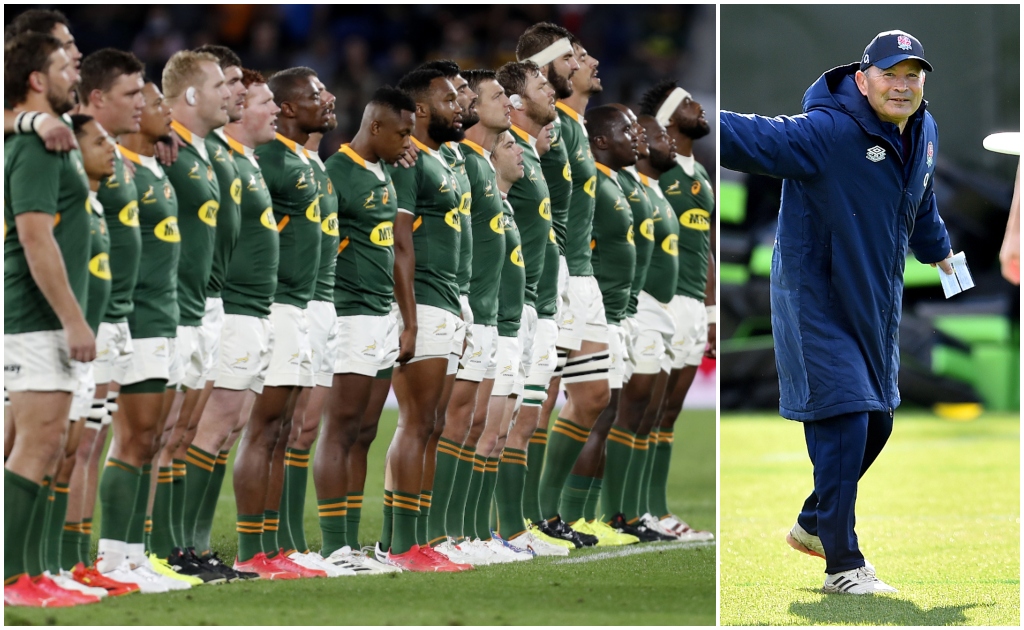
The Springboks will travel to the 2023 Rugby World Cup with a healthy blend of younger players and those in their rugby prime, writes Jon Cardinelli.
England head coach Eddie Jones was recently interviewed on Brian Moore’s Full Contact podcast. While Jones was given the opportunity to talk about his new book – and to explain his views about Marcus Smith and Maro Itoje – he was also encouraged to assess the major contenders for the 2023 World Cup title.
Jones spoke about the improvements made by each of the Six Nations teams, the revival of Australia, and the threat of New Zealand.
While he praised the Springboks for winning the World Cup in 2019 and then beating the British & Irish Lions in 2021, he suggested that the group may be past its best come the next global tournament in France.
“Any team that wins a World Cup and a Lions series in the space of two years is a serious, serious team,” Jones said, “But if you look at their age profile, they are getting older. Whether those players can sustain for another two years to the World Cup is a question.
“You’ve got [Duane] Vermeulen who’s 35. He’ll be 37 going to the World Cup. You’ve got a few others in their 30s.”
It was an interesting comment by a coach who usually has such a great command on the facts and figures.
The Boks certainly have work to do in the lead-up to 2023. That said, a closer look at the age profile of the current squad suggests that the majority of players will range between 25 and 32 at the next World Cup.
Springbok squad for 2021 Autumn Nations Series


Jones singled out Vermeulen, and one can understand why. Earlier this year, the number eight sustained an ankle injury while on duty for the Bulls in the Currie Cup. He was forced to miss the Lions series as a result.
After the series, Bok coaches Rassie Erasmus and Jacques Nienaber asked Vermeulen to stay on with the team until 2023. Having been denied the chance to face the Lions, and to exit the Test arena on his own terms, Vermeulen decided to push through to the next global tournament.
Since returning from injury this year, Vermeulen has been a key figure for the Boks, particularly on defence. The number eight produced a powerful performance on debut for Ulster against Clermont this past weekend.
Jones has questioned whether Vermeulen will be the same player in two years’ time. It’s a question that one could ask of just about any player in the game.
And with regards to Vermeulen’s advanced rugby age, there are numerous examples of players in their mid-to-late 30s excelling in big series and tournaments.
Victor Matfield was 38 when he travelled to the 2015 World Cup. Schalk Brits was the same age when he journeyed to the most recent global tournament in Japan.
Injured Boks who missed Autumn Nations Series

Jones suggested that the Boks will lean on their older heroes in 2023. Closer analysis of the current squad’s age profile, however, reveals that Vermeulen – and possibly Frans Steyn – will be the only individuals older than 35 at the next World Cup. Steyn has already said that the tournament may be a bridge too far.
As many as 18 players will fall into the 30 to 34 age category at the next World Cup, namely Willie le Roux, Makazole Mapimpi, Damian de Allende, Elton Jantjies, Faf de Klerk, Cobus Reinach, Franco Mostert, Pieter-Steph du Toit, Siya Kolisi, Kwagga Smith, Lood de Jager, Eben Etzebeth, Marvin Orie. Frans Malherbe, Steven Kitshoff, Vincent Koch, Trevor Nyakane and Bongi Mbonambi.
Of that group, only Le Roux, Mapimpi, Jantjies, Reinach, Koch and Nyakane will be older than 32.
Erasmus and Nienaber will have some big calls to make, particularly in the back division over the next two seasons.
With regards to the aforementioned forward contingent, their advanced rugby age should not be held against them. Indeed, their experience may prove invaluable at a World Cup staged in northern-hemisphere conditions conducive to brutal set-piece and breakdown battles.
That said, chances are good that a large proportion of the Boks’ World Cup squad will fall in the 25 to 29 age category.
Cheslin Kolbe, Damian Willemse, Aphelele Fassi, S’bu Nkosi, Lukhanyo Am, Jesse Kriel, Handré Pollard, Herschel Jantjies, Marco van Staden, Jasper Wiese, RG Snyman, Salmaan Moerat, Thomas du Toit, Ox Nché, Malcolm Marx and Joseph Dweba will be part of this group in 2023.
Nienaber has lamented the time lost to the pandemic – the Boks didn’t play Test rugby in 2020 – and the impact that loss has had on his plans for the four-year cycle.
And yet, it’s worth remembering that Erasmus and Nienaber joined the Boks in 2018 – less than two years out from the 2019 World Cup – and that they managed to implement a turnaround. They also blooded 20 new players before that global tournament and backed a number of youngsters.
Former Bok coach Jake White gave youngsters like JP Pietersen and Frans Steyn a chance in 2006, and later backed them to start the 2007 World Cup final. More recently. Erasmus selected Herschel Jantjies in the 2019 Rugby Championship and then picked the then 23-year-old for the World Cup final against England.
There is no shortage of young talent in South Africa at present. Tight forwards Jan-Hendrik Wessels and Ruan Nortje, loose forwards Evan Roos and Vincent Tshituka, scrum-halves Jaden Hendrikse and Sanele Nohamba, fly-half Jordan Hendrikse, centre Wandisile Simelane and wing Stravinho Jacobs are all 23 or younger.
Promising players like Grant Williams (25) and Johan Grobbelaar (23) spent much of the 2021 season in camp with the Boks without getting a game. Their time will come soon enough, though.
Jones is grasping at straws when he suggests that an over-reliance on ageing players will compromise the Boks in 2023.
The age profile of the current squad confirms that South Africa are well placed to strike a healthy balance between exciting youngsters and grizzled veterans. What’s more, there’s a good chance that more youngsters will invigorate the group in the 15 Tests leading up to the next World Cup.