Wayne Barnes’ verdict on TMO discourse as RWC final ref concedes ‘people will disagree’ in frank message to World Rugby



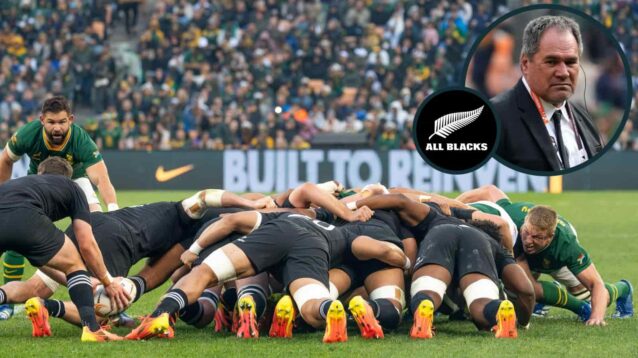
All Blacks v France clash in 2025, which led to debate about TMO intervention, and ex-Test referee Wayne Barnes.
Rugby World Cup final referee Wayne Barnes admits that the TMO usage can improve after a controversial weekend in the July internationals.
New Zealanders were particularly frustrated following a stop-start clash against France, which saw the television match official often get involved.
They had three tries ruled out – all correctly by the letter of the law – but it led to discussions about the speed of the game and whether it is impacting the sport’s entertainment.
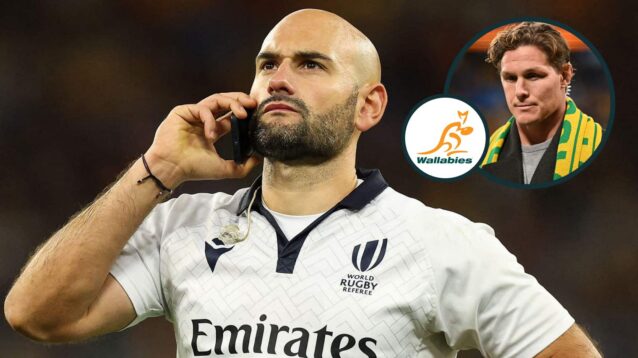
Appearing on Sport Nation’s Scotty & Steve show, Barnes was asked about the TMO interventions and he gave an honest response.
‘Preventing the big howler’
“For me it’s always been about preventing the big howler,” he said. “You look at it once and you realise the match officials have missed it.
“I don’t need to remind any of you down in New Zealand about the [2007] World Cup (which Barnes was in charge of), a decision you might not see immediately but you look at it once at the big screen and you think, ‘we need to get that and we need to move on.’”
Back in 2007, the TMO was unable to judge forward passes and it cost the All Blacks as they succumbed 20-18 to France in the World Cup quarter-final.
Since then, the governing body have widened the scope of the video official to include a whole range of things.
That means they have the license to get involved should they see something the on-field officials have missed, but that has resulted in the game being slowed down.
Ex-All Blacks slam overuse of TMOs that’s putting ‘people asleep’ as prop highlights hypocrisy
Some believe there are far too many interventions and Barnes admits that the TMO should only intervene or adjudicate on obvious things.
He therefore wants World Rugby and the relevant lawmakers to make sure that only blatant errors are being put up on the big screen.
“For me technology makes sport better, but what I think is really important to be clear on is that’s not meaning we’re trying to get a perfect game, a game where you don’t miss anything – a player never makes a mistake or a referee never makes a mistake,” he said.
“It’s there to get the big stuff. My view on that has always been the same. It’s if you’re sitting there as a match official and thinking, ‘I’ve missed something here’ – that could be a high tackle, a knock on, an offside.
“You’re sitting at home on the sofa thinking, ‘bloody hell, Barnes has missed a double movement there’ or ‘I’m sure the nine has knocked on at the back of the scrum’. Those are the ones you should get, it’s not about searching for things.
“It’s not about thinking, ‘I wonder what happened there, I wonder if…’ If you’re not sure, let’s play on and let’s get the continuity in the game.”
He added: “If you go back to that quarter-final in the 2023 World Cup [between All Blacks and Ireland], 44 minutes of ball in play, starting off with 35 phases, finishing with 40-odd phases. Those are the games, as a fan of rugby, I want to see. I want to see games that don’t stop and aren’t interrupted.
“Get the big stuff, don’t worry about the little stuff. If it hits you in the face, those are the ones you should be looking for.”
2023 RWC final
Barnes spent over 15 years as a Test match referee, with his final game before retirement being the 2023 World Cup final.
Despite criticism from some All Blacks fans, most were in agreement that he and his team managed a difficult game well, which included three yellow cards, a red and a disallowed try.
All the officials in the showpiece event knew each other well having refereed together in both the English Premiership and at Test level.
Barnes felt that made a difference and reckons it is something which could be looked at going forward.
“With the World Cup final, it was the first time ever a group of officials from one nation were together, so myself, Matt Carley, Karl Dickson and Tom Foley,” he added.
“We worked together around 100 times in the lead up to that game and knowing when and when not to come in, getting the big stuff.
“I know people will disagree with some of those decisions within the World Cup final, but what I hope you saw is a team who knew whose role it was to come in when, and when those individuals came in, it was dealt with pretty quickly.
“It’s one look, it’s ‘I’m about to show you someone tackling someone high, I’m about to show you someone dropping on someone’s knee’, and you look at it and everyone can see that straight away.
“It’s not about scratching around, saying ‘if you look at this angle, just look at the number seven over there and look at the way his hand maybe hits the ball forward’.
“We need the game to crack on so when teams work together as match officials, they work more in sync, they work more smoothly together, so I think that’s a starting point.”