URC referee boss wants officials to ‘win over the fans’ and rejects ‘coaching players’ claim


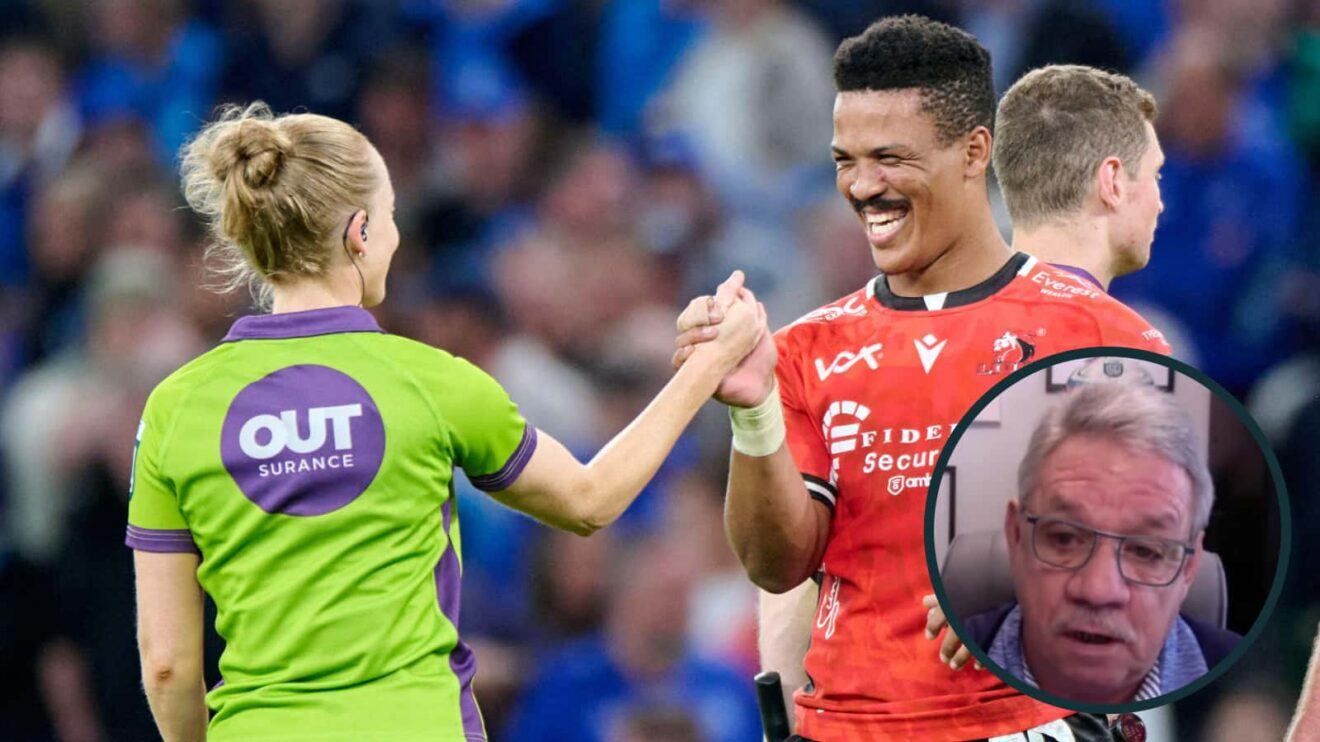
Hollie Davidson thanks Angelo Davids of Lions and an inset of Tappe Henning.
Head of Match Officials Tappe Henning has revealed that the URC have set the goal of referees winning over the fans.
The former international referee spoke to the media this week in the build-up to the season, where he revealed the four philosophies that the competition will be implementing with their officials, which are aligned with World Rugby.
The URC’s plan to win over the fans
Henning explained that player safety remains the top priority but he hopes that the referees get the support of the fans, embrace the contest of games and promote continuity.
“We are supporting the four pillars and the four game philosophies that were shared by World Rugby,” he said.
“As usual, the safety of players and protecting players is the top priority. Second to that is to embrace the contest. Thirdly, it is to promote continuity, and then probably something new is to win over the fans.
“We’re not suggesting referees should walk to fans and try to take selfies after a game, but the way that we approach the game, we’re going to try to present the game to our fans to give them a better understanding of our processes by communicating through in-stadium systems.
“So we’re quite excited about those four pillars that we are fully going to support and embrace in our competition through our performances closely aligned to what the expectations are of World Rugby.”
We are not coaching players
The former referee addressed several topics throughout the URC media roundtable without speaking on any matches in particular. A regular complaint around the officiating in the game has been that referees have a tendency to coach players out of penalizable positions instead of blowing their whistle.
However, Henning doesn’t see it that way and explained that referees will often give players instructions in order to keep a flow to the game. He further clarified that often the player hasn’t infringed yet and an instruction from the referee can stop them from doing so, with the referee’s ability to do so being a handy tool in matches.
“We do not see it as coaching. We’re not trying to coach the players,” he said.
“What we try to do through verbalising at certain times is to give clarity to a player that’s in a contest that he believes he can still contest, but the referee has seen his knee on the floor, and you don’t want him to continue with that contest, and we tell them hands off.
Want more from Planet Rugby? Add us as a preferred source on Google to your favourites list for world-class coverage you can trust.
“That is not coaching; that is just sharing in certain areas of the game where it’s not clear to the player that he’s not allowed to play or continue play or continue contesting. That is what we try to do. We see it as a communication to help the player understand if he can play or not. It’s the same as telling players to stay back, offside, step back. It’s not coaching. It’s just giving them advice in the areas where it’s grey, that look like: you are in a position where you can play or not, or you’re in a position where you offside step. If you do step, that’s fine. It helps with the continuity of the game as well.
“It’s the same with scrums. If a scrum is collapsing, one of our focus areas is to share with the player what the issue was and what needs to be fixed. And that’s not coaching the player how to scrum. It’s saying to the player, ‘The issue was you dropped your left shoulder and elbow, which caused the scrum to collapse’. If you maintain that, that will help us a lot to keep the scrum up. We do not want to coach players. We are not coaches. But we have certain management and soft skills that we can apply in the game to help the players play within the expectations of the law.”