Six Nations: Five things we learnt from round one as ‘common themes’ emerge and why Rassie’s prediction could be right
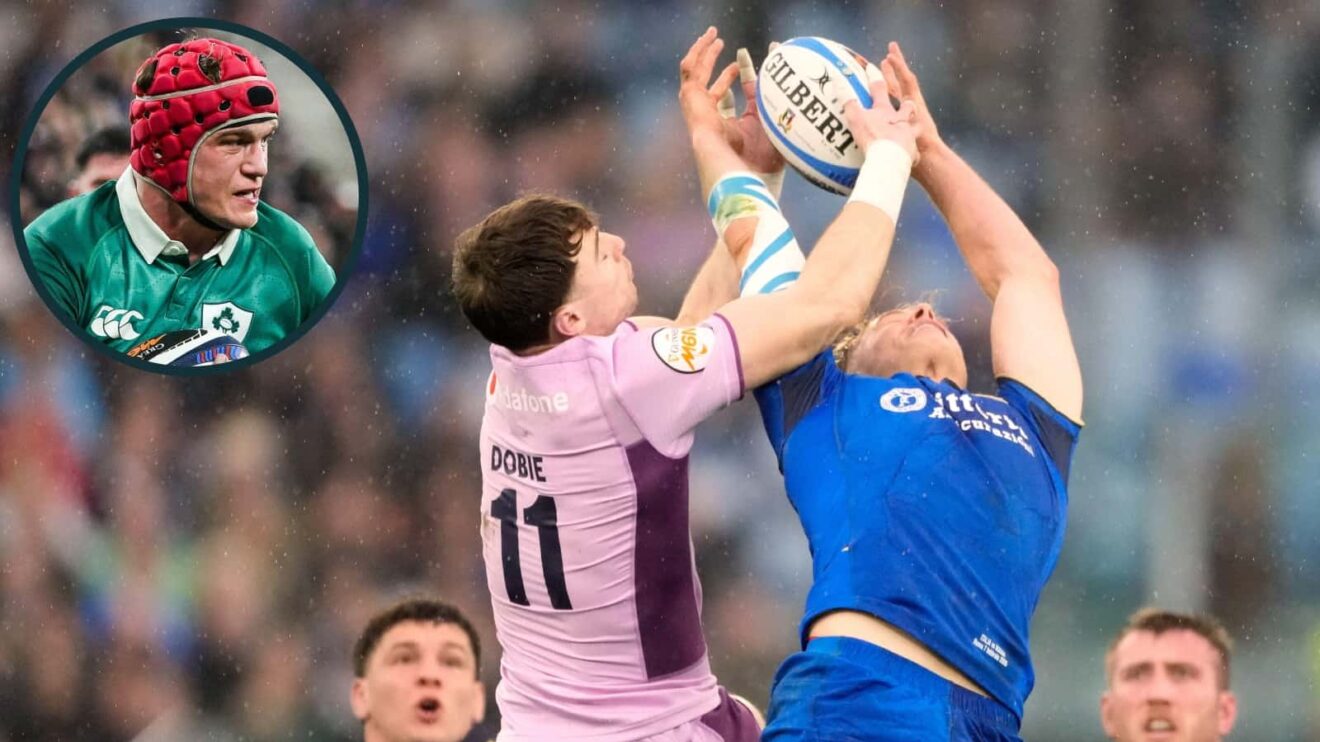
Scotland's Jamie Dobie and Italy's Louis Lynagh compete for the ball and an inset of Ireland's Josh van der Flier.
Following the opening weekend of the 2026 Six Nations, here are the five things we learnt from round one.
The aerial battle matters now more than ever
There was a common theme as international rugby woke from its hibernation, with the victorious side from all three of the tier one Test matches winning the aerial duel.
Last year was a learning curve for the international teams as the coaches and players adapted to World Rugby’s outlawing of the escorts, providing a fairer contest for possession under the high ball, and after 12 months of planning, implementation and trial and error, we are starting to see the true impact of the law change.
It started with the team selections, notably with Gregor Townsend, who unceremoniously dropped what just 12 months ago was deemed to be his best starting outside backs in the form of full-back Blair Kinghorn and wingers Darcy Graham and Duhan van der Merwe, with Tom Jordan, Jamie Dobie and Kyle Steyn taking their places, respectively. Similarly, Fabien Galthie didn’t even include the try-scoring sensation Damian Penuad in favour of 21-year-old rising star Théo Attissogbe.
Galthie certainly benefited from his bold selection more than Townsend did as Attissogbe quite literally rose to the occasion, wreaking havoc on Ireland’s backfield with his incredible vertical ability, with the French back-five forwards swooping in to gobble up the crumbs.
As for the Scots, Italy feasted in the air in the first half, applying the pressure mostly through the excellent Louis Lynagh who grabbed the opening try and secured possession which resulted in the second.
While Townsend’s side managed to apply pressure of their own and force errors, their ability to pounce on the scraps and capitalise on the possession was not nearly good enough to really trouble the Azzurri, who clinched a statement win in Rome – thriving in the chaos.
After the theme of bossing the airwaves featured prominently in the first two fixtures of the Championship, it was only fitting that the same was true for the weekend’s finale between England and Wales at the Allianz Stadium. It was hardly the only facet of the game where Steve Borthwick’s men dominated as they thundered to an emphatic home victory to finish the weekend at the summit of the standings, but it was an important one as they repeatedly managed to charge upfield time and time again, en route to scoring seven tries.
With modern defensive systems being so intricate, well-drilled, and difficult to penetrate, the removal of the escorts has tipped the scales back in favour of the attacking teams and the ones who thrive on broken, chaotic play, like Italy, France and more recently England, will continue to benefit while others need to play catch-up.
There is still an adjustment period for the Six Nations sides but the popularity of the escorts did the same and eventually it will even out once all the teams get to grips on the tactics and skill sets required under the new laws but, until then, the aerial game is about as important as the set-pieces if not more so.
Rassie could be right…
After the Springboks thrashed Wales in Cardiff last November, Rassie Erasmus slipped in a Six Nations prediction during his post-match presser that Italy would finish in a top-three position in this year’s Championship.
It’s quite possible that he did so without realising the magnitude of his bold call, as it would be the Azzurri’s highest-ever finish in the tournament, a mighty achievement in itself, but perhaps he didn’t also realise that Italy had three away days in Dublin, Lille and Cardiff.
“If I can make a prediction, Italy will finish two or three in the Six Nations,” he said. “For me, they are a team that is on the up from what we’ve experienced from them; we didn’t have an easy ride.”
The Boks played the Azzurri three times in 2025, so he is certainly speaking from a position of experience. Still, a two-position jump on their best-ever finish is a bold prediction, but perhaps he was onto something.
Italy notched up their 10th ever win over Scotland on Saturday and while it was by just three points, there was a different feel and energy about this victory in Rome. Far too often, the Azzurri have been able to pull off a shock result but failed to back it up a week later; last year being a prime example as they were battered 73-24 by France just a week on from beating Wales 22-15.
What stood out about the Azzurri’s win over the Scots was the sheer brutality of their defence, the methodical nature of their approach and the tactical nous. It was quite clear that they had a plan to counter Scotland’s threats and executed it brilliantly. All the while, missing six key players in crucial positions. Gonzalo Quesada is a well-respected head coach, a reputation he thoroughly deserves through his prior achievements with Stade Français and Jaguares. However, his work with Azzurri hasn’t quite garnered the plaudits he deserves, and if it comes to fruition this Six Nations, he may finally receive them. Round one was the first challenge, which they passed; now it’s time to back it up and that’s the tough bit.
Depth will be crucial
That brings us to the next point on depth, which could make or break the Azzurri’s campaign. The gruelling nature of the opening weekend suggests that most, if not all, the head coaches will need to be making alterations to their matchday 23s through injury and fatigue before even looking tactically.
Last year, Quesada sent a largely understrength squad to South Africa in July to widen the Italian selection pool which paid dividends in November but will be properly put to the test as this year’s Six Nations progresses. Borthwick, Townsend and interim Ireland boss Paul O’Connell were forced to do the same due to the British and Irish Lions tour, with England arguably benefitting most from doing so, as it laid the foundations for the ‘Pom Squad’ to explode in the autumn.
We saw on the opening day just how impactful a bench can be, with Ireland fighting back into a position where they had an outside chance of getting a positive result, as the eight replacements really stamped their mark and continued the trend of the game becoming a truly 23-man sport.
France’s bench didn’t fare nearly as well as it did during last year’s Six Nations, and Galthie will be demanding better with the same true for Borthwick’s ‘Pom Squad’. To maintain performances nowadays, it’s not just the strength of a starting XV or a matchday 23 but the entire squad, which will only become more apparent in the coming rounds.
Club cohesion doesn’t translate to international success
Scotland, Ireland and Italy bosses Townsend, Andy Farrell and Quesada all backed one club-heavy teams this weekend, but only the latter ended round one in the positive column. It’s completely reasonable to think that would pave the way for a more cohesive performance with many of the players sending week in and out, training and playing alongside one another. But that was not the case for the Scots and Ireland, who struggled in the areas where one would predict a more cohesive set of players who thrive; the set-piece and in attack.
Ireland have benefited immensely over the years with Leinster-heavy teams but many of Leo Cullen’s charges have hardly been in fine form this season and that was evident again in Paris.
Meanwhile, the core of the Scotland team came from the high-flying Glasgow Warriors, but they were unable to replicate their club form when changing jerseys. This could be solely down to the differing systems they have to execute in the Test set-ups, which requires a period of adjustment. Only time will tell, but it was plainly obvious that simply backing club cohesion doesn’t guarantee international success.
Contrast in officiating
Three different nations were represented through the referees in round one of the Six Nations, with England’s Karl Dickson officiating the opener, New Zealand’s Ben O’Keeffe the clash in Rome and France’s Pierre Brousset overseeing proceedings in Twickenham.
That meant we saw three different styles of refereeing, with all three of the men in the middle not only leaning on their assistants in contrasting ways but also having differing focal points. Sure, World Rugby and the Six Nations will have identified areas of the game they will have wanted to be zoned in on, but the officials still have their own ways of interpreting the laws and their biases from the domestic games they officiate.
Dickson, for example, only officially referred to his TMO for a review an hour into the match at the Stade de France, trusting that fellow RFU official Ian Tempest would notify him of anything that needed his attention while also backing his assistants to prompt him on anything he may have missed. He also benefited from having two experienced ARs in Australia’s Jordan Way and Angus Gardner.
O’Keeffe also put the tempo of the game high on his agenda, but was particularly hot on policing a fair contest with the high bombs, with both teams penalised for escorts, a rarity in the other fixtures, but he was also officiating the match in the toughest conditions.
Want more from Planet Rugby? Add us as a preferred source on Google to your favourites list for world-class coverage you can trust.
But it was Frenchman Brousset who provided the biggest contrast of the weekend. Unlike the duo that oversaw the matches before him, Brousset was quite happy to get TMO Tual Trainini involved in proceedings and happily punished players for their indiscretions, issuing six yellow cards – shockingly Ellis Genge escaped one.
As much preparation seemingly goes into planning for the refereeing team as the opposition nowadays, and it’s easy to see why that’s the case based on round one’s action.