Sir Ian McGeechan recalls work that turned ‘overrun’ Matt Dawson into Lions legend and names ‘Thursday afternoon’ activity so important to Wasps


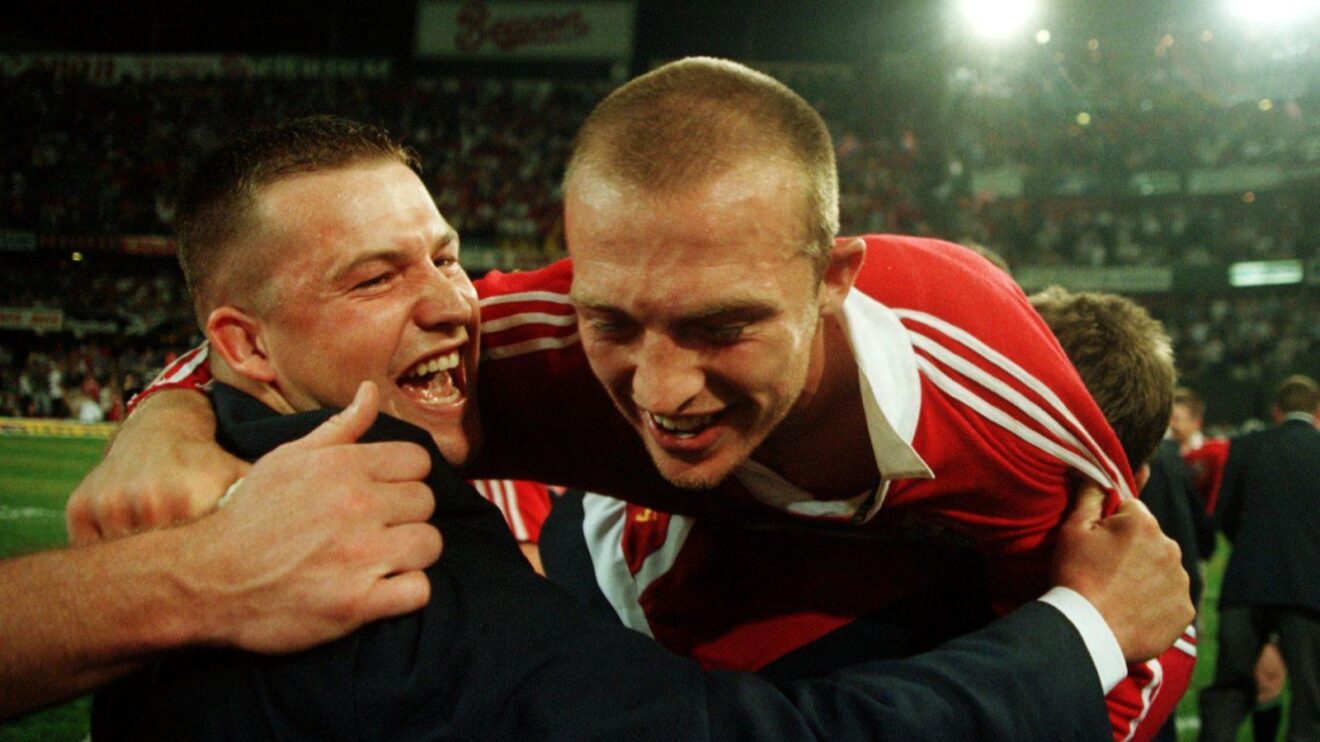
Matt Dawson was an integral part of Ian McGeechan's 1997 series-winning British and Irish Lions team
Sir Ian McGeechan has revealed the conversations he had to turn Rugby World Cup winner Matt Dawson into an “outstanding player”.
The legendary British and Irish Lions coach first encountered the scrum-half at Northampton, where he was in charge from 1994 through to 1999.
So impressed was McGeechan by the improvements Dawson made on his watch at Franklin’s Gardens, he named him in his 1997 Lions tour squad and picked him as the starting No.9 in all three Tests.
That was a series in which Dawson memorably dummied his way to the Springboks line in the first Test win in Cape Town. He then followed that impact by providing the pass the following week for Jeremy Guscott to win the second Test in Durban and clinch the series victory with a game to spare.
It was two years later when McGeechan exited Saints to take charge of Scotland, and he crossed paths with Dawson in the years that followed as the Franklin’s Gardens player was a regular Clive Woodward pick, a selection that culminated in him providing the extra-time pass for Jonny Wilkinson to win the 2003 World Cup final in Sydney.
“They were waiting for him…”
Asked by Champion Speakers, in association with Planet Rugby, for an example of conversations he would have had with players about creating shared objectives, McGeechan recalled his early dealings with Dawson.
“I suppose I could go back to my Northampton days with Matt Dawson as a youngster, who was a very natural running, high-involvement scrum-half with a very good pass.
“Now, he tended to overrun, so everybody just kept an eye on him because ultimately there would be a turnover because they were waiting for him. I just said, ‘Look, let’s try and build a game where actually I want you to have your hands on the ball four or five occasions without anything happening other than your passing’.
“Then I said: ‘Wait for the moment where people then forget about you, and that’s the time to break’. It might only be twice in a game, in a half, but actually when it happens it’s devastating.
“Have the patience to say pass, pass, because the next thing is, if you keep passing, there is another breakdown, there is another opportunity for you by passing, not by running all the time.
“We worked through that, and he took it on board. With England and with the Lions, he just became an outstanding number nine because he varied what he did and when he did it.”
Now 78 years old, McGeechan is still involved in the game, working as the consultant director of rugby at Doncaster Knights. While modern-day players have become their own brands in the social media era, how does the three-tour Lions head coach get them to work together as a team?
“I have been fortunate to play with and coach some hugely talented players,” he said. “It is them recognising that your talent is only effective if it impacts what everybody can do.
“It’s only partly individual, and if you get that right, then you find that your talent comes into play more and more often, because the right things are happening around you because of your approach.
“The other thing is you respect the people that you play with and you work with. I have had some tremendous support staff coaching-wise in different teams, where we would make a point of going out for a drink together at night.
“When I was at Wasps, we used to have afternoon teas on a Thursday, and it was all the support staff. We’d just talk about anything and everything.
Accumulation of talent
“It is recognising that talent appears in different ways, in different areas, and impacts in different ways. But what you do is you respect the differences that people have. The last thing I would have wanted was a team of all the same.
“What I actually wanted was an accumulation of talent, attitude and approach that was just pulling the most out of each other all the time. The support staff – we tried to do that. If there is something not right, you need that out in the open early, and you need people to understand that you will genuinely listen.
“On the back of those conversations, be it with players, a doctor, a physio, a fitness guy, another coach, whoever it is, you are actually trying to get the best environment and situation working.
“In the end, your working environment is a living environment as well. You have to have a smile on your face when you are coming into work in the morning, into the club to train, whatever it is.
“With the Lions, too, none of that is different. As a group, the thing I had to look at and pinch myself sometimes was looking at the quality of talent, but also the quality of person that was actually there in the whole group.
“If you respect that, then the pressure of social media now is massive, but you have to understand why you are there, why you have got a reputation, or why you have been able to achieve something. As long as you respect that position you are in, then you don’t take off in a direction that starts to isolate.”