Rugby Championship: Five things we’ve learnt so far as Springboks recover from ‘shellshock’ but All Blacks left with ‘questions’


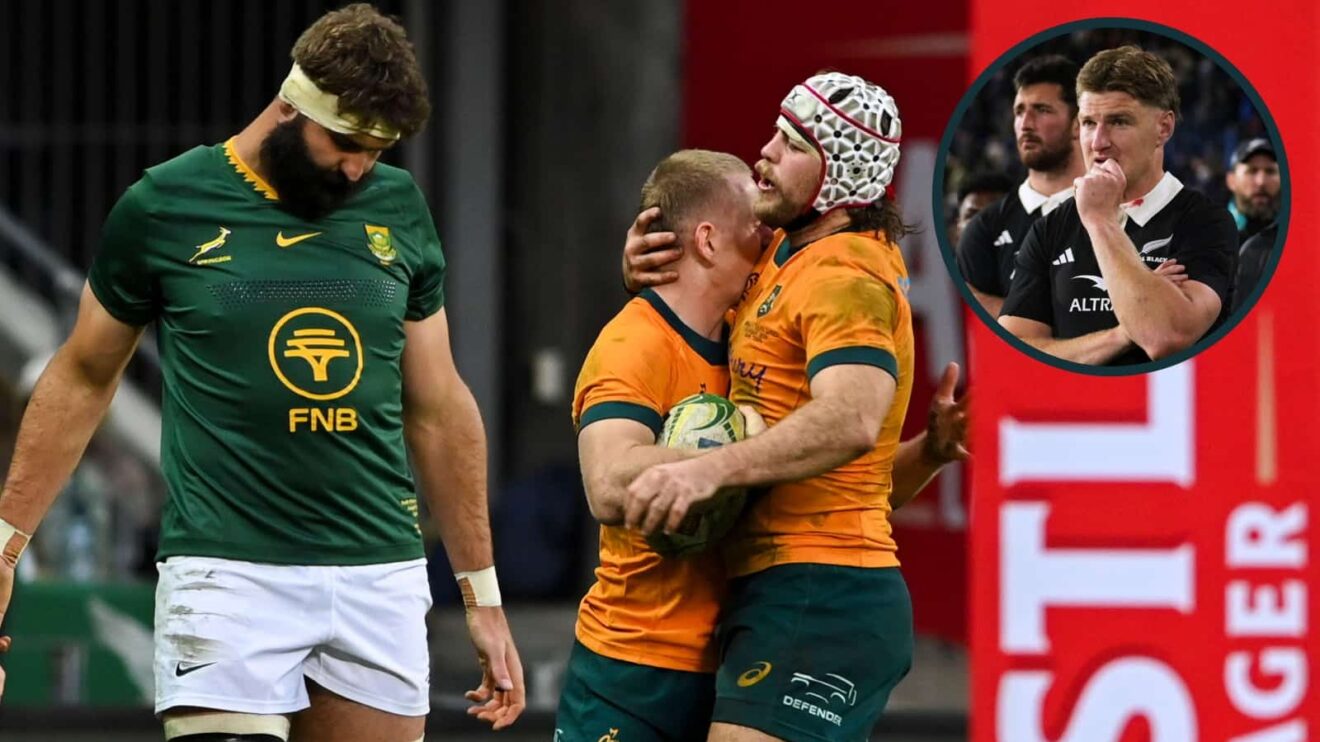
Max Jorgensen of Australia celebrates with Fraser McReight and an inset of All Blacks centre Jordie Barrett.
Following the conclusion of the opening two rounds of the Rugby Championship, here are five things we have learned.
The first fortnight of the tournament saw the Springboks host the Wallabies in South Africa while the All Blacks were in action against Los Pumas in Argentina.
The away teams won the first matches, while the hosts both bounced back on the second weekend to blow the competition wide open.
It’s anyone’s Championship
For just the second time in the tournament’s history, all four teams have registered a win after the opening two rounds of action, the only other time being in 2022.
The Wallabies stunned the world in the opening game of the competition, overturning a 22-point deficit to emphatically claim their first victory over the Springboks at Ellis Park since the game went professional, while the All Blacks put Argentina to the sword in the later kick-off.
However, the results were flipped on their head in round two as South Africa got back to winning ways while Los Pumas beat the All Blacks for the first time on Argentine soil.
With history made in the opening two rounds of the competition, one cannot write off more shock results in the four remaining rounds. The most telling being the next game on the fixture list with the All Blacks hosting their fiercest rivals at their fortress, Eden Park, putting their 50-game unbeaten run at the ground on the line. Even further down the line, the Wallabies have improved immensely in the past 12 months, and the Bledisloe Cup is far from a foregone conclusion for the All Blacks.
While the Springboks were left shellshocked in Johannesburg in round one, they produced a far more effective and efficient performance in Cape Town, with Handre Pollard taking control of proceedings – playing a far more risk-adverse game.
The defeat to the Wallabies raised plenty of questions, but in Cape Town, they seemed to have the answers despite Australia rallying to make it a far tighter final scoreline. With a week’s break, one would think that the coaching staff would have more and more answers for the players to produce an even more compelling performance in the land of the long white cloud.
But for their opponents, more questions than answers have arisen from the opening fortnight of action. The midfield make-up has yet to really fire, while the All Blacks were uncharacteristically ill-disciplined in Buenos Aires. Additionally, the New Zealanders struggled under the high ball, with Rieko Ioane and Sevu Reece featuring in the winger roles, but were underwhelming in both matches. The All Blacks’ forwards saved the day in the first but failed to do so in the second, while the attack faltered.
Meanwhile, the Wallabies showed a real ruthlessness edge, particularly in attack, despite the several setbacks they had in South Africa and were incredibly efficient at the breakdown. Their ability to remain in the fight in both of their meetings with the defending champions will bode well for them going forward and concern both Argentina and New Zealand.
Los Pumas are renowned for their passionate performances, but Felipe Contepomi has added a real tactical nous to the side, illustrated by their brilliant kicking game plan that put all kinds of pressure on the All Blacks, along with their extremely athletic back-rowers.
Ex-All Black: ‘Statistically’ Australia should have beaten the Springboks
Battlegrounds drawn but in the air
On the topic of the kicking game, it’s clear that the law amendments to remove the escorts and the move to ban the Dupont Law have clearly influenced the shape of the game.
The All Blacks have struggled to adapt under the high ball, as alluded to above, with Ioane and Reece repeatedly beaten in the air by the Pumas flyers. It’s not just the Kiwis who have had their issues with Australia benefiting from the additional space in the drop zone, launching devastating counterattacks when they did secure possession.
These law tweaks have benefitted smaller wingers like Mateo Carreras, Cheslin Kolbe, Kurt-Lee Arendse, and Max Jorgensen, who are able to react quickly once they have hit the ground from claiming the ball in the air.
While the gainline, set-pieces and collision areas remain key battlegrounds at the highest level, the aerial game is becoming more and more important. It’s not just about winning the contest in the air, but the drop zone too, with the likes of Pablo Matera, Siya Kolisi, Juan Martin Gonzalez and Kwagga Smith feasting on the scraps.
Officiating focuses
Three of the four games so far in the Rugby Championship have been officiated by Southern Hemisphere referees, with France’s Pierre Brousset being the only outlier for the first Test between Argentina and New Zealand.
With a vast majority of the players in the Springboks and Los Pumas squads plying their trade in the Northern Hemisphere, there was always going to be an adjustment period for those sets of players.
While World Rugby strives for consistency from its officials, there is a clear difference in the approach in certain facets of the game. Super Rugby officials tend to have a more laissez-faire stance on the breakdown and have a willingness to allow the game to play on at the scrum instead of ordering a rest or awarding a penalty.
This played into the hands of Argentina and Australia to a degree, with the pair possessing less dominant and aggressive scrummaging packs but fierce breakdown specialists.
The officials have been hot on the aforementioned escorts as well as the offside lines, which one can assume is also a directive from World Rugby.
With the tournament being a SANZAAR tournament, the same organisers as Super Rugby, speeding up the game has been a major focus, hence the notable ploy to limit the TMO’s influence and lengthy reviews, with officials relying on the fourth official to only notify the referee for clear-cut cases.
Injuries are taking their toll
Injuries have undoubtedly played their part in the results over the first two weeks of the tournament, with all four teams feeling the pinch.
The Springboks are dealing with a number eight crisis with Jasper Wiese suspended, paired with injuries to Elrigh Louw, Cameron Hanekom, Juarno Augustus and for the second game against Australia, Kolisi too. Arendse and Edwill van der Merwe have depleted the winger options for the tour, while there is somewhat of a prop crisis, too.
For the All Blacks, all three of the first-choice half-backs look to be out of the mix for the clash against the Springboks, while Tamaiti Williams returned in the second game against Los Pumas, but Tyrel Lomax missed both Tests.
Australia’s half-backs have been hit with Jake Gordon, Tom Lynagh, Ben Donaldson and Noah Lolesio all sidelined with the wing depth tested following setbacks to Harry Potter and Dylan Pietsch, with the injury list hitting 12.
Perhaps the most telling injury for Argentina has hit their mercurial fly-half, Tomas Albornoz, who has sustained a ‘traumatic dislocation’ of his finger. Frontline Pumas Benjamín Grondona, Emiliano Boffelli, and Thomas Gallo have also missed the opening games.
It’s fair to say that across the board, the depth of the four nations has been put to the test, and that is unlikely to change.
Experience matters
The old adage that money can’t buy experience rings true this Rugby Championship. In the opening weekend, it was the veteran heads of Nic White and James O’Connor who steered the Wallabies to an incredible victory.
Later that day, it was the over 200 Test caps worth of experience that Beauden Barrett and Ardie Savea possess that saw the All Blacks over the line in their tournament opener against Argentina.
The theme of the elder statesmen continued in round two as Eben Etzebeth and Pollard were the standout performers for the Springboks as they masterminded South Africa’s triumph, while Matera produced another blockbuster performance against the men in black to clinch another historic Argentine success. He was ably assisted by fellow centurion Julian Montoya on the day.
While there are certainly several youngsters and inexperienced players starting to make their mark on the tournament, the game-defining moments and performances are still coming from the veterans, further showing the value of experience at the highest level.