Toulon v Bath: Five takeaways as Charles Ollivon ‘dominates’ while Johann van Graan’s ‘Bomb Squad implodes’
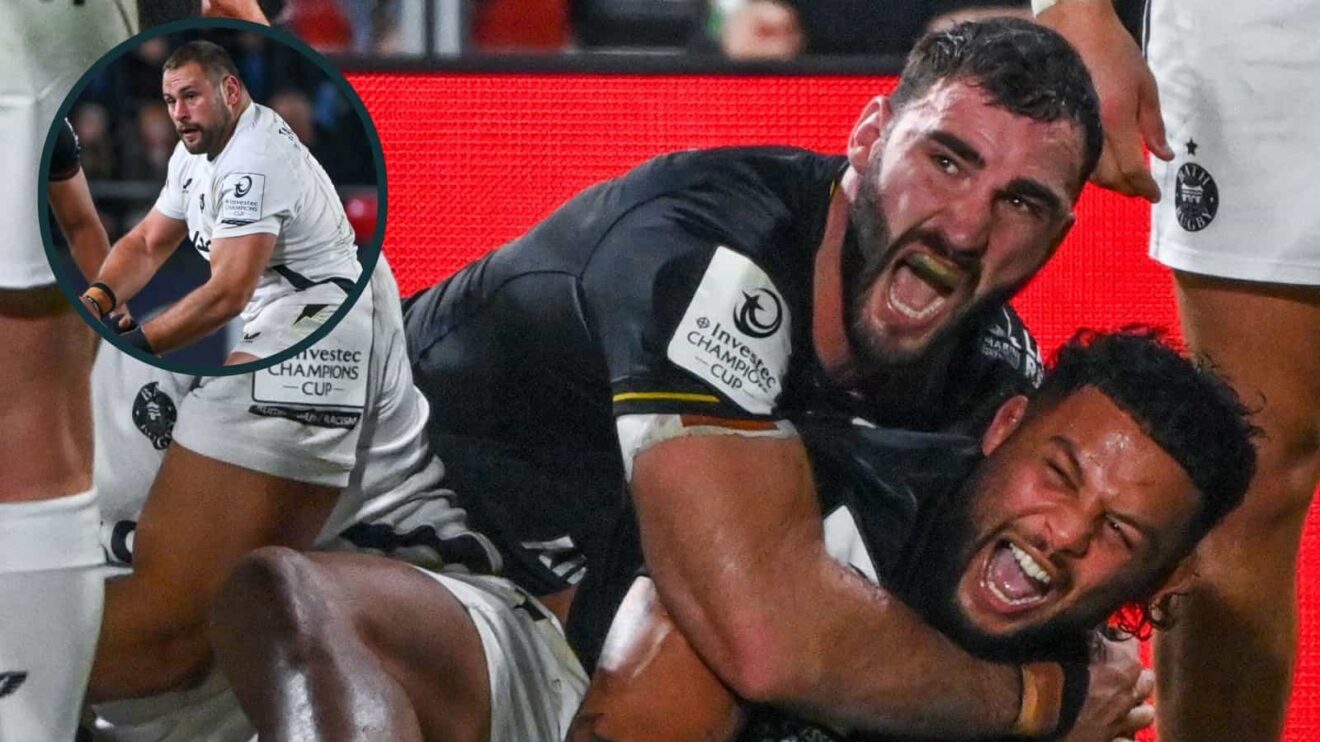
RC Toulon back rowers Charles Ollivon and Lewis Ludlam with an inset of Bath prop Thomas du Toit.
Following Toulon’s 45-34 victory over Bath, here are our five takeaways from the Investec Champions Cup clash.
The top line
This was a top-quality affair, a game played at Test-match intensity where possession was split 69 to 31 in favour of the hosts, and the set-piece became decisive, Toulon winning six scrum penalties and operating at 92 per cent success against Bath’s 71 despite the presence of Thomas du Toit in the latter stages.
The tries for Toulon came from Brian Alainu’uese, Nacho Brex, Gael Drean, Lewis Ludlam and Teddy Baugbigny, with Mateo Garcia adding four conversions and four penalties for a personal haul of 20 points, while Bath crossed through Ted Hill, Santiago Carreras, Arthur Green and Louie Hennessey, with Finn Russell flawless from the tee with four conversions and two penalties for 14 points.
At the heart of Toulon’s dominance stood the big man, Charles Ollivon, player of the match, a leader whose double-digit tackle count, highest ruck involvements and carrying metres defined the rhythm of the game, his influence stretching beyond collisions into decision-making that created Garcia’s strike platforms.
Around him, Toulon’s back-row thrived as Ludlam thundered in contact, Zach Mercer added six carries for 23 metres, and Esteban Abadie slowed Bath’s ball at the breakdown.
Baptiste Serin’s tempo from nine was critical, his 41 passes and three box kicks shaping Toulon’s exit and launch patterns, and Kyle Sinckler making 26 metres from seven carries and 12 tackles without a miss. But the final act mattered most; Baubigny’s last try denied Bath a losing bonus and gave Toulon five points, lifting them to five in the cramped affair that’s Pool 3, a key outcome for a team that’s openly pinned its colours to the mast of EPCR Rugby this year.
Test match intensity
This was a contest that carried the weight and rhythm of a full-blooded Test match, a game played at a pace that never dipped and with collisions that echoed through every phase, Toulon holding 69 per cent of possession yet never able to shake Bath’s relentless defiance, every ruck a battle for inches, every carry met with ferocious resistance.
Bath’s five clean breaks against Toulon’s four told of a side willing to strike from deep, whilst post-contact metres sat almost level at 160 to 159, proof that neither pack yielded an inch in the trenches. And when the game opened into chaos, the skill level soared. Finn Russell’s orchestration from 10 was at times a masterclass in composure, his two penalties and four conversions keeping Bath alive and making sure they took a point with them.
To emphasise how close this match was for so long, Bath completed 116 tackles to Toulon’s 107, with both sides missing 14, a symmetry that underlined the contest’s balance. Ruck speed sat at 3.4 seconds for Bath and 3.3 for Toulon, virtually identical despite Toulon’s 69 per cent possession. Collision count was high: Bath logged 61 ruck wins, Toulon 53, and post-contact metres were separated by a single metre – 160 for Bath, 159 for Toulon. Remarkable stuff for the stattos amongst you.
Back-row riches
This was a game where the back rows defined the heartbeats of both sides, a contest that informed all on the soggy Mayol turf, and in that theatre Ollivon stood as the conductor, the player of the match and the soul of Toulon, a man whose influence stretches beyond this club into the very fabric of French rugby, his work-rate relentless, his presence in every collision and every carry a statement that he’s back and he’s firing.
Toulon’s dominance in possession owed much to Ollivon’s ability to secure clean ball and accelerate tempo, his tackle count in double figures, and his ruck involvements, the highest on the field. But as ever, it was his decision-making under pressure that elevated him, choosing the right moment to link with Garcia, the right angle to punch through Bath’s defensive wall, the right tone to lead a surge that broke the game open in the final quarter.
Around him, Ludlam broke contact for a pastime and in the latter stages, Abadie’s speed over the ball slowed Bath’s pick-and-go, and Mercer’s footwork and offload game added layers of complexity to Toulon’s attack, cohorts that complemented Ollivon’s authority with energy and craft. RCT may rue the lack of a specialist on the floor, but if you want your back rows laced with power, there’s few better.
Bath were no less blessed, Hill a towering figure whose try at 21 minutes shifted momentum, his tackle dominance and post-contact metres a testament to his physicality and intelligence, and alongside him, the Bath loose forwards fought with courage to keep parity in collisions and ruck speed.
But this was a match formed by back-row rugby at its purest, a blend of athleticism and intellect, and at its core was Ollivon, the heartbeat of Toulon and France, a leader whose influence turns contests into triumphs and whose performance here was a masterclass in modern forward play.
Bath Bomb Squad implosion
The scrum was the decisive battleground and, much to many’s surprise, Toulon owned it, winning six penalties directly from set-piece and forcing Bath to retreat under sustained pressure that shaped territory and scoreboard.
Despite Beno Obano and Billy Sela doing their best in anchoring the Bath front-row, Toulon’s cohesion and timing delivered a 92 per cent scrum success rate compared to Bath’s 71, and those numbers tell the story of dominance in the dark arts, despite the introduction of Francois van Wyk and Du Toit as part of the bomb squad.
The architect of that Bath struggle, former England tighthead Sinckler, produced a performance that will ignite conversations across the Channel as his contract comes to an end at RCT this year. His work in the loose was exceptional: seven carries for 26 metres, two dominant collisions, and a clean break that launched Toulon’s most threatening sequence in the second half. Add 12 tackles without a miss and three ruck arrivals in the attacking third, and you have a tighthead operating at a level that blends power with mobility.
Word from inside the game suggests Sinckler is keen to return to the Prem to reclaim his England shirt, and on this evidence clubs will be preparing serious offers because this was a display that combined technical precision with explosive athleticism.
Bath’s bomb squad delivered impact in open play, but Toulon’s collective scrum power was irresistible, their front row generating momentum that fed into Ollivon and Mercer in the back-row and ultimately created the platform for Ludlam’s and right at the death, Baubigny’s vital tries. This was elite-level forward play, and Sinckler’s individual metrics underline why he remains one of the most valuable propping assets in European rugby.
Pool implications
The closing moments of this match and that final try carried consequences that will echo through Pool 3, because that score did more than seal victory – it stripped Bath of a second losing bonus point and handed Toulon the maximum return. At 38-34, Bath were within seven and set to leave with two points – one for four tries and one for the margin – but Baubigny’s late surge pushed the hosts to 45-34, erasing that cushion and leaving Bath with only the four-try bonus.
Toulon banked the full five points: four tries plus win, lifting them to 5 points from two rounds and placing them in the middle of a congested pool. Bath now sit on six points after their opening-round win and this single bonus, a gap that just keeps them ahead of the chasing pack.
In a pool where the average qualification threshold hovers around 14 points, missing that extra bonus compresses Bath’s pathway and amplifies RCT’s revival. In tournaments where knockout places often pivot on bonus points, this was a swing of seismic proportions delivered in the dying seconds of a game played at test-match intensity.