PREM Rugby: The six measures that decided a record-breaking opening round



PREM Rugby: The six measures that decided a record-breaking opening round
After a record-breaking opening weekend of the 2026/27 PREM Rugby season, we ran all five games through the six measures elite coaches use to read a match, and the winners took almost every one.
The top line
Jason Gilmore came out of Friday night at the Stoop with a set of numbers he clearly felt told a different story to the scoreboard. Harlequins had gained 657 metres in attack to Bath’s 526 and forced Johann van Graan’s side into 144 tackles, he said, but Bath had been 28-10 up at the break and won 33-17 with a bonus point.
He’ll not have been the only director of rugby poring over a stat sheet on Monday morning. In a weekend that produced 52 tries, the most in any opening round in the league’s history, and four away wins out of five, the side with more of the ball lost four times out of five, three of them by double figures.
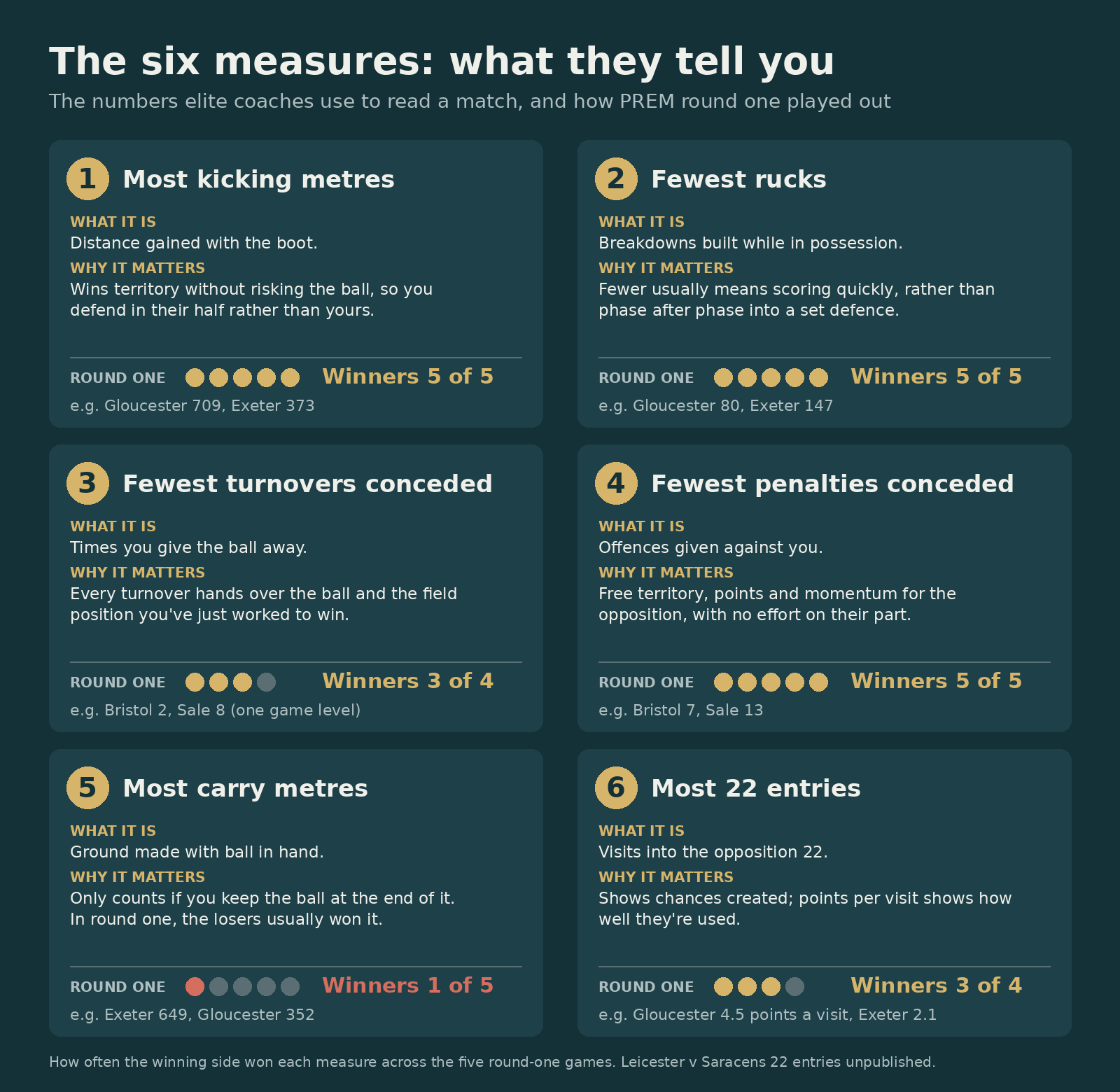
None of that would surprise the analysts in the coaching boxes. Possession and territory are the figures read out on television at half-time, but elite coaches tend to read matches through a different set of numbers, the six measures we used to unpick Sale v Bristol last weekend, each of them revealing something specific about how a side plays:
- Most kicking metres: territory gained without putting the ball at risk
- Fewest rucks: tries scored quickly, rather than phase after phase into a set defence
- Fewest turnovers conceded: keeping hold of the ball you’ve worked to win
- Fewest penalties conceded: no free field position or momentum handed over
- Most carry metres: ground made with ball in hand
- Most 22 entries: chances created; points per entry tells you how efficiently they were converted
And here’s the thing: run round one through those six and three measures were perfect. The side that kicked further, built fewer rucks and conceded fewer penalties won every game, whilst carry metres went almost completely the other way, favouring the losing side four times out of five.
PREM Rugby: The six measures that decided a record-breaking opening round
The ruck count
In all five games, the winners built fewer rucks than the side they beat:
- Northampton 87, Newcastle 93
- Gloucester 80, Exeter 147
- Bath 60, Harlequins 97
- Bristol 85, Sale 93
- Saracens 76, Leicester 92
Sandy Park is about as clear an example as you’ll get of what a big ruck count often means. Exeter had 56 per cent of the ball and 57 per cent of the territory, accumulated 78 attacking phases inside the Gloucester 22 to their visitors’ 29, and lost 45-24, Gloucester’s biggest-ever win at the ground. Each of those phases gave the Gloucester defence another few seconds to get off the floor and come again; Jac Morgan made 23 tackles on debut, Gloucester made 242 to Exeter’s 138, and Rob Baxter’s men went through phase after phase without the gainline moving much at all.
Gloucester built fewer rucks because they scored quicker, averaging 4.5 points every time they entered the Exeter 22 against Exeter’s 2.1. That conversion rate, rather than possession, is how a side with 44 per cent of the ball comes away with seven tries.
Carry metres
Carry metres went with the losing side in four of the five games:
- Harlequins 641, Bath 364; Bath won by 16
- Exeter 649, Gloucester 352; Gloucester won by 21
- Sale 503, Bristol 236; Bristol won by 10
- Leicester 617, Saracens 431; Saracens won by 2
The harsh truth is that metres only count if you keep the ball at the end of them. A side that carries hard and then coughs it up hands the opposition the ball and the field position its own defence has just worked so hard to give away, which is how Bristol scored five tries from 56 carries whilst Sale turned it over eight times to their two.
Northampton were the exception, making 717 metres to Newcastle’s 431, and they were the only side to win all six measures, getting into the 22 twelve times to ten and scoring 4.9 points a visit against 2.6. With Tommy Freeman and James Pater helping themselves to hat-tricks, a Red Bulls side with 25 new faces was always going to find Franklin’s Gardens a tough place to start.
Discipline
Penalties went with the winner in every game:
- Northampton 8, Newcastle 10
- Gloucester 7, Exeter 8
- Bath 6, Harlequins 10
- Bristol 7, Sale 13
- Saracens 8, Leicester 10
They mattered most at Welford Road, where Leicester and Saracens finished within two per cent of each other on possession and territory and level on six tries. Nick Isiekwe was shown a 20-minute red card for a high tackle on Freddie Steward on 54 minutes with Leicester 31-28 up, yet Saracens won that period 12-7, Rotimi Segun scoring twice before Alec Clarey won the late scrum penalty that let Charlie Bracken send the ball into the stands. For Saracens to spend 20 minutes a man down and still concede fewer penalties than Leicester tells you how little their decision-making deteriorated under pressure.
“Rugby’s cruel,” observed Joe Shaw afterwards. “It could have gone any way with 10 minutes to go.”
Wallabies centre banned after dangerous tackle on Springboks fly-half and misses All Blacks Tests
Kicks and 22 entries
The winners kicked for more metres in all five games, and Gloucester’s 709 to Exeter’s 373 is the one to note, nearly double, from a side perfectly happy to defend in the opposition half. Bristol kicked 613 to Sale’s 409, Northampton 391 to 277, Saracens 859 to 811 and Bath 575 to 549.
The 22 entries tell a similar story. Northampton, Bath and Bristol all made more visits than their opponents, but Exeter had one more than Gloucester and still lost by 21. Entries only matter when they are converted; one ending in a turnover or penalty simply becomes territory for the opposition.
So what does it all mean?
Put all ten sides together, with each team’s own figures and a tick wherever it won the measure:-
| Team | Result | Kicks | Rucks | Turnovers | Penalties | Carry metres | 22 entries | Won |
| Northampton | W 59-26 v Newcastle | 391 ✓ | 87 ✓ | 1 ✓ | 8 ✓ | 717 ✓ | 12 ✓ | 6 of 6 |
| Gloucester | W 45-24 at Exeter | 709 ✓ | 80 ✓ | 4 ✓ | 7 ✓ | 352 | 10 | 4 of 6 |
| Bath | W 33-17 at Harlequins | 575 ✓ | 60 ✓ | 9 | 6 ✓ | 364 | 12 ✓ | 4 of 6 |
| Bristol | W 34-24 at Sale | 613 ✓ | 85 ✓ | 2 ✓ | 7 ✓ | 236 | 10 ✓ | 5 of 6 |
| Saracens | W 40-38 at Leicester | 859 ✓ | 76 ✓ | 3 = | 8 ✓ | 431 | n/a | 3 of 5 |
| Leicester | L 38-40 v Saracens | 811 | 92 | 3 = | 10 | 617 ✓ | n/a | 1 of 5 |
| Exeter | L 24-45 v Gloucester | 373 | 147 | 5 | 8 | 649 ✓ | 11 ✓ | 2 of 6 |
| Harlequins | L 17-33 v Bath | 549 | 97 | 7 ✓ | 10 | 641 ✓ | 11 | 2 of 6 |
| Sale | L 24-34 v Bristol | 409 | 93 | 8 | 13 | 503 ✓ | 8 | 1 of 6 |
| Newcastle | L 26-59 at Northampton | 277 | 93 | 5 | 10 | 431 | 10 | 0 of 6 |
| Winners took | 5 of 5 | 5 of 5 | 3 of 4 | 5 of 5 | 1 of 5 | 3 of 4 |
Turnovers conceded are the opposition’s turnovers won; Saracens and Leicester were level. Penalties and 22 entries come from separate match data, and the Leicester v Saracens entries weren’t published.
Round two will test the measures straight away. Sale need to cut a penalty count of 13 at the StoneX, Harlequins must keep the ball at the end of their carries at Kingsholm, and Leicester need to rein in a ruck count of 92 at Kingston Park. On this evidence we’d take Bath to beat Exeter, Northampton to edge a tight one at Ashton Gate, and Gloucester, Leicester and Saracens to win too.
It’s one round, and the tightest game on the card needed a red card and a late scrum penalty to separate the sides, but the measures that decide Test rugby look to be deciding club rugby just as largely this autumn. And with Exeter heading to the Rec on Friday night on the back of 147 rucks at Sandy Park, Rob Baxter has five days to find a quicker route to the try line.
READ MORE: Ex-Springboks coach: Why Wallabies defeat is a ‘good thing’ and won’t ‘worry’ Rassie Erasmus