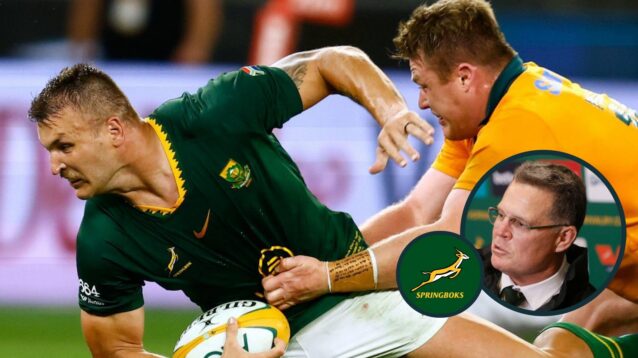
Planet Rugby’s Personality of the Year 2025: ‘Unstoppable’ Rassie Erasmus celebrated after becoming the ‘gravitational centre’ of Test rugby



Springboks head coach Rassie Erasmus and the South Africa team with the Rugby Championship trophy.
There are coaches who influence matches, coaches who influence seasons, and then there is Rassie Erasmus; a man who influences the entire sport simply by wandering into a stadium and blinking in its general direction.
If rugby were a global weather system, Rassie would be the jet stream: invisible, unstoppable, and capable of ruining everyone else’s plans with a single puff. He is Planet Rugby’s person of the year, not because he won the most games, or delivered the most polite press conferences, but because he has become the gravitational centre of Test rugby, the figure around whom the rest of the sport now orbits, rather like confused satellites wondering why their trajectory suddenly changed.
To understand Rassie is to accept that he does not coach rugby in the way the rest of us recognise it. He coaches something else entirely; a hybrid of physics, psychology and controlled demolition. Other coaches talk about “embracing chaos”; Rassie manufactures it in bulk, labels it neatly, and hands it to his players with instructions printed in triplicate. What looks like madness from the outside is, in fact, a meticulously calibrated environment in which only one team – his team – knows the rules.
The architect of constructed chaos
The Springboks under Erasmus do not simply play rugby, they impose a world view where South Africa is the ‘Promised Land’. They play with the conviction that the sport, at its core, is about force, clarity and emotional certainty, and that everything else – flair, tempo, width, attacking shape – is merely garnish.
Lovely garnish, yes, but garnish nonetheless. Rugby, in his world, is a sport of suffering, and the team that suffers best wins. So he builds teams that enjoy suffering, teams that look at a 50-minute scrum reset not as a setback, but somewhat akin the moment a medieval torturer hears the prisoner whisper ‘I can’t take any more,’ which is, historically, when the real creativity begins.
This is why South Africa under Rassie feel less like a rugby team and more like a military unit that has accidentally wandered into a sporting event and decided to stay. They don’t “embrace” confrontation, they treat it like a national pastime. They don’t “manage” pressure, they squeeze it until it squeals. And they don’t “weather” momentum swings, they simply refuse to acknowledge that momentum applies to them.
The bench that broke the sport
Nowhere is Rassie’s genius more visible than in the 50-70 minute window, a period of the game he has turned into his personal kingdom. Whilst other nations treat this phase as a test of endurance, Rassie treats it as an opportunity for escalation. Where others see fatigue, he sees leverage. Where others see the need for preservation, he sees the moment to apply pressure so relentlessly that the opposition’s structure buckles like a cheap camping chair under a heavy uncle.
The modern Springbok bench is not a collection of replacements, it is a second wave of artillery. Fresh props, fresh locks, fresh back-rows; all enormous, all technically precise, all capable of turning the final half-hour of a Test match into a physics experiment. Other nations bring on substitutes, South Africa bring on reinforcements. Reinforcements who look like they’ve been grown in a cryogenic chamber beneath Pretoria and released only when the opposition’s lungs have begun to resemble damp cardboard.
This is not innovation for its own sake. It is innovation rooted in a deep understanding of how the sport actually behaves under pressure. Rassie knows that fatigue makes players sloppy, and sloppiness makes referees strict. He knows that the laws do not change, but their enforcement does, and that the team capable of staying legal when everyone else is impersonating a collapsing deckchair will win penalties, territory and, ultimately, matches.
And while the rest of the world mutters about “dark arts” and “gamesmanship”, Rassie simply smiles, because he knows that the only dark art in rugby is failing to prepare for the obvious.
The referee whisperer and emotional engineer
To reduce Erasmus to a tactician is to miss half the story. He is also a master of emotional engineering, a man who understands that Test rugby is played as much in the mind as in the body. He knows when to provoke, when to inspire, when to unsettle, and when to turn a press conference into a psychological operation. He does not merely coach players, he coaches narratives. He builds siege mentality, unity and belief so strong it could power a small city.
And then there is his relationship with referees, a relationship best described as “complicated”, in the same way that a tornado has a complicated relationship with a caravan park. He doesn’t hate referees and he certainly doesn’t fight them. He simply understands them better than they understand themselves and he knows when they tighten, why they tighten, and he knows that after minute 50, fatigue makes players sloppy, and sloppiness makes referees angry.
So he selects players who stay legal when everyone else is impersonating a supermarket trolley with a bent wheel. This isn’t gamesmanship, this is foresight, this is preparation, and above all, this is a man who has studied the sport so deeply he can predict when a referee’s patience will evaporate like a puddle in the Karoo.
The man who rebuilt a dynasty – twice
And this is where the reverence becomes unavoidable; Rassie Erasmus has rebuilt South African rugby twice, which is frankly absurd when you consider most coaches struggle to build anything more structurally sound than a garden shed. Once in 2018, when he took a drifting, fractured side and turned them into world champions in 18 months. And again in 2023-2025, when he reshaped them into something even more formidable; a team that doesn’t just win, but dictates the terms on which the sport is played, rather like a judge who has grown tired of legal argument and simply bangs the gavel because he already knows the verdict.
He has created a blueprint that other nations pretend they can copy, but cannot. Because the blueprint is not the system, the blueprint is Rassie. You can photocopy the structures, the drills, the bench profiles, the tactical shapes but without the man himself, it’s like trying to recreate a Michelin-starred dish armed only with a microwave and a tin of salt.
His influence extends beyond results. He has redefined the decisive window of Test rugby, he has reimagined the bench as a strategic weapon, and he has forced the rest of the world to confront the uncomfortable truth that cohesion without confrontation is a dead end. He has made South Africa not just champions, but inevitable winners; the sporting equivalent of a Terminator; relentless, unblinking, and absolutely committed to completing the mission no matter how many times you think you’ve stopped them.
You can throw everything at them – tactics, tempo, trick plays, inspirational speeches – and they will still rise, dust themselves off, and continue marching forward with the cold certainty of a machine that has never once considered the possibility of failure.
And yet, for all the satire his methods invite – the water-carrier antics, the touchline theatrics, the occasional referee-related explosion – there is a seriousness beneath it all that commands respect. Rassie Erasmus is not a disruptor for the sake of disruption, he is a disruptor because he understands the sport more deeply than anyone else, and because he is willing to challenge every assumption, every tradition, every comfortable lie the game tells itself. He is the man who walks into a room full of sacred cows and immediately starts sharpening the knives.
He is the most influential rugby mind of his generation, he is the most disruptive force in the modern era, he is the man who has bent the sport toward his logic, reshaped its decisive moments, and forced every other nation to rethink what Test rugby actually requires.
And that’s why he’s our Rugby Personality of the Year 2025.
READ MORE: Springboks: Rassie Erasmus joined by hundreds of fans on annual Christmas Day walk in Cape Town