Opinion: Owen Farrell’s rescinded red card an appalling act of double-standards
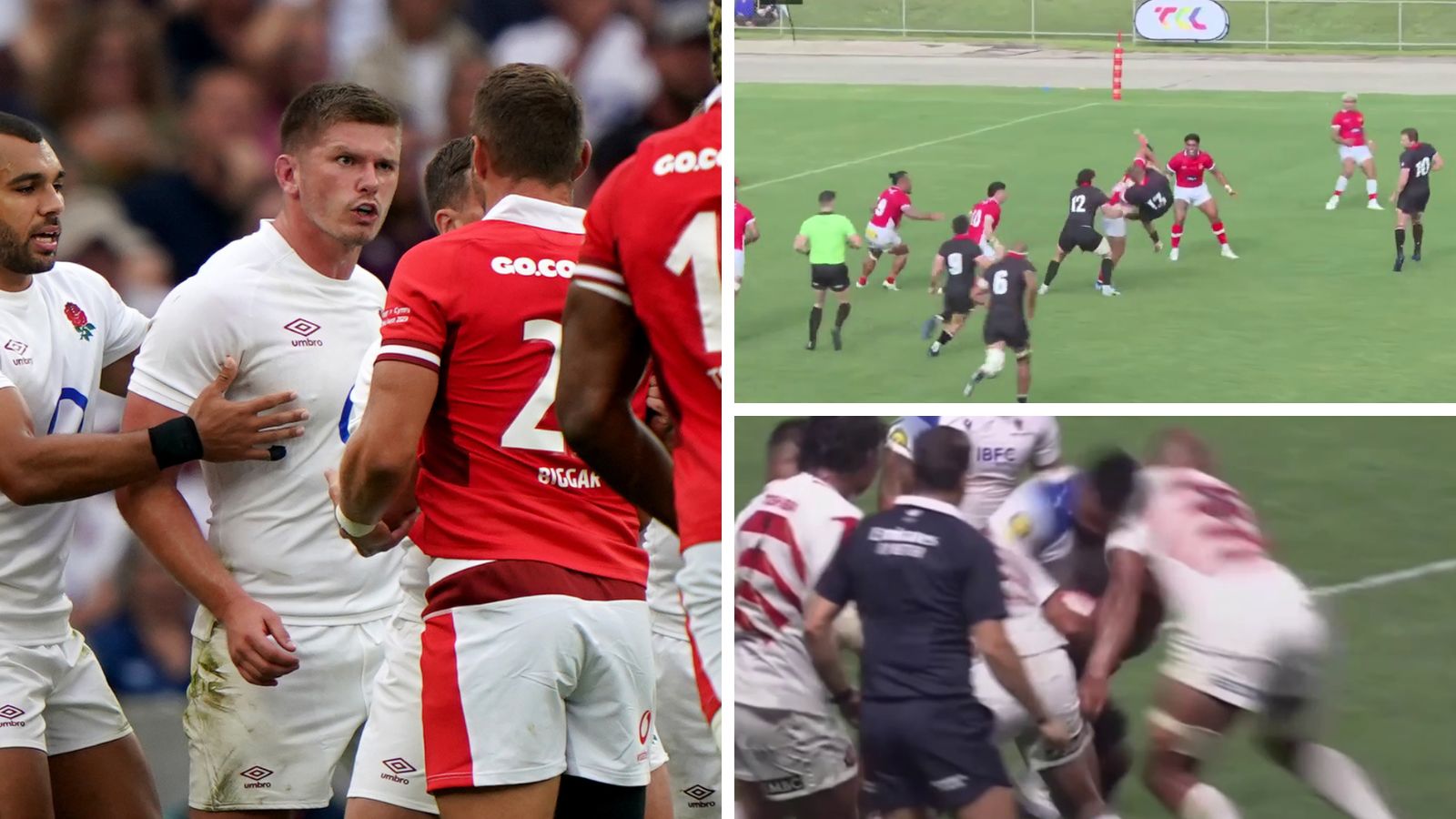
Owen Farrell, George Moala and Michael Leitch were all red carded for illegal tackles but not all of them were suspended.
Planet Rugby features writer Lawrence Nolan doesn’t hold back after England captain Owen Farrell’s red card was overturned in a shock disciplinary verdict on Tuesday.
Farrell un-Leitched…
It is fair to say that the verdict on Owen Farrell’s tackle on Taine Basham has polarised rugby worldwide. Perhaps there would be less global ripple if the verdict had been in isolation, but onlookers in Tonga and most pertinently, Japan, are seething with the indignance.
Rightly so. Farrell’s tackle we will look at in context in a moment, but for George Moala to get 10 weeks – thus missing the entire World Cup – for his tackle on his Canadian opposite was harsh. Not just because the tackle was silly, but not evil (he did not drive the player downwards), but also because, aside from a one-match ban more than a decade ago, Moala’s record is clean.
He might have missed the World Cup anyway even with six games, but a clean record, contrition, good appeal would most likely have pulled that down to four, even three with attendance at one of Farrell’s favourite haunts: tackle school.
But 10 weeks? Even in context of other disciplinary issues, that smacks of draconian book-throwing for little reason, or perhaps making an example of someone for some point or other. Lest we forget, Johnny Sexton walked onto the field as a non-player and openly abused officials, but only gets three weeks. In terms of the sport’s repute, whose is the bigger offence there? And if you needed to make an example of someone for the good of the game, which of those deserves more lenience?
For Farrell, the precedent was set not three weeks before – and here, your correspondent is perhaps compelled to abide by his own precedents too.
For a fortnight ago, I defended Michael Leitch to the hilt after he had been sent off against Samoa.
“…the pertinent part is the contact before Leitch’s tackle, between Sootala Fa’aso’o and the Japanese hooker,” I wrote.
“Before that, Leitch had been standing as if to try and make a tackle with his inside shoulder; the connection of Fa’aso’o with the hooker knocked the ball-carrier straight towards a head-on clash with Leitch.
“Leitch did not charge into the tackle. He did not have dominant force in the contact. He simply turned away and adopted a self-protective stance. Had he gone into the tackle, he would quite probably have ended up with his head on the wrong side and at risk of an ugly collision himself.”
The argument was that Leitch had been red-carded for an act of self-preservation and that that should have been taken into consideration. Perhaps it even was – but either way, Leitch was banned, for six weeks initially but with that halved for mitigating factors and Leitch’s decent history, reduced by one further match for his attendance at tackle school.
Stunned by Farrell’s judgement
When Farrell’s judgement emerged on Tuesday, I was therefore stunned. Not only because he had not been banned, but also because it was hard not to see the parallels between the disciplinary panel’s thoughts on the matter and the defence put up for Leitch.
Great, if they are listening – too many tackles like that are being punished. What’s not so great is the appalling inconsistency which sees Leitch still sidelined, Basham likely sidelined with concussion and Farrell continuing with his preparations as if nothing had happened.
There are two other differences in the situations from our view. The recipient of Leitch’s tackle was already being tackled and properly so. The force of the hit from Japan’s hooker on Fa’aso’o very clearly took the latter in a new direction of running, off balance, and with Japan’s hooker still wrapped around his waist when Leitch’s shoulder made contact.
By contrast, the contact from Jamie George which served to so exonerate his team-mate was, at best, a bit of a push, at worst an inconsequential grabbing hand on Basham’s shoulder. Either way, George was not attached to Basham by anything more than a finger when Farrell hit, nor was Basham irretrievably off-balance.
🟥❌ England captain Owen Farrell has red card overturned.
🏴 Read the full story as fly-half cleared to play. #RWC2023 https://t.co/GxXfV85Ydc
— Planet Rugby (@PlanetRugby) August 15, 2023
And then, the most important part, the moment of contact. Leitch very obviously does not step into it, does not want to hit like that. He does brace, but is standing still when hit and he is rocked backwards by the force of it.
Farrell moves into the hit. He clearly dips and then moves upwards, his feet are planted wide and steady, his weight moves into the contact. It’s not for us to say that he intended to hit the head, but he clearly intended to make a dominant contact. This did not have the look of an act of self-preservation.
Unlike Moala and Leitch, Farrell has plenty of previous – including plenty of points from a tackle-school loyalty program. Of contrition, there was in the game, and has been since, very little.
But, even so, even if I am forced to live by the precedent of my own arguments and say that Farrell’s and Leitch’s acts were similar enough, then I cannot advocate for Farrell’s act to be a summary red-card offence.
However, I can, indisputably, register astonishment, frustration and suspicion at the fact that Leitch is banned and Farrell is not. And yes, suspicion, suspicion that somewhere on high some strings were pulled somewhere to ensure Farrell was not found to have committed an offence. On the precedent of the Leitch ban alone – elements in the tackle incident notwithstanding – Farrell should have seen six matches as an entry point and lest we forget, his mitigation levels are low indeed when you consider his history.
Decision tarnishes rugby’s disciplinary processes
The decision to let him off is an appalling act of double-standards which further tarnishes rugby’s already-murky, inconsistent and fragmented disciplinary processes, not to mention being a shoulder to the chops of those waging a crucial campaign for better head injury management.
World Rugby has precedent too, for appealing decisions it feels to be incorrect or unduly lenient. If it does not perceive the skews and inconsistencies at the highest levels of disciplinary process and follow this precedent now, we shall have a very clear idea of how murky, inconsistent and fragmented its own priorities are.
READ MORE: ‘Terrible look’ – Six Nations refuse to publish full Owen Farrell disciplinary judgement