Loose Pass: B&I Lions tour proved ‘tradition’ trumps any ‘glitzy’ concept but R360’s ‘fat cheques’ still poses major threat


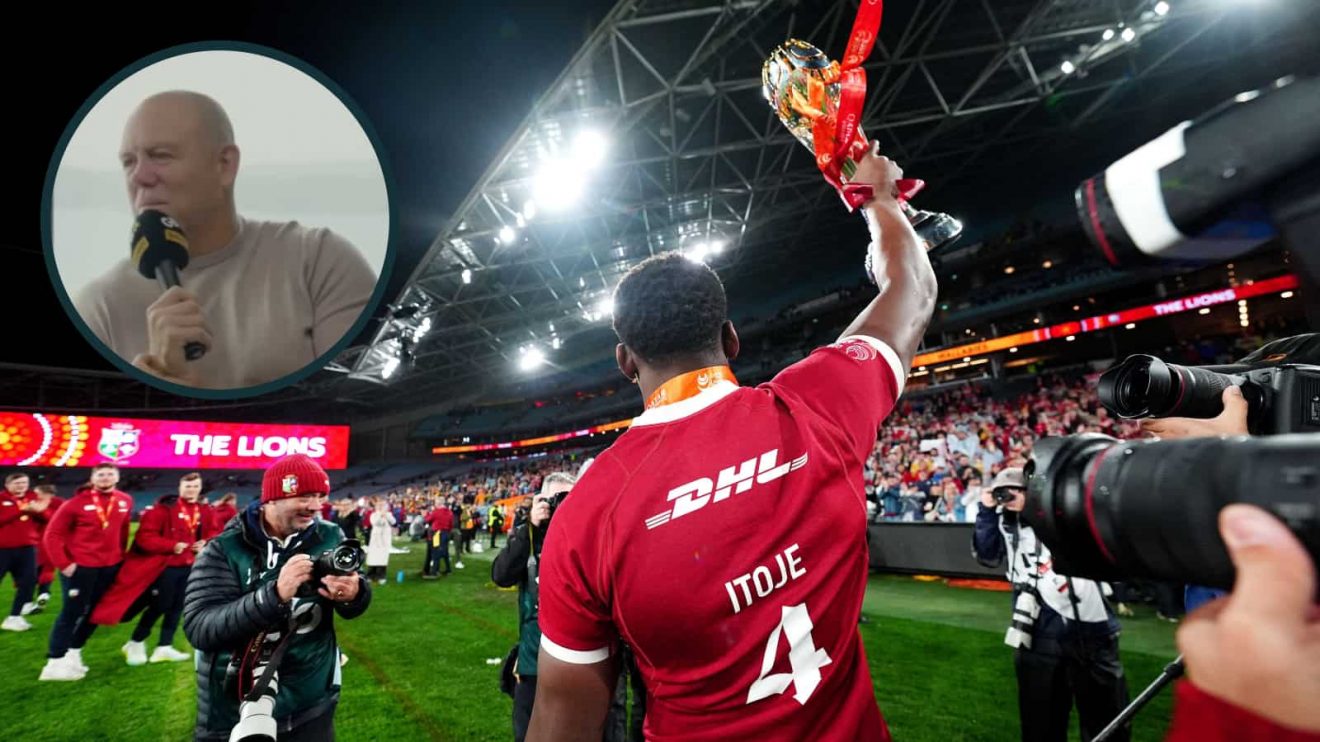
British and Irish Lions captain Maro Itoje and an inset of Mike Tindall.
This week we will mostly be looking back and forward on the Lions tour, and looking forward for Australia…
In four years’ time
Of all the post-tour analyses, thoughts and games being passed back and forth among fans and some scribes on Sunday, one of the most popular ones concerned sweepstakes and other competitions to name the next set of tourists.
Harmless fun, definitely a time-filler on those 22-hour return flights and an inevitable variation on the same sorts of debates that have been had all tour.
But also now based upon a number of suppositions and assumptions, few of which can be taken as for granted as they traditionally have been, even as recently as, say, four years ago.
That includes the assumption that all players will be available to both Lions and All Blacks alike, rather than having been lured away by the big fat cheques being dangled in front of them all by the R360 lot, whose ongoing campaign to ‘disrupt’ everything for the sake of money is becoming unsightly in the extreme.
That the Lions will play New Zealand in 2029 is, R360 sell-outs notwithstanding, a given, but after that? France and South America have both been tabled as alternatives the past few weeks – the players have made it reasonably clear that they’re less open to that sort of change than many observers, while the marked improvement in the Wallabies in the final two Tests also went some way to watering down the burning flame of change among observers.
David Campese slams ‘microwave meal version’ of Lions tour as ‘hype far greater than the reality’
And what about the midweek games? The ones on this tour were, with the glaring exception of the First Nation team, pretty poor. Pacific Islands have been mooted as alternatives there, which would tick a few boxes for inclusion of smaller nations but possibly make the tour even a little too abrasive, given the development of Fiji especially and of course, not to mention the fixture calendar which continues to keep the seamstresses busy.
But back to those players. Ben Earl was unequivocal on what it meant for him to tour and take the field, the significance he noticed in others, the friendships he forged with opponents. “I’d do anything” to go on the next tour is a phrase often used in jest, but Earl clearly meant it. The Lions, selection for the Lions and touring with the Lions in countries with decades of Lions tour history continues to be a pinnacle of achievement. How much can rugby afford to tamper with and convolute such ambitions for the players who aim to achieve it?
It’s true that for the observer, this tour has not been a classic. The team has been thoroughly professional in going about its work, to the extent that it has often felt a little too separate from the joys and local interactions that such tours are supposed to create. Yet that is from the outside; from the inside it’s been notable that there has been not one iota of dissent, that almost all players who have briefly popped their head out of camp and shared a passing word or two have had the time of their lives.
Something that is good for players should not be under threat from anybody in a position of administrative power within the game, nor without. We’ll see what the landscape looks like in four years’ time, but whatever we do have, hopefully it is something that players had input into and not something that money bought, or that administrators have sought to construct. If this tour has taught us anything, it is that however glitzy, glam and glorious a concept you create, it will struggle when going up against the fabric of tradition that the game has worn for so long.
Matt Williams: B&I Lions restored ‘absolutely tarnished’ image after ‘disgraceful’ Springboks series
Advance Australia
The Wallabies, meanwhile, will be considering a lot of chances missed. This is a three-Test, 240-minute series in which the Wallabies led the Lions for 158 minutes, that crucial two minutes short of the 160 proving to be the pivotal two minutes.
Future hosts will surely seek to not be as undercooked ahead of the first Test as this Australia team evidently was, while the bad luck that nipped chunks out of the preparation ahead of the series also made perhaps more of a difference than has been commented on. Selection mistakes, such as the initial omission of Taniela Tupou, also made a difference in the final reckoning.
But with the first Test debacle now banished to memory, and with face saved by a dominant win in filthy weather in Sydney, Australia’s future looks bright. The Giteau law is gone, meaning Australian coaches can now seek to tap into the same wells of knowledge that Rassie Erasmus has done so successfully with South Africa, not to mention prolonging some international careers which still have a few more miles to run. Australia’s team has not felt settled for years now, the restrictions on overseas players clearly a contributor to that. A more settled look to the team would be a clear benefit.
Looming for Joe Schmidt now are two Tests against South Africa, in South Africa, difficult assignments, but also against a team that has not faced much serious opposition in this recent Test window. The third Test performance, more than anything else, was marked by precisely the sort of endless aggression and physicality required to have a chance against the World champions, while you’d think that it would rattle the current crop of All Blacks.
Australia may have lost the series, but the benefits to the Wallabies, both on and off the field, have been huge. If it ends up being a catalyst for a re-emergence of the Wallabies as a rugby force, the pain of those final two minutes in Melbourne will fade quickly.
READ MORE: Opinion: Wallabies MUST capitalise on scrapped policy and embrace new era