Law discussion: Should Joe McCarthy and Josh McKay’s Champions Cup tries have stood?


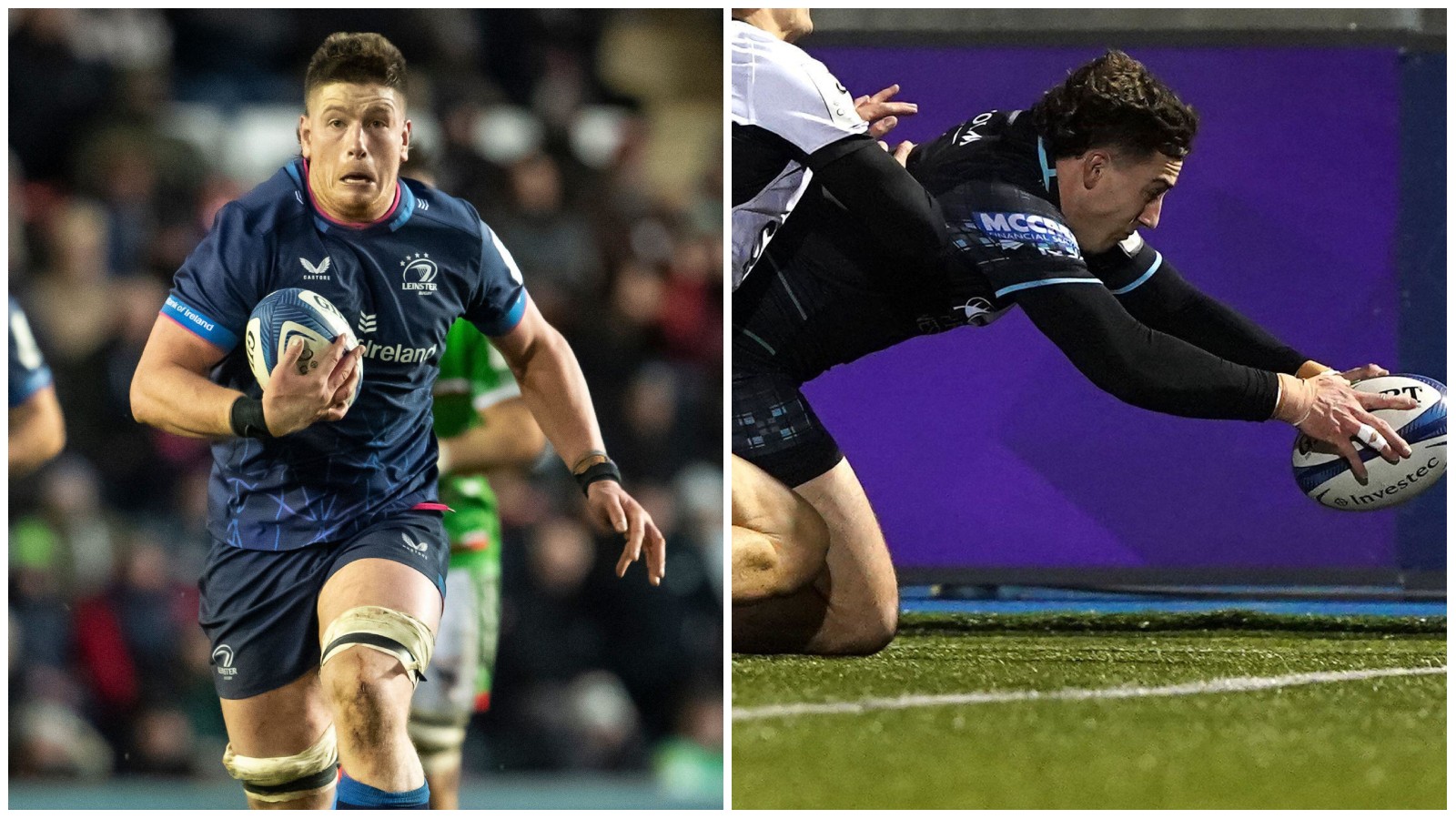
Leinster second-row Joe McCarthy alongside Glasgow Warriors full-back Josh McKay.
A terrific weekend of rugby conjured up not only several super tries and a couple of thrilling finishes, but also several points of contention. As rugby does!
We’re not going to delve into the red cards here; among other reasons, they’ve been covered elsewhere. But there were absolutely a couple of moments, one when scoring a try and one when a try was disallowed, which are worth looking at from a purely legal point of view.
To release or not to release?
Leinster, who made a slow start to Saturday’s Champions Cup game, have finally got their way up to the Leicester line, and momentum is with them. After a series of drives, lock Joe McCarthy picks and goes and drives into a Leicester tackler, with Tadhg Furlong driving over in support in a classic pick-and-go quick ruck.
As Furlong drives over the tacklers, McCarthy is released at the back of the ruck. He gets to his toes and torpedoes forward over the line, dotting down. Referee Andrea Piardi, who is five metres away to the left of the ruck, instantly blows for the try.
Tigers players are incensed, as they feel McCarthy should have released the ball before picking and going again. But Piardi is unmoved, while the TMO also, even as replays are broadcast, feels not compelled to intervene.
So, the legalese first:
Law 14: The Tackle states:
For a tackle to occur, the ball-carrier is held and brought to ground by one or more opponents.
Being brought to ground means that the ball-carrier is lying, sitting or has at least one knee on the ground or on another player who is on the ground.
Being held means that a tackler must continue holding the ball-carrier until the ball-carrier is on the ground.
This checklist is quickly completed. McCarthy runs into the guts of Hanro Liebenberg, who gets his arms around McCarthy’s body. Both McCarthy’s knees hit the ground while Liebenberg is still engaged.
Law 14 continues:
Tacklers must:
Immediately release the ball and the ball-carrier after both players go to ground.
Immediately move away from the tackled player and from the ball, or get up.
Be on their feet before attempting to play the ball.
Allow the tackled player to release or play the ball.
Allow the tackled player to move away from the ball.
This checklist is also completed as much as possible. The impact of Furlong takes Liebenberg off McCarthy and Liebenberg doesn’t even have time to try and play the ball before McCarthy is off again for his second charge.
How on earth does that try from Joe McCarthy stand?
— Jared Wright (@jaredwright17) January 20, 2024
Law 14 continues further:
Tackled players must immediately:
Make the ball available so that play can continue by releasing, passing or pushing the ball in any direction except forward. They may place the ball in any direction.
Move away from the ball or get up.
Ensure that they do not lie on, over or near the ball to prevent opposition players from gaining possession of it.
This first part does not happen. Subsequent replays show the ball very much in McCarthy’s grasp as he propels himself to his toes and forwards. Not for one second does he let go of the ball.
However, he does get up almost instantly.
So the question really is: should he have had to let go of the ball?
As we see from these checklists, yes he should. A tackle occurred, and the tackler fulfilled his duties. McCarthy should have placed the ball before getting up and playing it again.
In this instance, you could probably excuse Mr. Piardi as he was unsighted by the clearout of Furlong. But it is mystifying as to why the TMO did not intervene, as the replays were crystal clear and almost immediate.
The vagaries of obstruction
Glasgow were too good for what was largely a second-string Toulon team on Friday, but it took a while for the Warriors to wear the visitors down.
After 15 minutes and 5-0 to the good, Glasgow full-back Josh McKay took a deep ball and ran a slant line towards the Toulon chasing line. A gap opened up, and McKay tore through, going all the way for what would have been a scintillating 60m score.
But the TMO tells referee Matthew Carley to check for an obstruction. In his words: “I want you to look at a player in front of the ball carrier who prevents a potential tackle.”
It’s lock Scott Cummings who stands still – and leans a little backwards – into Toulon hooker Teddy Baubigny, preventing Baubigny from being in the perfect position.
It seems very harsh. Baubigny got to McKay despite the bump with Cummings and flapped at McKay rather unconvincingly. It was not only Baubigny either, prop Emerick Setiano also made a thoroughly unconvincing attempt at tackling McKay. Neither tackler bent, neither stepped in with the shoulder to the thighs or guts as you should. It was a very poor tackle technique.
The relevant law is Law 9: Foul Play, which states:
An offside player must not intentionally obstruct an opponent or interfere with play.
A player must not intentionally prevent an opponent from tackling or attempting to tackle the ball-carrier.
The key word here is actually ‘intentional’. The video does show Cummings stopping his slow jog in retreat and leaning slightly – in the manner in which you would lean when bracing for a collision – just at the moment Baubigny approaches.
A bit of Josh McKay magic 🪄🏉
But 𝗶𝘁'𝘀 𝗱𝗶𝘀𝗮𝗹𝗹𝗼𝘄𝗲𝗱… no try 😳#InvestecChampionsCup pic.twitter.com/0ZwK0szknA
— Rugby on TNT Sports (@rugbyontnt) January 19, 2024
As outlined above, Baubigny probably could have got there. And he treads a fine line; the contact was minimal at best, while Baubigny’s attempt at a tackle was very poor.
But unfortunately, the leaning position of Cummings is enough for him to contravene both of the laws above, as he is offside when he obstructs and he intentionally tries to prevent an attempt to tackle.
It looked harsh, and you wish Baubigny had looked as though he really wanted to tackle rather than just hoping for the penalty. And if Cummings had just not leaned, we might be talking about a different outcome. But to the law, the decision was correct.
READ MORE: Loose Pass: Quirks of a formula, perceptions of recklessness and of advantage, and the Smiths