John Smit calls on World Rugby to adopt his ref comms ‘plan B’ idea and compares ‘most outstanding player for Australia’ to Springboks great


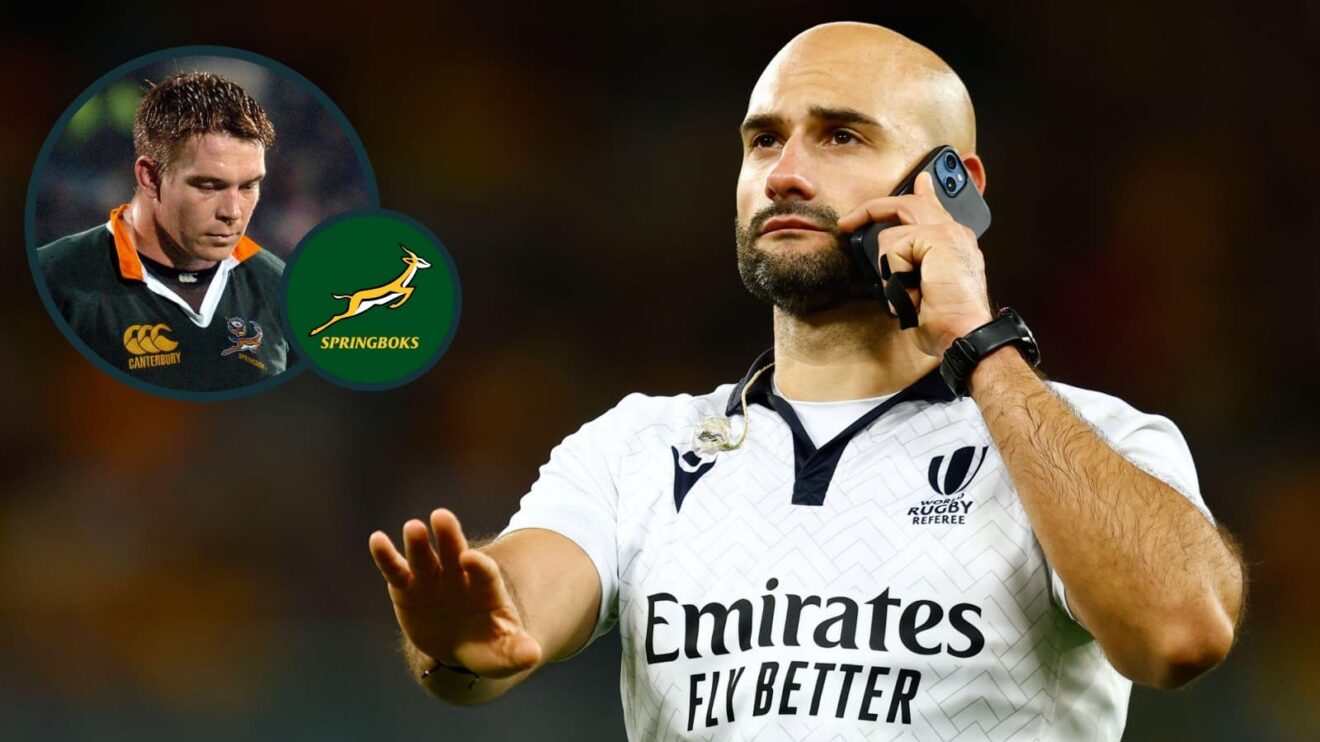
Referee Andrea Piardi on the mobile phone last Sunday in Perth and, inset, Springboks legend John Smit
Springboks legend John Smit has called on World Rugby to adopt his plan B to deal with future breakdowns in communication between a referee and the TMO.
Last Sunday’s clash with the Wallabies in Perth was the second successive South African match affected by broken comms. It resulted in a touchline jobsworth running onto the pitch on several occasions to hand a mobile phone to referee Andrea Piardi so that he could talk with TMO Matteo Liperini about a variety of contentious incidents.
The embarrassing situation followed on from the first-half delay experienced 13 days earlier when the comms went down in the Springboks-All Blacks match refereed by England’s Karl Dickson in Baltimore.
Rather than simply join the chorus of criticism about what unfolded in Perth in a fixture the Springboks lost 38-42 to the Wallabies, Smit has instead voiced his sympathy for the match officials and offered his innovative opinion on what should happen about any future comms breakdowns.
“There has to be something like that in World Rugby…”
Appearing on the latest episode of the I Love Rugby show hosted by George Gregan, Smit, the 2007 Rugby World Cup-winning skipper, suggested that a stadium-loud horn needs to be made available to the TMO so it can be blown to alert the referee that the action must be stopped and footage reviewed on the big screen.
This, according to the retired Springbok front-rower, would stop game time being lost as the action last Sunday continued until there was a break in play which allowed the mobile phone to be run onto the pitch for the referee to take a call.
“I feel terrible for the referees,” Smit began. “That is the worst-case scenario. He [Piardi] is a really good referee, and he had a fantastic game under the circumstances, but he was dealt a few cards. If you think about everything, a Wallaby camp, a Springbok camp, an All Black camp or England camp, everyone’s got a plan B in terms of strategy. ‘It’s not working this way, boys. Let’s try a little bit of a wider channel’.
“And there has to be something like that in World Rugby. Comms are comms; no one’s doing it on purpose. But something goes down, then all the responsibility actually needs to get back onto the head referee, the guy in charge. What could be a solution? Maybe there’s got to be a horn. So, for example, there’s no comms between TMO and referee, you’ve got this massive screen and the referee still can see whatever he [the TMO] is seeing.
“If there is something that a TMO picks up but he can’t get the comms in and he can’t stop the game, there needs to be a horn where the referee stops the game, stops the clock, has a look and makes the decision himself. The phone needs to get taken out of it.
“So comms go down, TMO continues to do his job, but all he’s got to do is help him [the referee] pick up things like high shots, foul play and all that kind of thing. Blow a horn in the stadium, the referee stops the game, the clip comes on, he makes a decision with his team and the game goes on.
“What happened on Sunday was there’s no comms and the team can’t get the message on and there’s 30, 40, 50 seconds of phase play before they stop the game, which you have now lost.
“I’d be conservative and say that if I was the captain of South Africa on the weekend, my issue would have been, can we turn the clock back to when the incident happened? Can we save that time because we desperately needed that time, but it’s not within the laws of the game to now go back and say, ‘Okay, well that transgression, that high shot, was made 45 seconds ago, let’s bring the clock back’.
“So that is one thing. And then the other is, and South Africa’s been good at it as well, sort of slowing the game down, if there’s a time clock for a kick, surely there should be a time clock for after the conversion has gone over. How much time have you got before you have to kick the ball off?
“There’s a couple of things that could be addressed there, but one thing is, when you lose comms, give the power to the referees, put the same clips on the TV and save the game time. We lost probably four or five minutes of game time on Sunday and start controlling how teams can’t manipulate time. I’ve got no criticism about the referees. They were under the pump. That’s a hard situation to deal with.
“But we can have a plan B, a strategy that can at least bring the game back to the actual referees of the game. I’m not going to talk old school here, but give the decision-making back to the referees. Have a horn in every stadium when the comms are down, and if the TMO sees something, he blows the horn, game stops, but we didn’t have that on Sunday.”
Despite the comms farce affecting the second half flow of the match, Smit admitted that it was “a fair result” that Australia held on to win by four points. “It was probably the most varied kind of attack that we have had to face for a while, and that keeps a defensive system that’s pretty hectic on its press.
“It keeps them working and guessing all the time and having to make decisions. You saw a couple of times the rush sort of got caught in no man’s land, and a line break unfolded from it.
“It’s because there becomes this uncertainty around is, it coming direct or is it going wide? That variance was incredible, and you guys [Australia] have got some monsters. There’s some big boys there and they carried well, they stood up, got over the advantage line and had the ability to get rid of that ball behind a first receiver and get the ball to the first five-eighth. That was most impressive.”
Want more from Planet Rugby? Add us as a preferred source on Google to your favourites list for world-class coverage you can trust.
Smit went on to single out Wallaby scrum-half Ryan Lonergan for his contribution, describing his influence as similar to what Fourie du Preez used to wield when playing for South Africa. “Without a shadow of a doubt, he [Lonergan] was the most outstanding player for Australia and certainly on the field because he controlled things. We all love Fourie, and we all know how valuable he was as a team player.
“But Fourie was one of those scrum-halves that exited well. He managed the game well, he passed when he had to pass and he found the right people – and I saw that in heaps on Sunday (with Lonergan). The exit ability was incredible. His ability to get them out of their 22, just sort of between the 10 and the halfway line, takes a bit of pressure off and his decision-making around the back.
“It was the first time I’ve watched the game at home for the last six weeks and had the pleasure of commentating for my wife, but I said to her, ‘This nine has completely controlled the game’. It’s the first time I’ve seen someone play a similar kind of distribution, controlling, management, strategy, quarterback role since the days of Fourie de Preez.”