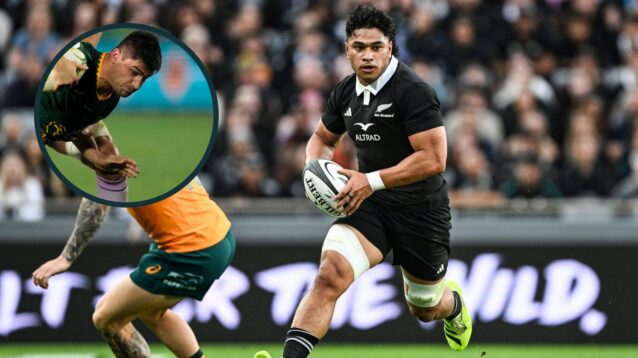
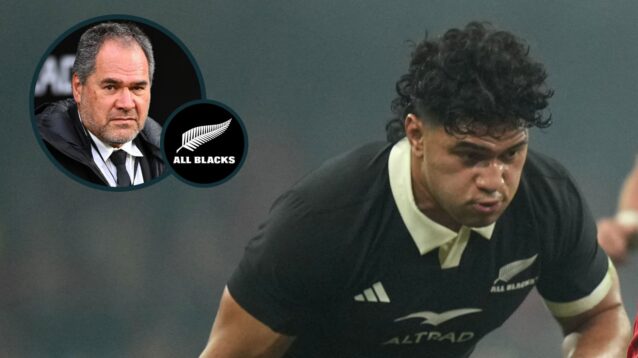
Ireland v All Blacks: Five takeaways including the not-so-farcical red card as ‘outrageous’ Wallace Sititi shines


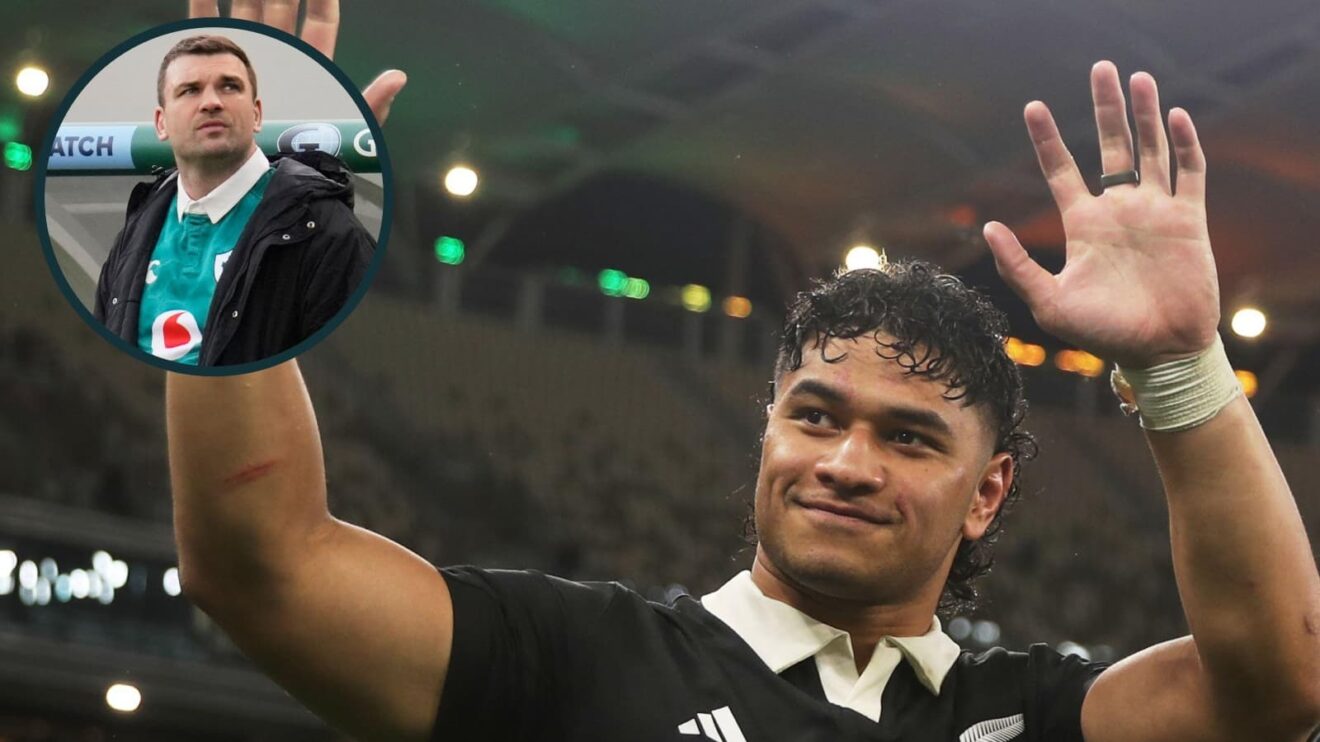
All Blacks loose forward Wallace Sititi and an inset of Ireland's Tadhg Beirne.
Following the All Blacks’ 26-13 victory over Ireland at Soldier Field in Chicago, here are our five takeaways.
The top line
A modern rugby rivalry of the highest order, and one that had it all as the Americans were treated to two of the best teams in the business throwing absolutely everything they had at one another. It was brutal, beautiful, controversial – an out-and-out blockbuster aptly dubbed ‘The Rematch’.
Ireland threatened a repeat of their 2016 heroics at Soldier Field as they opened up a 10-0 lead, courtesy of a Jack Crowley penalty and a Tadhg Furlong try, despite being down a man due to Tadhg Beirne’s red card – more on that shortly.
However, the All Blacks‘ reply was emphatic as Leicester Fainga’anuku skinned Garry Ringrose, sent Will Jordan sprinting through a gap with slick handling, and seeing Ardie Savea sneak over the line. Beauden Barrett’s conversion meant that Ireland led 10-7 at halftime.
Crowley added a penalty in the 50th minute, but that would be their last contribution to the scoreline as the All Blacks took control of the match with their bench making a telling impact as Tamaiti Williams and Wallace Sititi crossed the whitewash before Cam Roigard completed the win.
All Blacks squash 2016 demons in comeback win over Ireland in Chicago
Beirne sending-off
The Planet Rugby offices are rarely pleased that the 20-minute red card is in place, but today, we were. The controversial law trial meant that this game remained a true contest right to the end after a clumsy tackle by Beirne, probably Ireland’s best player over the last two years.
It took under three minutes to produce the first bit of controversy in this one as Roigard threw a forward pass to Beauden Barrett, who was running a decoy line, and Beirne had little time to adjust but made a head-high, no-arms tackle.
Matters only got worse from there as the big screen was unable to show the replay to referee Pierre Brousset, who insisted that he had to see the footage, but ignored pleas for him to review the incident on the sidelines.
After a lengthy delay, we finally got a decision with Brousset rightly deeming the tackle to meet the yellow card threshold and sent for the final call to be made by the TMO bunker.
This is where the real discourse starts as the Foul Play Review Officer, Dan Jones, deemed that shot warranted a red card, and while the Irish fans will cry incompetence, there is certainly merit to the call.
Beirne shoots out of the line and is expected to make a low, legal tackle when he goes into contact and to the letter, he fails to do that. He is upright, and he does not use his arms and hits Barrett high.
“It’s been upgraded to red card because it’s a high level of danger,” Brousset told Dan Sheehan when explaining the final decision, with the Ireland captain arguing that it was “a forward pass, where’s the mitigation?”
Sheehan’s argument is a poor one; the onus is on Beirne to make a legal tackle regardless, and he didn’t. However, that does not mean that the call wasn’t a harsh one, as it looked far more like a rugby incident than anything else. The assessment that it was a ‘high level of danger’ is also very questionable. It was deemed that Barrett didn’t require an HIA and would remain on the pitch. The decision is far less farcical than what it’s being made out to be, but certainly wasn’t a great one.
Not-so undercooked Ireland
Reports of Ireland being undercooked for this match were greatly exaggerated as Andy Farrell’s charges were well and truly up for the fight against an All Blacks outfit that looked to be shaking off more rust than their opponents.
Sure, there were teething problems like the lineout being rather poor, but overall, the men in green were far sharper than many predicted that they’d be. Jamison Gibson-Park was fizzing passes and rocketing the ball into touch with real venom, while Furlong was outstanding in all facets.
Fellow Leinster stars Jack Conan and Josh van der Flier were their usual busy selves as they all hit the standards that earned them Lions call-ups in the first place.
Unfortunately, for Farrell, not all the Lions and Leinster stars found their form in the green jumper as Ringrose repeatedly misread the All Blacks’ attack and was punished, while James Lowe had several really soft moments. Bundee Aki also struggled somewhat.
All Blacks still aren’t clicking
The All Blacks remain a work in progress under Scott Robertson, as for much of the match, they struggled to really get going on attack and were pinned back in their half.
The real turning point was the introduction of Sititi, who was simply sublime, but before he was thrown into the mix, New Zealand lacked fluency and were very inaccurate.
While it is stated that Jason Holland’s departure is his own decision, it’s plainly obvious that something isn’t quite right, particularly with the attack, whether that’d be a lack of clear direction or just poor execution.
Robertson does deserve credit for his bench selections, particularly the timing of their inclusions, as that was very much the difference between winning and losing.
Justified selections
Both coaches made selection calls that raised an eyebrow or two, but both were vindicated.
Crowley dominated the Inter-pro derby and deservedly got the nod over Sam Prendergast as the starting fly-half, and for the most part, the Munsterman delivered. He played a major role in pinning the All Blacks back and put in a commanding performance for much of his shift. He fell off in the latter stages of his 67 minutes on the park, but he had far more good moments than bad.
Stuart McCloskey was given a rare start in a big match, and the Ulster number 12 did not disappoint. The centre was abrasive with his carries, racking up more metres and carries than any other Irish player. When he came off, the All Blacks gained the ascendancy and punished Ringrose and Aki’s poor defence.
In the black jersey, Fainga’anuku was outstanding following Jordie Barrett’s injury and is simply producing far better performances than Rieko Ioane. His combination with Quinn Tupaea was pivotal to the All Blacks’ success, while Beauden Barrett continues to prove that he is the best choice at number ten.
The back-row also performed well as a trio, with Peter Lakai starring in the number eight jumper, while Sititi was outrageously brilliant, Robertson will do well to keep the current set-up and play to their strengths, after its clear success in Chicago. Ryan Baird also continues to impress on the side of the scrum for Ireland.
READ MORE: Why Ireland faced a slightly different All Blacks Haka in Chicago after introducing ‘sacred’ tool