How England ditched Felix Jones blitz for ‘moderated push’ and what Fin Smith is doing ‘wonderfully well’ under new coach


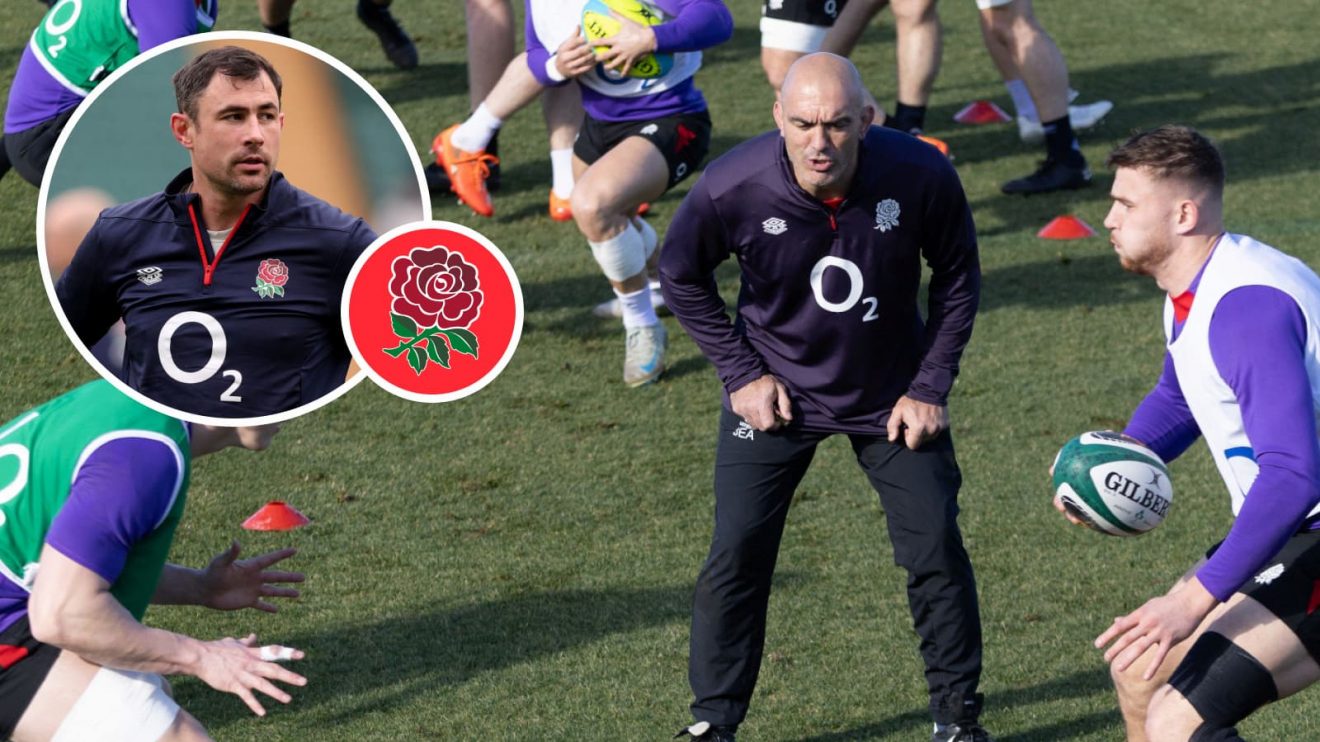
England defence coach Joe El-Abd at training session.
Since Felix Jones left the England set-up to be replaced by Joe El-Abd, much discourse has taken place around the new defensive system that the latter has implemented.
It’s clear that England are using a more passive system in terms of line speed and that they are keen to get defensive breakdown situations in wider channels that perhaps we’ve seen in recent times.
Their shift against Scotland was quite remarkable statistically, making 206 completed tackles with a 85.48 success rate. Whilst the number of tackles made was high, the effectiveness is aligned with their returns in the 2024 Six Nations, where we saw an average completion of around 86% over and above this season’s 84%, a negligible difference.
What is the change that England have implemented, why are they doing it and what advantage does it create?
Felix Jones blitz
The premise of a focussed blitz system is to ‘shrink the pitch’.
By that, we mean play in as small an area as possible, to maintain rucks in the central part of the pitch and to use power in contact to win the collision or make the tackle. As seen in Fig 1, the 13 or outside centre will look to rush out of the line to ‘cut the pitch in half’.

Wingers will maintain control of ‘the edge’ but tight into their centres and relatively much higher in their start point, relying upon the team’s percussive power around the breakdown to prevent the defence folding and to stop their opponents gaining width. In coaching terms, this is called ‘closing the gate’ and you will see wings facing the ball with their eyes and tracking up and down in order to prevent the chance of a long cut out pass. Whereas traditionally, wingers were trying to stay square and then adjust in, in the blitz you’re trying to step in facing the ball. They can move off either foot to go forward or back, depending what happens to the attack and their role, with the 13, is key.
England: Steve Borthwick breaks down key factor behind benching Marcus Smith
Nine works as a pendulum and is fluid ‘in the boot’ and can work around the openside wing if the system fails to take the last man in attack and the opposition break the gate/edge.
It relies upon supreme fitness, requiring players to ‘self-recycle’ back into the line and to make close quarter hit after close quarter hit.
Given the close quarter nature of the system, power is a significant factor in its implementation, as carriers will be coming inside off pops and centres looking to crash back inside due to the defensive creep on their outside. Less important is personnel used and spacing, simply because more bodies are in closer contact with each other and generally, the key is to win the primary moment with a dominant tackle.
England’s moderated push
In England’s case, they are now reverting to a moderated push system, similar to an old fashioned drift, but slightly more dynamic and fluid.
The key premise here is to create laterality – that is to get the ball into isolated runners in wider situations. Steve Borthwick has been picking exceptionally quick and mobile forwards in the back five of his pack. At times, he’s played effectively three openside flankers in his back-row, and for all the athletic qualities of the Currys, Earl, Itoje and company, their straight line power isn’t quite at the level of sides such as France, South Africa and Ireland. So England are looking to play to their strengths and are backing the pace of their back five and loose trio to get across and make interventions in the wide channels, rather than down the middle.
Whilst the tight men still guard the close quarter exchanges, the wider defenders, starting with the openside forward and the key defending players at 12/13, are looking to attack the INSIDE shoulder of the attacker, asking them to work towards the tramlines. (see Fig 2). In the blitz, those players will attack the OUTSIDE shoulder to entice them back into the defended area in traffic.

You might ask why, and the reasons are clear; against both Ireland and France, their nines like to break close alongside the ruck and to get into scramble situations as quickly as possible. In a blitz, you are almost always defending both sides of that breakdown moment, so once broken, recovery is hard. In France’s case, Antoine Dupont absolutely thrives on breaking the ruck defence, either with his own pace or by pop offloads to carriers on the burst.
By moving the potential breakdown point to wider channels, you are asking your opponents to either come back with the grain and re-attack the openside, or, to kick for position, something we’ll mention in a moment. Using that perceived advantage of forward mobility, England should have more numbers on feet as the phases come.
Spacing is absolutely key in the moderated push – there’s generally more of the pitch to cover so accuracy in both position and person (keeping props out of match-ups with centres and so on) is vital to achieve success.
A key man in this system is the ten – he closes down the inside attack and must defend reliably and consistently – something that Fin Smith has done wonderfully well, averaging 16 tackles a match with a 94% completion record, and notching up five dominant hits since he was brought in as a starter against France.
Cascading to prevent exit
England are also employing a clever cascade system in numbers (see Fig 3).

This is changing the front and support line formation to suit the part of the pitch you’re playing in. When defending an exit in their opponent’s 22, in very rough terms, the formation will be likely 12 in the primary line and a pod of three behind (12/3). As their opponents move up the field, the resourcing will change; in the opposition 22 to England’s own ten metre line area we will see 13/2; England’s ten metre to England 22 or closer, 14/1 and when in 22 or near goal line, as much as a 15/0, although you might also see 14 with nine sweeping ‘in the boot’ in those scenarios. A feature of this formation is to see a back-rower, usually Tom Willis or Ben Earl, as part of that secondary pod.
This is a plan to deliver two clear outcomes:
1. To use England’s aerial ability to create contests and to win them, returning in transition with kick or carry.
2. To get teams to over-kick and to use their fast back-rowers to get the first ruck off the turned over possession as far up field as possible.
It’s particularly interesting that England have opted to recall Elliot Daly at 15 to supercharge the return. Whilst he no longer has Marcus Smith’s electric pace and footwork, he has a real intuition for spotting cracks in defensive systems in front of him and Borthwick has clearly brought him in to exploit the overlong kicks with his handling ability to get his back-row cohorts running at the soft shoulders he sees.
The first ruck position from the kick return is an absolute key focus of the English system – they want it as far upfield as possible – between their own ten metre line and the halfway line if they can, and having carriers alongside Daly with the pace and agility of Earl and Willis is a key component of this plan.
As with all defensive systems, the execution and concentration is always the key to success. Sometimes, just changing up what a team does can refocus those qualities and in England’s case, there’s little doubt that whilst the system suits their resources and selection better, the new voice of implementation has been just as important for them.