France v Italy: Five takeaways as Les Bleus march on to Grand Slam but ‘courageous’ Azzurri can take positives as ‘freefalling’ England await
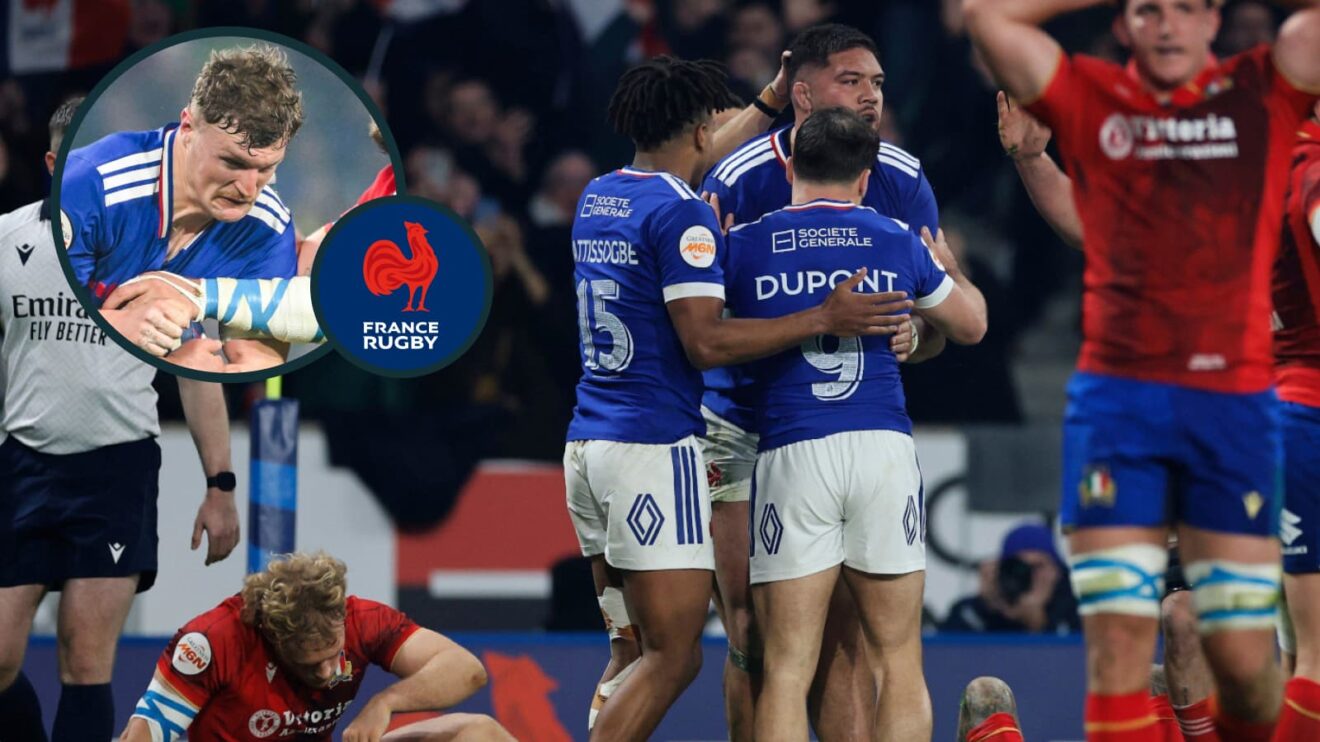
France lock Emmanuel Meafou scored against Italy.
Following a 33-8 victory for France against Italy in the Six Nations on Sunday, here’s our five takeaways from the game at Stade Pierre-Mauroy.
The top line
France are on course for the Grand Slam and, frankly, it is difficult to see who stops them. Despite Matthieu Jalibert withdrawing the night before the game, Fabien Galthié’s side barely registered disruption that would have sent lesser sides into panic as a bonus-point win was secured in Lille.
The scoreline of 33-8 looks emphatic in the cold light of the table, yet the story was more nuanced than that; at 72 minutes, Italy were still within touching distance, and three of France’s five tries owed as much to individual error and gift-wrapped opportunities as to the irresistible system that has made them the tournament’s dominant force since 2022.
Italy were competitive for large parts, particularly in defence, frequently courageous, and monstered Les Bleus at scrum-time. But they were consistently undone principally by the moments that separate good sides from great ones as they struggled in the air and really couldn’t win enough shoulders in the collision with ball in hand.
They will still take a lot from this game – their defensive resilience a big plus for Gonzalo Quesada. They host in Rome against England next with more to offer than today’s scoreboard suggested, and given England’s freefall spiral, the Azzurri will be licking their lips despite this result. France, meanwhile, march on. Three from three, a Grand Slam in their sights, whilst the rest are playing for the scraps.
Dupont, Flament, Meafou
There is a particular kind of excellence that makes the difficult look simple, and Antoine Dupont operates in that register consistently enough now that we risk becoming numb to it. Sunday was not his most spectacular afternoon; France did not need him to be, but when those key moments that mattered arrived, he simply owned them.
And just not in attack either; the turnover that snuffed out Leonardo Marin’s most threatening burst of the game, arriving at precisely the moment Italy might have converted pressure into points, was vintage Dupont; anticipation so sharp it borders on the supernatural, execution so clean it removes any doubt in the official’s mind. Alongside him, as he returned from his self-enforced absence, Thibaud Flament was imperious, his lineout work the spine on which France’s set-piece dominance was built and his traffic carries piecing. Both he and Emmanuel Meafou added enormous dynamism in tight, another layer to the second-row, and the Meafou try in the first half, forcing through the Italian defence with a combination of power and low body position that set the tone for a forward pack that controlled the collision legally and accurately, without ever needing to resort to brutality.
Then there is Louis Bielle-Biarrey. Louis Lynagh’s tap-back handed him the invitation, but what he did with it was entirely his own. The acceleration off the mark, the body position through the contact, the finish, a reminder that you do not give this man a sniff in space and expect to recover. Add in his work-rate, whether chasing, tackling, clearing or challenging to complete an all-round world-class package.
His record across this campaign and last year’s tournament is now extraordinary by any metric, a record eight-match scoring run, and the uncomfortable truth for every defensive coach remaining in this Six Nations is that there is still no reliable answer to him when France go wide with pace and conviction. He is the tournament’s most dangerous finisher, and by a massive distance.
Italy errors
Credit where it is due to Quesada’s side. They competed with genuine intensity throughout, and the half-time score of 19–8 told a story France’s coaching staff will have studied carefully. To their huge credit, there was no capitulation, and Italy were far from passive in the face of French pressure, defending brilliantly either side of the interval.
The problem was the one that has haunted them at the highest level for years and which Quesada has been steadily but not yet completely eliminating; accuracy deserted them precisely when they needed it most. Final passes went to ground in the French 22, decision-making was rushed under pressure, and the execution, especially in their aerial game, that had looked so assured against Scotland and Ireland in Rounds One and Two, went missing at exactly the moments when they’d created momentum, and France were creaking.
Lynagh had a difficult afternoon, though not entirely of his own making, given the ball he was asked to handle and some of the wayward kicks he chased tirelessly. But the yellow card for the deliberate knock-on that gifted France field position effectively ended the contest as a competition and was the moment Italy’s resistance crumbled. The 33–8 scoreline was probably harsher than the game warranted at that stage. Marin, for the record, was again impressive, carrying well, reading the game intelligently, and causing problems in the channels that a better-supported attack might have converted. Italy’s passing game on return plays from midfield showed flashes of the kind of dynamism that could trouble England’s defensive structure in Rome and once again Tommaso Menoncello had moments of brilliance but couldn’t quite convert. Quesada will have noted his team’s struggles, and he’ll know exactly what to fix before they face England.
France nine depth
When Baptiste Serin replaces Dupont in the final quarter and France do not lose a yard of momentum, when Charles Ollivon, a man who has scored in every Six Nations round this campaign until this match, emerges from the bench, when a side missing one of the finest fly-halves in European rugby still claims a bonus point with something to spare, you are watching something more than a talented team. You are watching a programme that has been industrially engineered to make individualism irrelevant, but the system is the focus. Galthie is able to do this due the sheer depth he’s created and the conveyor belt behind the first XV is starting to look as if it is simply relentless.
At scrum-half alone, France possess a depth that is frankly absurd by the standards of any other nation in world rugby. Dupont, Serin, Juanaud, Le Garrec and Graou among them, any one of whom would walk into most Tier One squads without too much debate and start for most of them. The back five stocks are, if anything, even more extraordinary. Flament and Meafou might be regarded as the first-choice engine room in the second-row, but then Guillard, Jelonch, Jégou, Cros, Ollivon and Nouchi are, between them, providing a back-row and lock rotation of a quality that most head coaches would consider a luxury at the level of a single name, let alone four. In midfield, the centres are carrying real menace, and Emilien Gailleton, a man converted from the wing and growing game by game into one of the most complete midfield operators in the championship was the player who tied it all together in Lille, his footwork for France’s fourth try on Sunday showcasing the kind of instinctive nose for the line that terrifies scrambling defences. This squad has been built to win a Grand Slam, but Scotland in Round Four will be the biggest test of the competition so far for France. The Grand Slam feels, by now, like the minimum return, and Les Bleus know what’s expected of them.
Work-ons
Italy’s aerial game and territorial kicking were uncharacteristically imprecise; loose from hand in a tournament where field position against this French back three is an existential matter and they paid dearly for it, conceding two 70m tries. Ramos, Theo Attissogbe, and Bielle-Biarrey (with the support act from Gael Drean on debut) are collectively the most dangerous counter-attacking unit in the championship, and Italy fed them too many opportunities with wayward exits and poorly-weighted kicks. It is a correctable problem, and Quesada’s meticulous preparation suggests it will be addressed before Rome.
Want more from Planet Rugby? Add us as a preferred source on Google to your favourites list for world-class coverage you can trust.
On the other side of the ledger, France remain a tighthead short of genuine elite status at scrum time. The platform, or lack of it, gave Italy so many easy outs as their front row, with both Simone Ferrari and Danilo Fischetti shining both in the tight and strutting their qualities in the loose, exerted a worrying level of scrum dominance. It is the one area of the France squad where the question remains unanswered and there’s a concern it may yet be the question that matters most when the Grand Slam is on the line.
For Galthie, the worry is deep; there are no options that are quantumly better than those he’s picking – Rabah Slimani is too old to realistically make a World Cup 2027 cycle, Emerick Setiano isn’t a man in favour right now, but the solution may very well be found in the massive shape of Tevita Tatafu. He qualified on residency grounds, having moved to Bayonne from Tonga at 17 in 2019, and made his France debut against Japan in the 2024 Autumn Nations Series, but was pulled by France as a forfeit for this game for reasons unspecified by the FFR. The fact that he played for Bayonne on Saturday suggests it’s not a serious injury, and he may very well feature in France’s trip to Murrayfield.
READ MORE: France land timely blows to floor Italy in Six Nations as Grand Slam dream remains on track