Ex-Irish boss’ ‘grateful’ verdict on World Rugby summit but predicts Bomb Squads’ legality will be raised while one law ‘remains a concern’
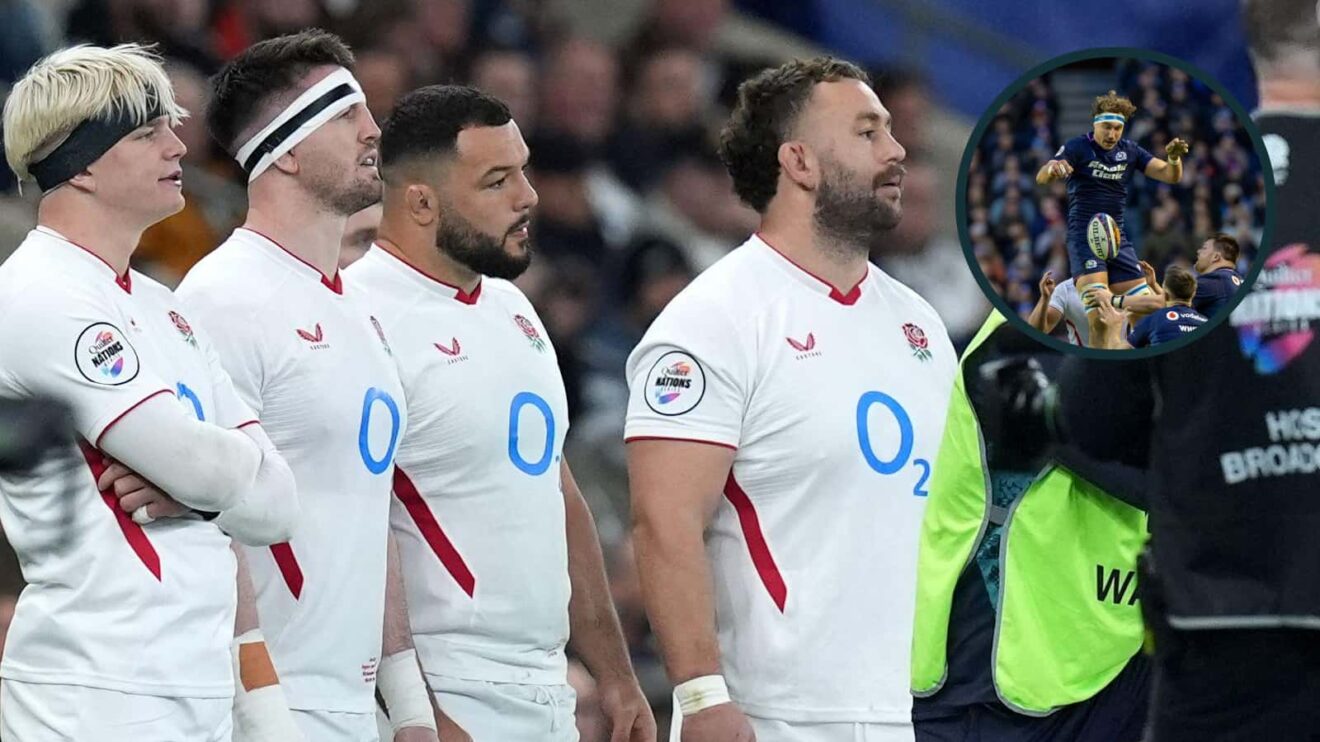
England bench during the Autumn Nations Series and an inset of a Scotland lineout during the Six Nations.
Ex-Irish referee boss Owen Doyle is pleased that no law changes have occurred following World Rugby’s Shape of the Game summit.
However, he believes that one global trial ‘remains a concern’ and predicts that debate around the substitutions will be re-raised at future meetings.
Speaking to the media in Cape Town, Rassie Erasmus said that he was pleased with the outcome of the meeting, and while World Rugby put out a statement of ‘universal agreement’, the Springboks boss explained that there were clear talks from nations looking after their own interests.
Still, the conversation was always brought back to ‘what’s best for rugby’, according to the coach.
Providing his views on the meeting, Doyle wrote that he would have loved to be a ‘fly on the wall’ in London to witness what unfolded, but was ultimately ‘grateful’ that no new law trials were introduced and no alterations were made.
Lineouts remain a problem
Despite having an overall positive reaction to World Rugby’s statement following the summit, he did have one gripe, which was that the trial around skewed lineout throws gives the throwing team a ‘disproportionate advantage’.
A skewed lineout throw is permitted under the current trial provided that the opposition does not compete for possession and the ball travels over the five metre line and not beyond the 15 metre.
Doyle has advocated for unions to ‘vote down’ its permanent adoption into the lawbook and reaffirmed that stance.
“The lineout global trial remains a concern. It goes forward for full ratification at World Rugby’s June meeting, despite its unintended consequences,” he wrote in the Irish Times.
“A crooked throw will not be whistled if the opposition does not put up a contesting jumper. Fine so far, and the throwing team can then play the ball to the scrumhalf, or form a maul.
“However, when the maul is illegally formed, the throwing team is being given a disproportionate advantage. Three or four players leave the lineout early, as the ball is thrown, then binding together they turn and drive on their jumper, as he lands, to propel the maul forward. It is extremely difficult to defend, or to stop.”
Eddie Jones fumes at ‘joke’ World Rugby conference which was ‘a waste of time’
The former international referee, who served as the head of match officials at the Irish Rugby Football Union, says that even if the law remains in its current form, there is a fix that does not require change.
“A simple tweak will fix it: apply the law which prohibits players leaving the lineout until it has ended. Allowing the practice to continue is effectively another law change, which has never been proposed or trialled in any way,” he added.
There were reports of factions forming during the summit, suggesting that while a consensus was met in London, not all the unions are aligned.
SA Rugby boss: Why New Zealand and South Africa may never host a Rugby World Cup again
Bomb Squads and red cards
Doyle points to the number of substitutes and bench splits as an example as well as the red card sanctions which he believes will be revisited at future summits, with the former not even warranting a discussion this year.
“While the 20-minute red card is now part of the game, there is still discussion in relation to the on-field permanent (straight) red,” he wrote.
“France, in particular, have been very vocal in insisting on the retention of the latter, so there’s clearly more to come on this, hopefully sooner rather than later. The conference outcomes don’t mean that everything in the garden is rosy.
Want more from Planet Rugby? Add us as a preferred source on Google to your favourites list for world-class coverage you can trust.
“The bomb squads and 7-1 bench splits, for example, will continue. Apparently, it didn’t even merit discussion. It’s a subject that will come up again.
“But right now, we should just be grateful that the current laws are retained and the charter of the game has been reinforced. In time, we will see more law-change proposals. These should always be tailored to fit the charter – not the other way around.”