Ex-All Black hails ‘mature’ Springboks approach as Rassie Erasmus’ men sacrifice desire to ‘absolutely dismantle’



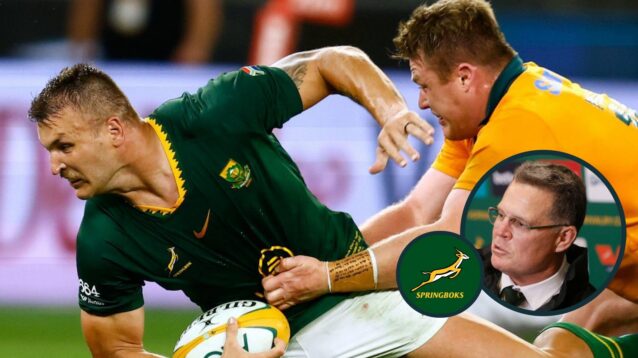
Springboks lock RG Snyman celebrates scoring against the All Blacks in Wellington with an inset of head coach Rassie Erasmus. (Photos by James Foy/Speed Media/Icon Sportswire)
James Parsons has hailed the fresh approach the Springboks used in their record victory over the All Blacks in Wellington.
The former Test and Blues hooker believes that Rassie Erasmus’ charges used subtle tactics which helped South Africa in being far more ruthless with the ball in hand, particularly once they entered New Zealand’s 22.
In round three of the Rugby Championship, the Springboks spoiled multiple opportunities in the All Blacks‘ 22, capitalising on just two of their 13 entries through tries for Cobus Reinach and Malcolm Marx.
However, they had a much better conversion rate in Wellington, grabbing six tries from their 12 entries, with Cheslin Kolbe crossing twice, while Andre Esterhuizen, Kwagga Smith, Damian Willemse and RG Snyman added further five-pointers.
Four of their six tries came in the final 20 minutes of the clash at Sky Stadium, and while that was certainly the turning point in the fixture, Parsons says that the cracks for New Zealand were already showing the week prior and that the conditions played a big role in the All Blacks’ heaviest defeat in their history as they were thrashed 43-10 by their fiercest rivals.
Springboks’ mindset shift
He dived into the Springboks‘ attacking stats and detailed how a subtle change in the way the South Africans carried into contact made a huge difference. He suggests that a tactical tweak saw the Boks carry more conservatively, meaning that they went to ground far quicker and didn’t fight for more yards post-contact in order to speed up the attack and give the All Blacks’ defence less time to react.
“You can isolate the second half, but it wasn’t going all our way,” Parsons remarked on the Aotearoa Rugby Podcast.
“Also looking back to Eden Park, we said if we allowed South Africa to have that many opportunities again, and we knew Wellington was going to be dry conditions, it was too much ball, too much territory to be able to withstand it – any defence would crumble.
“I suppose it shows that in the sense that South Africa still had 21 turnovers, but there are some key stats for me that just show why they were able to find the space on the outside.
“The breakdown is really critical, and we say rugby simple: you win the collision, you put yourself in a position defensively to bring line speed or play on top of teams.
“Well, South Africa won the collision on attack in particular. They had a 70% gain line, which is no surprise, but I think the All Blacks haven’t faced a 70% gain line this season. They had 50% lightning-quick ball, but one of the smart things, and I don’t know if it’s Tony Brown or Rassie Erasmus, is that they only had 13% dominant carries. As we’ve outlined previously, they’re used to 50% or 60% dominant carries. You’d look at that stat and go, ‘Oh man, All Blacks must have done a job like in the tight collision’, but it was more that the South Africans didn’t try and overplay their hand in the contact.”
Further explaining the reasoning to go to ground more easily, he continued: “This idea of post-contact metres and fighting your way actually buys the defence time, and what they did is they almost sacrificed those extra two or three metres to recycle that ball quickly.
“From a logical point of view, 70% gain-line, you’re on the back foot defensively, 50% lightning-quick ball, you’re again on the back foot, you just got no chance to get set and then every time they took a close collision in tight, you are expecting it to be that big brute collision, the D tightens and then the Springboks have that quick recycle and then they play with width.
“The skills of Damian Willemse and co. just exposed that. It would be easy to go look at the 70% defensive stat and go ‘Oh one-on-one tackles is a key focus’ but to bring it back to why it makes it challenging is purely around that collision area and the way the South Africans dominated those collisions but also played the chess game really well in terms of deciding when to go through the middle but also when to sacrifice a little bit to gain a lot on the edge.”
Opinion: Felipe Contepomi rightfully ‘fed up’ as inexcusable errors mar Rugby Championship race

Springboks attacking stats v New Zealand via the Aotearoa Rugby Podcast
‘Not All Blacks standards’ – Israel Dagg hits out after shocking statistic revealed
Parking their egos
Show host Ross Karl asked Parsons whether the All Blacks should have expected such a fast and loose game from the Springboks, considering how they set up the team with Erasmus selecting a young, inexperienced backline with many of the players renowned for their attacking prowess.
“Absolutely,” he responded.
“Because if you look at it statistically, they had 12 entries this weekend and 13 last. The weather conditions (in Auckland) meant they could only capitalise on two. Then in Wellington, they capitalised six and still had six turnovers; they still had 21 turnovers.
“Like if you looked at it in the first half, you would have sat there and gone, ‘This isn’t working’, they were dropping a lot of balls, they missed a lot of opportunities, but they stuck with it, they backed their game plan, and the passes started to stick.”
All Blacks great: Springboks ‘on another planet’ as ‘mini Jonah Lomu’ typifies historic victory
Parsons believes that the Springboks players parked their egos and made a massive adjustment in their mindset when it comes to carrying the ball into contact in order to come out on top. Traditionally, South Africans are renowned for their abrasiveness and physicality in contact but the ex-hooker was impressed by their willingness to sacrifice physical dominance to improve the lethality of the attack.
“I think they made a big adjustment. They made a real big adjustment in terms of that tight collision. It almost removed a little bit of ego to generate that quick ball to skin them on the outside,” he added.
“That is not easy to do when you think of the Springboks and the way that they want to absolutely dismantle you in those tight quarters.
“They were really mature in their approach, and it shows their ability to really understand multiple ways of playing rugby. They’ve got the ability to play that kick game when you put Handre Pollard back in and they’ve got this ability to put some X-factor players out wide.
“The forwards have to play their role as well, and obviously they did that at the set-piece, but more importantly, they were smart around that collision.”
The All Blacks were unable to adjust on the night but Parsons explained how they could when the two nations met again and South Africa deploy similar tactics.
“The adjustment starts at the set-piece, you’ve got to have parity or dominance and then in the collision area, but you can’t do that if they’re on the front foot already from the set-piece,” he concluded.