Opinion: Champions Cup final to get ‘independent’ director treatment but organisers must fork out for easy 2026/27 fix


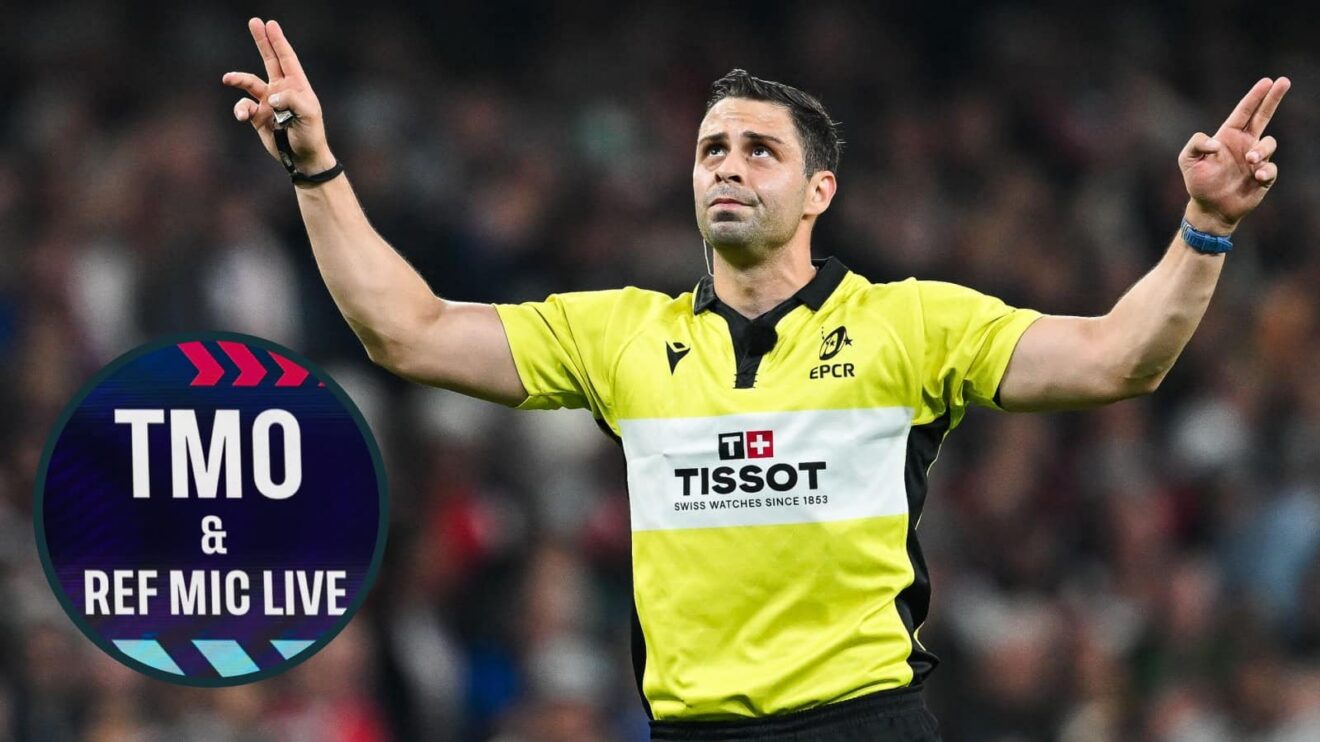
Referee Nika Amashukeli.
After the controversy surrounding the semi-final between Union Bordeaux Begles and Bath Rugby, the Investec Champions Cup final will reportedly have an independent TV director.
Bath boss Johann van Graan bemoaned three dangerous headshots on Alfie Barbeary that went unpunished during his team’s defeat to the French club, pointing to the TV broadcast director’s failure to provide the TMO with sufficient video evidence.
Further criticism was levelled at France TV’s handling of the fixture with ex-England internationals Andy Goode and Lawrence Dallaglio, and Ireland legend Brian O’Driscoll slamming what unfolded.
Owen Doyle, the ex-director of referees at the Irish Rugby Football Union, had a rather dim view of the events, too. “It’s been going on for donkeys years now and remains an unacceptable disgrace that the TV director controls what is shown on replay and what is not,” he wrote.
EPCR get independent TV director for Champions Cup Final after semi-final controversy – report
In response to all this, The Irish Times reports that an independent broadcast director is set to be in position for this month’s Champions Cup final between Leinster and Bordeaux in Bilbao. An Englishman is likely to be at the helm to ensure fairness and to make sure that the correct angles and replays are shown to the viewers and officials.
This is clearly needed after what we witnessed in Bordeaux, but it’s treating the symptom and not the illness, as the main issue is that the EPCR confirmed to AFP that the video systems like Hawk-Eye weren’t utilised for the last-four encounter.
“The TMO interventions are managed by the television broadcast,” EPCR told AFP. “Two screens are used: one live, and another with a five-second delay. This is identical for all EPCR matches. Every incident the TMO wants to study can be the subject of a formal review.”
Essentially, this means that the fourth official is at the behest of the home broadcaster to provide replays and angles of anything they wish to review.
This set-up is used in PREM Rugby and EPCR competitions, but it is frankly archaic and not fit for a top-tier club tournament, never mind the knockout stages of what is supposed to be and marketed as the world’s leading club competition.
World Rugby’s TMO standards
For World Rugby, this set-up is not acceptable as highlighted on the governing body’s website: “For TMO services in particular, World Rugby insist that Independent Video Replay is used at all of their tournaments. This means that the selection of and control of images being shown to the referee is independent of any input from the television production function.”
Effectively, the World Rugby U20 Championship has a better video replay and TMO set-up than the premier club competition. The argument would be that they have more funds available to cover the costs and fewer fixtures to manage, and that’s fair enough, but where there’s a will, there’s a way. The URC has made it work, and there’s no reason why the Champions Cup can’t too.
During his rant on the Rugby Pod, Goode also referenced the lack of uniformity around the levels of sanction in the club game at the moment, which isn’t completely aligned with World Rugby. The French are utilising the orange card, the English don’t have a Foul Play Review Officer (TMO bunker) this season, the URC does, while down in Super Rugby Pacific, the TMO’s powers continue to be reduced season on season.
He is right, this is an issue, and it all boils down to the bigwigs in control of the coffers and what they are willing to ‘splurge on’ as a Foul Play Review Officer means another paycheck to cut, Hawk-Eye is another expense that does provide a clear-cut return on investment.
Ultimately, every governing body has to protect the future of their tournament, but for the integrity of the game, setting a higher global standard for the technology available to the officials and removing the influence of home broadcasters should be the absolute bare minimum.
World Rugby protects its prized asset, the Rugby World Cup, by eliminating the possibility of that influence, as the TMO will have a real-time video replay system, located in the TMO booth and independently operated by a technician. This system is able to replay and rewind at any point from any given angle and would not rely on what the broadcast director is providing to the audience. The TMO works closely with the technician, flagging potential incidents to review when there is a break in play, and when the review is initiated with the on-field referee, control of the broadcast is handed over to the technician.
The likes of Hawk-Eye, QTV, and SMT make this possible for the World Cup, and it’s needed for the sport’s biggest event. EPCR doesn’t need to go quite as extreme lengths, but simply adopt one similar to the URC, where Hawk-Eye is used. Where the TMO is not reliant on the TV broadcaster for angles or footage, as they have access to all of it independently.
URC’s use of Hawk-Eye and how to cover the cost
URC Head of Match Officials Tappe Henning has long been an advocate of the technology. “It’s an unbelievable system. Hawk-Eye offers so much. I can’t even begin to describe how much technology we can apply in the game, and we are so excited to bring it into the game, accuracy of decision-making is hugely important, and if we can use it to improve it, it will be great,” he said back in 2022. In 2025, the URC became the first major club competition to implement this system completely and remove the reliance on broadcasters to support TMOs.
The URC has not been without its controversial moments this season, but the Champions Cup has again emphasised that the current system is outdated, and Henning will surely have data to present to the EPCR on the benefit Hawk-Eye will have. It’s an easy fix for next season and one that surely has to happen.
Want more from Planet Rugby? Add us as a preferred source on Google to your favourites list for world-class coverage you can trust.
Again, the argument of how or who will fund it will arise, and the answer to that lies with those board members earning the big bucks, but surely it’s an opportunity for a commercial partner to get involved? There is a real snobbery in rugby around advertising, as highlighted by the ‘outrageous’ decision of ITV to play a 30-second ad during each half of Six Nations matches, but a similar ploy could be used to fund the expense.
Ala, “This TMO review is brought to you by…’ or said advertiser’s logo appearing on a banner running throughout the duration of a review process. It’s a small trade-off to protect the integrity of the game and make what is already an incredibly difficult job so much easier for the officials.
It’s simple: move with the times, invest in the technology and protect the integrity of the game and tournament.