Bordeaux-Begles v Ulster: Five takeaways as French ‘juggernaut’ rumbles on while Irish spirit begs the question of ‘shambolic’ English sides


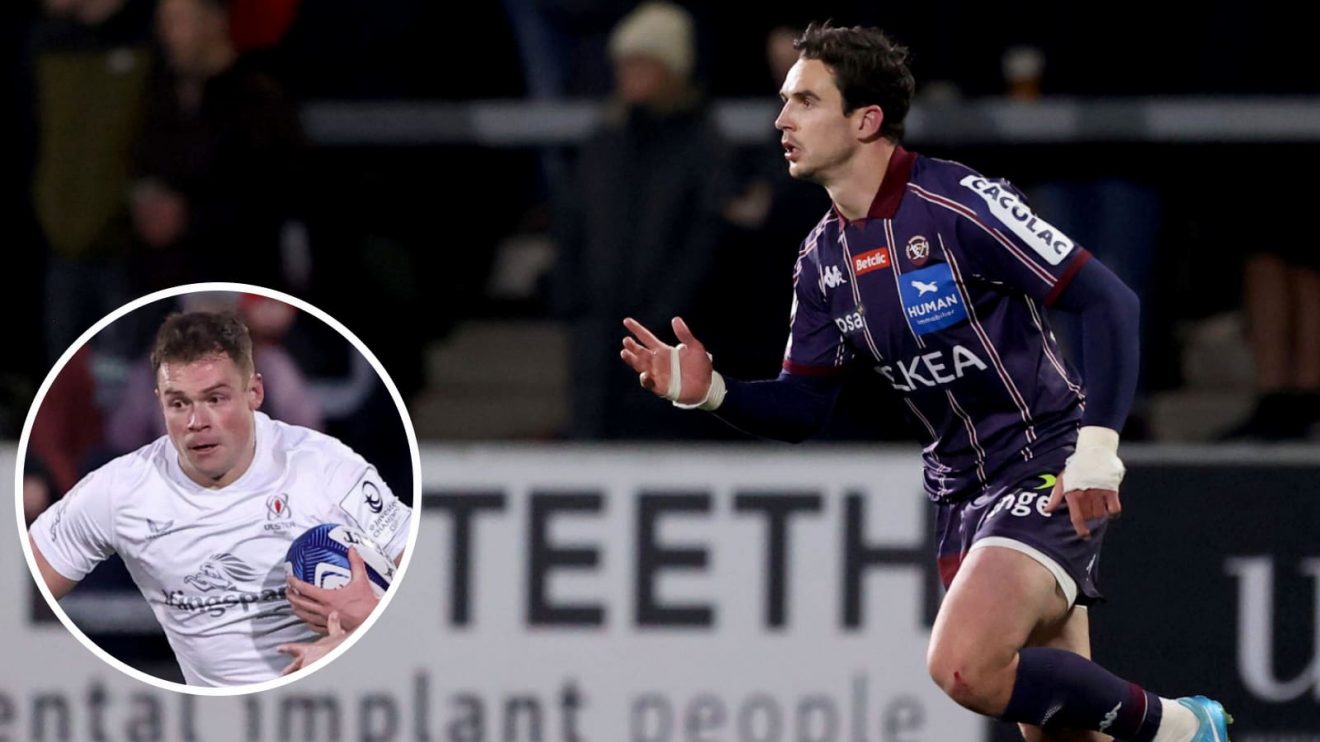
Joey Carbery in action for Bordeaux-Begles and Zac Ward featuring for Ulster.
Following a 43-31 victory for Bordeaux-Begles over Ulster, here are our five takeaways from the Investec Champions Cup last-16 encounter at the Stade Chaban-Delmas on Sunday.
The top line
Bordeaux-Begles produced a dominant 50 minutes to take the game away from Ulster and earn their place in the quarter-finals of the Champions Cup, where they will face Munster.
It was always going to be a tough ask for the visitors and so it proved as UBB showed all their qualities in the early stages. The forwards were brutal in contact and the backs, led by Maxime Lucu and Joey Carbery, had too much quality for the Irish side’s rearguard.
They scored 21 points in as many minutes with Damian Penaud, Ben Tameifuna and Adam Coleman touching down for a comfortable lead. At that point you feared a hammering was on the cards, but Ulster responded through Tom O’Toole and David McCann to reduce the arrears.
However, Romain Buros’ try at the end of the first half proved crucial and took the game away from the visitors. Maxime Lamothe’s try then effectively secured the victory for the Frenchmen, despite the province’s spirited response. Nick Timoney and Zac Ward, who touched down twice, meant Ulster exited the Champions Cup with their heads held high, but Bordeaux, as expected, had too much class.
Joey Carbery’s chance to impress
The forgotten man of Irish rugby was keen to remind everyone back home that he remains a rather decent rugby player. While France international Matthieu Jalibert will likely take the reins for the very biggest matches in the Top 14 and Champions Cup, the fact that Carbery was trusted by the Bordeaux coaches for this huge knockout match says a lot about his form this season.
After joining the French outfit from Munster, the playmaker has become a key part of the squad, whether it be at fly-half, full-back or as an impact player on the bench. It is evident that the 29-year-old is playing with confidence, which is fantastic to see after the struggles of last season.
The way that UBB play seems to suit him down to the ground and there were several classy touches from the Ireland international, with the highlight an outstanding pick up and break which led to Buros’ try on the stroke of half-time.
With Sam Prendergast and Jack Crowley two exceptionally talented young fly-halves, no one is suggesting that Andy Farrell should be trying to lure him back to Ireland, but Carbery is certainly not done at the highest level on this evidence. It was certainly interesting that the momentum swung after the playmaker went off early in the second period.
French brutality and dexterity
There is a wonderful balance to French rugby at the moment and it is showing on the field. The Top 14 has always been the most physical domestic competition in the world but, with a few exceptions, teams rather preferred to bring the power and very little else. It therefore created a rather turgid affair, albeit it was often quite effective.
Gone are those days, however, with the majority of French sides combining the beauty with the brawn. The way some of their teams have ripped through their opponents has been frightening at times. Toulon on Saturday and Bordeaux – at times – on Sunday were exceptional in the way they used their muscle and skills to open up Saracens and Ulster respectively.
While the big budgets inevitably help greatly, it is much more than that. French rugby is an absolute juggernaut at the moment with the academies producing elite talent, the overseas stars adding so much ability and nous, and the coaches innovating to great effect, making it very difficult for Europe and South Africa to stop.
👉 La Rochelle v Munster: Five takeaways as Irish province pip hosts in ‘Ronan O’Gara derby’
Irish spirit
At 36-14 in arrears, Ulster could have easily folded in the final half-hour, but the Irish province were absolutely magnificent in the latter stages of the contest. It was a tremendous response from a side who have received plenty of criticism this season and only just scraped into the knockout stages.
The bench made an impact, with Matthew Dalton, Nathan Doak and Stewart Moore standouts, but their big players also stood up. Jacob Stockdale and Stuart McCloskey were already two of their more threatening players in the first half but, as Ulster grew in stature, so did those two players.
With Ward joining them in impressing and continuing his own upward progression, they caused real issues for one of the Champions Cup favourites. It was not the result they would have liked but they can come away from the Stade Chaban-Delmas with immense pride.
URC and Premiership comparisons
It has been fascinating to watch Munster and Ulster over the past couple of days and compare it to the English sides, who suffered some embarrassing results and produced – in the case of Leicester Tigers and Harlequins – shambolic performances.
While it never really looked like the Irish province would stage a dramatic comeback and realistically force UBB to panic too much, the way they fought and took the Frenchmen on physically was a credit to themselves and the United Rugby Championship.
Both Munster, who were exceptional against the La Rochelle behemoths, and Ulster have shown incredible resilience against supposedly better teams in hostile atmospheres. It is something the Premiership outfits can learn from and ultimately makes you wonder whether it is competition that is adequately preparing their sides for the Champions Cup.
The PRO14 – as it was called – used to be a distant third behind the English and French domestic competitions in terms of its intensity and entertainment value, but that has changed markedly since it has become the URC.