Loose Pass: Officiating, law change ideas and tactics



This week we will mostly be concerning ourselves with some early thoughts from the Rugby World Cup in no particular order of preference…
On officiating
Offside at rucks is still a problem. Players are standing with one of their feet behind the last foot of the ruck, it is true, but the other foot is still some way further forward in the classic ‘ready, steady, go’ stance. France spent so much of the game against Argentina with their defensive line somewhere around a metre into the ruck it was laughable.
Still, there is so much generally going on at rucks you can forgive the referees for not always seeing the line as it is – more in a moment. But surely it cannot be beyond the wit of the officials to work as a three and allow the assistant referee to determine the offside line while the referee keeps the ruck honest?
We’d estimate around 40 per cent of defensive lines are currently fractionally offside at the moment: that’s 40 per cent of phases currently being denied a crucial extra metre of space and momentum. In the era of rush defence and scrapping for space, that defence needs to be rewarded for its accuracy. Currently many are being rewarded for exhausting the referee’s ability to control, like children wearing out a parent until the ice cream is bought.
But then the rucks are not looking that great right now either. Tacklers are infuriatingly slow to roll away right across the board, while the first cleaners are equally infuriatingly flying in off their feet. A lot of rucks are degenerating all too quickly into a pile of limbs on the ground, especially those where it’s pretty clear that a defender has managed to get his hands on the ball. Tidying up the piles is involving a number of players entering from a suspiciously diagonal angle, while those lucky enough to remain on their feet and in a decent position are getting little protection from the neck rolls and shoulder charges employed to clean them out.
Often it seems referees are concerned more with outcomes of rucks instead of processes, which has merits as an approach considering all that is going on and the emphasis on continuity, but it’s not all that instructive to the viewer, coach, aspiring player or casual fan when so many technical offences seem to be going unheeded.
We understand that there’s a lot to observe for referees in a chaotic situation and that a lot is happening faster than minds can process. We also realise we are verging on pedantry here and that there’s an argument in many situations for materiality of offences. We get that a game with 40 penalties instead of 20 might not be so exciting to fans new or old. But all of this is, we think, trumped by the principle that a flurry of early penalties in games where the teams are pushing the borders might positively encourage teams to get all this technical stuff spot on, thereby producing some very, very good games indeed rather than the patchy, edgy ones we’ve seen so far.
The @qantaswallabies spent the day scrambling to organise Reece Hodge’s disciplinary hearing, still stunned that he’s been cited for a dangerous tackle after a complaint from Fiji. #7NEWS pic.twitter.com/vPOAv57Bil
— 7NEWS Queensland (@7NewsBrisbane) September 23, 2019
Oh, and we’re not going to start on high tackles, except to say that there does need to be some sort of attempt to distinguish between collision and tackle attempt where the tackler was unwilling to try and go lower, otherwise controversies such as the Reece Hodge one will continue.
On game-play improvements
There will doubtless be a clutch of suggestions following the World Cup for law changes which might make the game a better one on the eye.
We can start with not allowing the scrum-half to play the ball in a ruck with his foot at all. The current habit for the scrum-half to dab the ball back with his toe at rucks in the manner of a soccer player teasing an opponent is wasting an inordinate amount of time as well as making it far too easy for box-kicks, currently a bit of a scourge in terms of positive play, to happen.
We could continue with making sure that the only person a maul-enforcing player could bind on to is the ball-carrier himself. Still the maul remains too unstoppable as the ball carrier at the back finds extra drivers joining the maul in front and to the side of him. Occasionally the carrier is still unbinding and rebinding onto the newly-joined player, a move outlawed a while ago, but not a law breach being officiated at the moment.
We could also continue on the maul and say that once it has broken up as the result of a forward drive to the extent that no players from the defending team are involved any more, players in front of the ball carrier must disengage and rejoin behind him again if it is to continue driving forward. Currently once a maul defence breaks up, there is often a trio of attacking players driving forward in conga formation with the ball in the clutches of the hindmost player, which in any other facet of the game is an accidental offside.
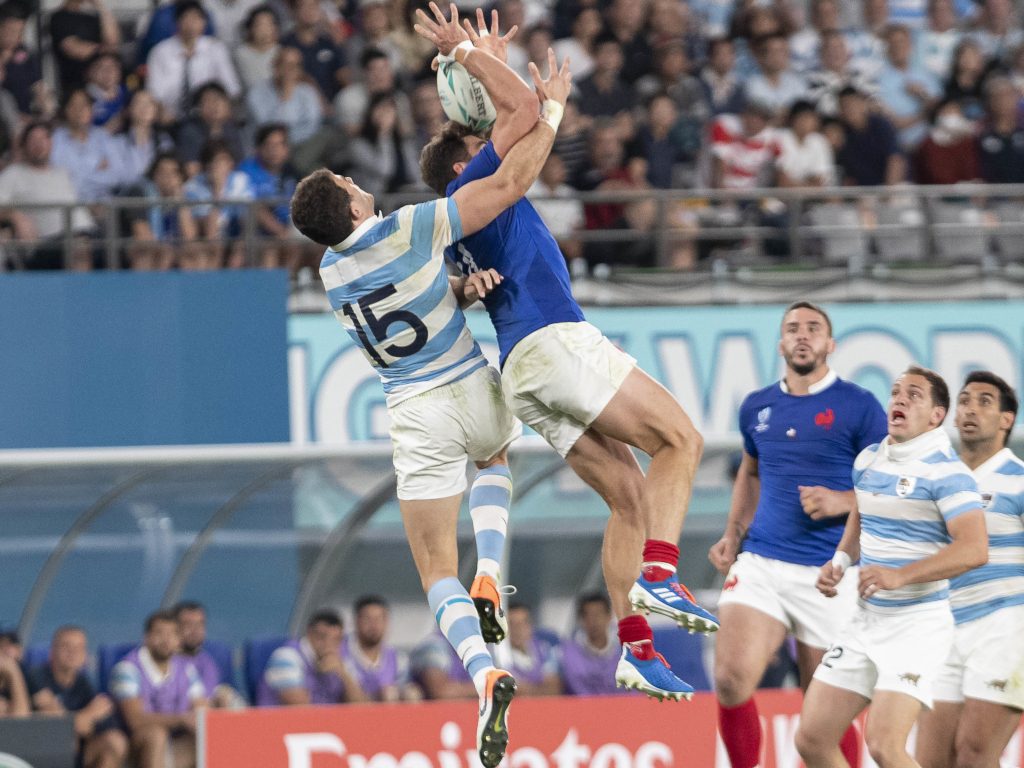
And just on the basis of safety and the elimination of controversy or miscued adjudications on intent, let’s get a safe catch rule, or introduce the ability to pre-call a mark anywhere on the pitch, for the high ball. Collisions are still too controversial in the air, TMOs are still too jittery when looking at them in slow-motion, and kicking is still too prevalent. Wouldn’t this discourage teams from kicking aimlessly high enough – not to mention removing the endless box-kicks as a strategy…
On tactics
Two things are clear: it’s started as the World Cup of rush defences, box-kicks, and deep backward passes designed to tempt the rush into an over-rush before one flat killer pass gets the attacking team into the space outside.
We can’t remember a World Cup where so many of the teams played with such similar shapes and lines. In attack, the leitmotif of all teams seems to be that there’s one player short and flat, one deep, narrow and long, the ball often transferred for around 10 metres of negative territory back to the deep long guy before a long, wide, flat pass from him to runners coming on at pace and looking for gaps.
That’s for wider plays. Shorter plays are marked with a slow pass to a man in the middle of a trio, with the men either side of him looking to seal off at the inevitable tackle as quickly and efficiently as possible.
The exceptions are maybe Wales and New Zealand, with the former offering a glimpse of one very specific tactic of attacking flat inside the 10 during their first half, but reverting to the generic above during the second.
New Zealand, put under such extraordinary pressure from South Africa’s rush defence early on, improvised through necessity as they so often do, dipping deep into the box of tricks to come up with the goods.
Defences will improve through the tournament, so either the teams who manage to come up with the best tricks will be the winners, or the defences will simply prove too strong. New Zealand thus remain our favourites, with the aggressive defence of South Africa the greatest threat and a forward-thinking Wales lurking along with an all-round impressive Ireland waiting for any slip-ups from those two.
A fascinating start – and as all teams, including the officiating team, get their act further together, the World Cup has enormous potential.
Loose Pass compiled by Lawrence Nolan
[jwplayer 0enP3k6f]